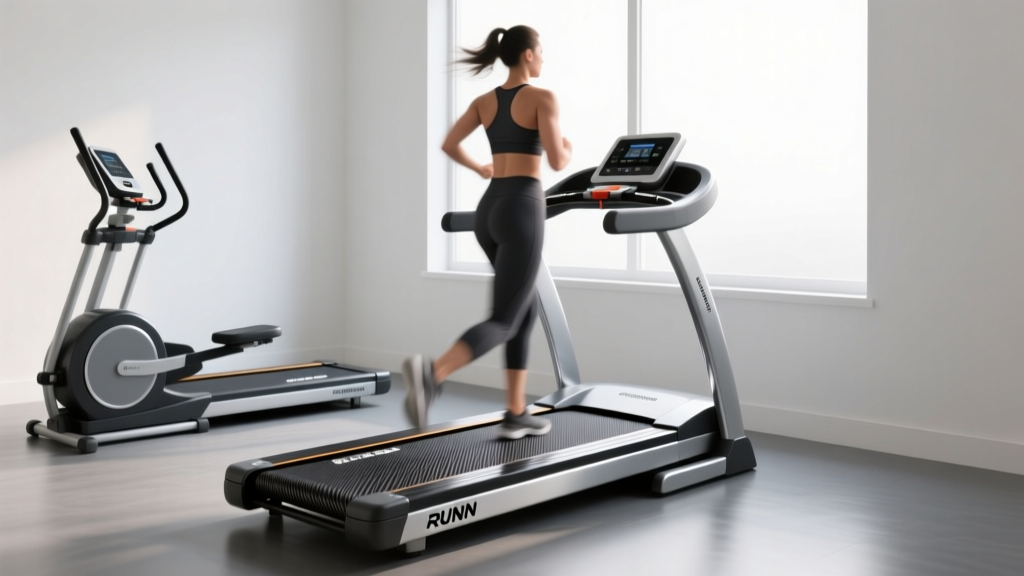
Elliptical vs Treadmill Layouts: Bowflex T16 Treadmill Reviews
Comparing elliptical vs treadmill layouts for tight spaces, featuring spatial insights from Bowflex T16 treadmill reviews and 2026 clearance guides.

The Spatial Dilemma: Biomechanics vs. Room Geometry
When outfitting a home gym, the debate between an elliptical and a treadmill usually centers on joint impact and caloric expenditure. However, from a spatial design and layout optimization perspective, the decision is entirely dictated by room geometry, ceiling clearance, and structural load limits. As we navigate the 2026 housing market, where dedicated home gym square footage is at a premium, understanding the exact three-dimensional footprint of your cardio machine is no longer optional—it is the primary constraint.
This guide bypasses the standard biomechanical arguments to analyze the elliptical vs. treadmill debate strictly through the lens of space optimization, using real-world dimensions, architectural clearances, and insights derived from recent Bowflex T16 treadmill reviews to benchmark premium treadmill footprints against modern elliptical alternatives.
⚠️ The 36-Inch Safety Rule: According to Mayo Clinic's home gym safety guidelines, you must maintain a minimum of 36 inches of clear walkway space on all sides of a cardio machine. For treadmills, ASTM International safety standards mandate an unobstructed 'ejection zone' behind the belt to prevent severe friction burns in the event of a fall.Footprint Face-Off: The Clearance Matrix
Before committing to a layout, you must calculate the 'Active Zone'—the total square footage required when the machine is in use, including user stride, arm swing, and mandatory safety clearances. Below is a comparative matrix of standard premium treadmills versus high-end compact ellipticals.
| Machine Class | Base Footprint (L x W) | Active Zone (w/ Clearances) | Min. Ceiling Height | Floor Joist Impact |
|---|---|---|---|---|
| Premium Treadmill (e.g., Bowflex T16 Class) | 82" x 36" (20.3 sq ft) | 154" x 72" (77 sq ft) | User Height + 10" | High (Rhythmic Deflection) |
| Standard Elliptical (e.g., Sole E95) | 82" x 31" (17.6 sq ft) | 118" x 67" (55 sq ft) | User Height + 4" | Low (Static Load) |
| Compact Cross-Trainer (e.g., Bowflex Max M9) | 49" x 30" (10.2 sq ft) | 85" x 66" (39 sq ft) | User Height + 15" | Moderate (Vertical Force) |
Analyzing the Bowflex T16 Treadmill Reviews: A Layout Perspective
While mainstream fitness influencers focus on incline metrics and interactive programming in their Bowflex T16 treadmill reviews, spatial designers and home gym architects look at the machine's physical envelope. The Bowflex T16 (and its premium treadmill peers) represents a significant spatial commitment. Here is what you must account for when integrating this class of treadmill into a home layout:
1. The Apex Height Calculation
The most common layout failure in home treadmill installations is ceiling clearance. A premium treadmill deck sits approximately 8 to 10 inches off the floor. When you add a 6-foot-tall user, the apex height reaches roughly 82 inches. If your home gym is located in a basement with dropped ceilings, HVAC ductwork, or exposed floor joists, you must measure from the lowest hanging obstruction directly above the running belt, not just the center of the room. For the Bowflex T16 class, a minimum ceiling height of 8 feet (96 inches) is mandatory to prevent head-strike injuries during high-incline running.
2. The Folding Mechanism Reality
According to Garage Gym Reviews' folding treadmill analysis, folding treadmills save floor space but rarely save volume. When folded vertically, the T16-class footprint shrinks from 82 inches to roughly 45 inches in length, but the height extends to over 70 inches, and the width remains a bulky 36 inches. Furthermore, you must allocate a 'swing arc' of at least 40 inches in front of the machine to safely lower the deck without striking a wall or adjacent equipment.
Elliptical Layouts: When Vertical Space is Compromised
If your spatial audit reveals a ceiling height below 8 feet, or if your room features low-hanging pendant lighting and ceiling fans, the elliptical becomes the undisputed champion of layout optimization. Because an elliptical keeps the user's feet within 12 to 18 inches of the floor, a 6'4" user can comfortably exercise under a standard 8-foot ceiling with zero risk of head trauma.
Moreover, compact vertical ellipticals (like the Bowflex Max Trainer series) utilize a 'stepper-climber' hybrid motion. These machines require less than 11 square feet of base floor space and eliminate the need for a rear ejection zone entirely, allowing you to place the machine just 12 inches from a wall, cutting the required Active Zone by nearly 50% compared to a treadmill.
Step-by-Step Home Cardio Layout Framework
Do not rely on manufacturer floor plans alone. Use this 4-step spatial protocol to map your room before purchasing:
- Map the Ejection & Swing Zones: Tape out the machine's base dimensions on your floor using painter's tape. Next, tape out a 36-inch perimeter. For treadmills, extend the rear tape to 78 inches to visualize the ASTM safety ejection zone. If this tape crosses a doorway swing path or a primary walkway, the layout is invalid.
- Audit the HVAC & Ventilation Corridor: Cardio machines generate massive thermal output. A user on a treadmill generates roughly 400-600 BTUs of heat per hour. Ensure your machine's console and motor hood are not placed directly against a wall or in a dead-air corner. Leave a 24-inch ventilation corridor facing a window or a forced-air return vent to prevent motor overheating and user heat exhaustion.
- Calculate the Glare Cone: Position the machine so that windows do not create direct glare on the LCD/LED console during your primary workout hours (usually 6:00 AM or 6:00 PM). Angling the treadmill 15 to 20 degrees off a parallel wall can solve both window glare and spatial monotony.
- Verify the Electrical Circuit: Premium treadmills with 3.5+ CHP motors and 15-inch HD touchscreens draw significant amperage, especially during startup torque. They require a dedicated 20-amp circuit. Ellipticals, lacking a high-draw drive motor, typically operate safely on a standard shared 15-amp bedroom circuit.
Edge Cases: Floor Joists and Structural Deflection
An often-ignored element of space optimization is structural integrity. Treadmills create rhythmic, repetitive impact loading. A 200-pound runner on a treadmill generates peak vertical forces of up to 500 pounds per stride. In second-story rooms or over unfinished basements with wide floor joist spacing (e.g., 16 inches on center or greater), this rhythmic loading causes 'floor deflection'—a trampoline-like bounce that can shake adjacent rooms, rattle light fixtures, and eventually fatigue drywall seams.
Ellipticals, by contrast, are zero-impact. The force vector is smooth and continuous rather than percussive. If your home gym is located on a suspended second floor, an elliptical is vastly superior from a structural load perspective, eliminating the need to install heavy-duty rubber mats or reinforce floor joists to mitigate vibration transfer.
💡 Pro-Tip for Multi-Story Homes: If you must place a treadmill on a suspended floor, position it directly over a load-bearing wall or directly atop a primary support beam. Refer to ASTM International sports equipment safety standards for guidelines on equipment placement and vibration dampening in residential structures.Final Verdict: Which Machine Wins the Space War?
The choice between an elliptical and a treadmill ultimately comes down to your room's Z-axis (height) and X-axis (length). If your home gym boasts 9-foot ceilings, a dedicated 20-amp circuit, and a rectangular footprint exceeding 10 feet in length, the premium treadmill experience (as benchmarked by the Bowflex T16) is viable, provided you respect the rear ejection zone.
However, if you are converting a spare bedroom with standard 8-foot ceilings, shared electrical circuits, and strict square-footage limitations, the elliptical—specifically a compact vertical cross-trainer—offers a vastly superior spatial footprint. It eliminates the rear clearance requirement, reduces the active zone by nearly 40%, and entirely neutralizes the risk of floor joist deflection and ceiling-strike injuries, making it the undisputed king of optimized home cardio layouts.
More gear to consider
All reviews
Elliptical vs Infrared Treadmill: 2026 Home Cardio Trends
GoPlus 2-in-1 Folding Treadmill Motor Guide: HP vs CHP Tested

Air Bike vs Assault Bike: What's Better, StairMaster or Treadmill?

Rowing Machine Guide: How Long Is a Mile on a Treadmill vs Rower?

Air Bike vs Assault Bike: ProForm 730cs Treadmill Market Shift