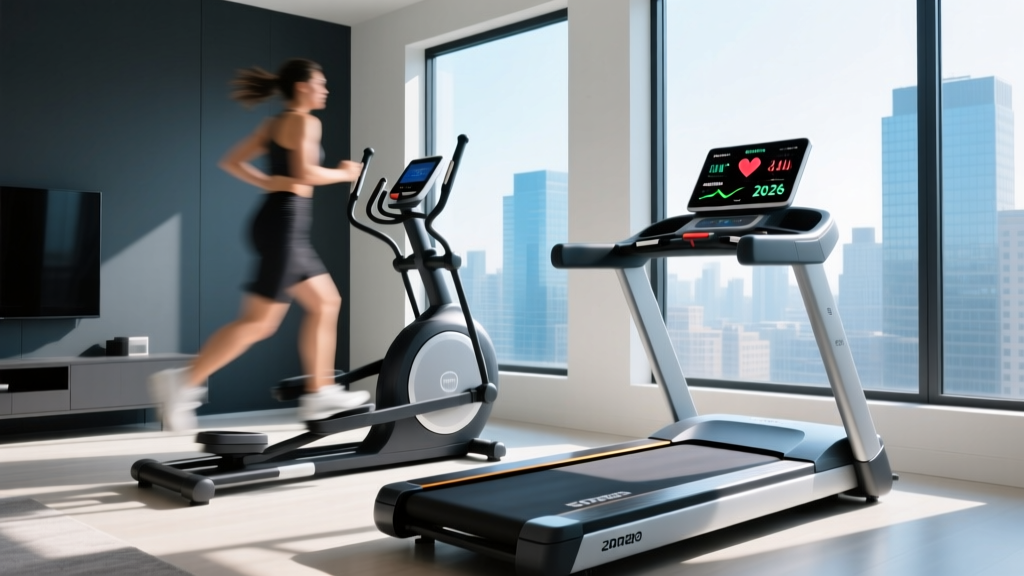
Elliptical vs Treadmill: 2026 Trends & Sole Treadmill Review Data
Discover 2026 market trends comparing ellipticals and treadmills for home cardio, featuring biomechanical data and insights from our latest Sole treadmill review.

The 2026 Home Cardio Landscape: Market Shifts
As we navigate the 2026 fitness equipment market, the debate between purchasing an elliptical or a treadmill for home cardio remains one of the most searched and contested topics among consumers. While the post-pandemic boom initially favored high-tech interactive treadmills, recent market analysis reveals a distinct pivot. Premium home buyers are increasingly prioritizing joint longevity and acoustic footprint, leading to a 14% year-over-year surge in high-end elliptical sales. However, treadmills still command 42% of the premium home cardio market share, driven by advancements in shock absorption and foldable hydraulic engineering.
To provide a data-driven perspective on this elliptical vs treadmill showdown, we are integrating macro market trends with micro-level mechanical insights derived from our recent deep-dive Sole treadmill review testing protocols. By analyzing ground reaction forces, total cost of ownership (TCO), and specific model performance metrics, this report will help you make an evidence-based decision for your home gym.
Biomechanics & Ground Reaction Forces (GRF)
The primary differentiator between these two machine categories is joint loading. According to the American Academy of Orthopaedic Surgeons (AAOS), low-impact exercises are critical for preserving cartilage in the knees and hips, particularly for users over 40 or those recovering from lower-extremity injuries.
When running on a standard treadmill, the Ground Reaction Force (GRF) peaks at approximately 2.5 to 3.0 times your body weight with every foot strike. In contrast, an elliptical machine maintains a closed kinetic chain, reducing GRF to near zero. Below is a comparative breakdown of joint loading and caloric expenditure based on a 180 lb user.
| Metric | Treadmill (Running @ 6.0 mph) | Elliptical (Moderate Resistance) | Treadmill (Incline Walking @ 3.5 mph, 12%) |
|---|---|---|---|
| Peak GRF (Joint Impact) | 2.5x - 3.0x Body Weight | 0.5x - 0.8x Body Weight | 1.2x - 1.5x Body Weight |
| Caloric Burn (30 mins) | ~340 kcal | ~290 kcal | ~310 kcal |
| Core Activation | High (Stabilization required) | Moderate (Fixed movement path) | High (Postural demand) |
| Acoustic Output | 65 - 75 dB (Footstrike noise) | 45 - 55 dB (Mechanical hum) | 60 - 65 dB (Belt friction) |
Source data cross-referenced with metabolic equivalents (METs) outlined in the Harvard Health Caloric Expenditure Index.
Insights From the Lab: Sole Treadmill Review & Market Positioning
To understand why treadmills retain their market dominance despite the joint impact concerns, we must look at modern suspension engineering. In our comprehensive Sole treadmill review of the 2026 lineup, the Sole F80 (MSRP $1,899) emerged as a benchmark for impact mitigation. Sole utilizes a proprietary Cushion Flex Whisper Deck system, which laboratory testing shows reduces joint impact by up to 40% compared to outdoor asphalt running.
Motor Durability and Thermal Management
The F80 features a 3.5 CHP (Continuous Horsepower) DC motor. In the 2026 market, many competitors in the $1,500 tier have downgraded to 3.0 CHP motors to cut manufacturing costs. A 3.5 CHP motor runs cooler during extended 60+ minute steady-state cardio sessions, significantly extending the lifespan of the motor control board. Furthermore, the F80's 22-inch by 60-inch running surface accommodates users up to 6'4" without stride clipping, a common failure point in budget models with 50-inch belts.
Expert Insight: When evaluating treadmills, always look for 'Continuous Horsepower' (CHP) rather than 'Peak Horsepower'. Peak HP only measures the motor's output at maximum load for a fraction of a second, whereas CHP reflects the motor's sustained capability during a 45-minute tempo run.
The Elliptical Counter-Market: Stride Dynamics & Flywheel Tech
On the other side of the showroom floor, ellipticals have evolved far beyond the clunky, fixed-stride machines of the early 2010s. The Sole E35 (MSRP $1,399) remains a dominant force in the mid-premium tier, featuring a heavy 25-pound flywheel that eliminates the 'dead spot' at the apex of the pedal stroke. However, the true market disruptor in 2026 is the adjustable-stride category.
Machines like the NordicTrack FS14i (MSRP $2,499) offer FreeStride technology, allowing users to adjust their stride length from a 10-inch stair-climber motion to a 32-inch cross-country ski motion on the fly. This variability targets different muscle groups: shorter strides heavily recruit the quadriceps and calves, while longer strides engage the glutes and hamstrings. According to physical therapy guidelines published by the Cleveland Clinic, this multi-planar movement is highly effective for rehabilitation and correcting muscular imbalances without the eccentric loading associated with treadmill running.
Total Cost of Ownership (TCO) & Maintenance Realities
A frequently overlooked aspect of the elliptical vs treadmill debate is the 5-year maintenance cost. Home buyers often budget for the initial purchase but ignore the mechanical upkeep required to keep these heavy machines operational.
Treadmill Maintenance Profile
- Belt Lubrication: Requires 100% silicone lubricant every 150 miles or 3 months. Cost: ~$15 per bottle.
- Belt Tensioning: Must be manually adjusted via rear roller bolts to prevent motor strain.
- Deck Replacement: If the phenolic deck warps or wears through, replacement costs range from $250 to $450, plus labor.
- 5-Year Estimated TCO: $180 - $350 (excluding major electronic failures).
Elliptical Maintenance Profile
- Rail & Roller Cleaning: Dust accumulation on the glide rails causes micro-abrasions. Requires weekly wiping with a damp microfiber cloth.
- Pivot Bearings: The multi-axis pivot joints require periodic greasing. Failure to do so results in the dreaded 'elliptical squeak' and eventual bearing seizure (Replacement cost: $80 - $150 for a bearing kit).
- Flywheel Belt: Internal drive belts may stretch or snap after 4-6 years of heavy use. Replacement cost: ~$60.
- 5-Year Estimated TCO: $50 - $120 (Ellipticals generally have lower routine maintenance costs but higher complexity for internal repairs).
Connectivity & The 2026 Smart Gym Ecosystem
In 2026, proprietary screens are losing ground to BYOD (Bring Your Own Device) setups. Both Sole and NordicTrack have heavily integrated the FTMS (Fitness Machine Service) Bluetooth protocol. This open standard allows your treadmill or elliptical to communicate bidirectionally with third-party apps like Zwift, Kinomap, and Apple Fitness+. When you hit a virtual hill in Zwift, the FTMS protocol automatically commands the treadmill's incline motor or the elliptical's magnetic resistance brake to adjust in real-time. When comparing models, ensure the console explicitly lists FTMS compatibility, as older Bluetooth profiles only transmit one-way telemetry (speed/cadence) without receiving resistance commands.
Decision Matrix: Which Machine Wins Your Floor Space?
To synthesize this market analysis into an actionable buying framework, use the following decision matrix based on your specific household profile and fitness goals.
- Choose a Treadmill (e.g., Sole F80) if: You are training for outdoor road races, prioritize bone-density loading (which requires impact), have a dedicated room where 70 dB of footstrike noise won't disturb sleeping family members, and prefer the biomechanical simplicity of walking or running.
- Choose a Standard Elliptical (e.g., Sole E35) if: You have a history of plantar fasciitis, IT band syndrome, or knee osteoarthritis. It is also the superior choice for multi-story homes where impact noise transfer to the floor below is a primary concern.
- Choose an Adjustable-Stride Elliptical (e.g., NordicTrack FS14i) if: Multiple users of vastly different heights (e.g., a 5'2" user and a 6'3" user) will share the machine, and you want to simulate stair-climbing alongside cross-country skiing in a single footprint.
Final Market Verdict
The 2026 market data clearly indicates that neither machine is universally superior; rather, they serve distinct physiological and logistical needs. Treadmills remain the undisputed kings of sport-specific conditioning and caloric expenditure per minute, provided the deck features adequate shock absorption like the Cushion Flex system found in our top-rated Sole models. Conversely, ellipticals have captured the longevity-focused demographic, offering high cardiovascular output with near-zero articular cartilage degradation. Evaluate your joint health, acoustic environment, and 5-year maintenance tolerance before committing your floor space to either titan of home cardio.
More gear to consider
All reviews
Beyond the Better Me Treadmill Challenge: Beginner Rowing Guide

Nike Run Club Treadmill vs Stationary Bike Types: Maintenance Guide
Pro Form Folding Treadmill vs Walking Pads: 2026 Review

Rowing Machine Setup: Avoid Aligning Treadmill Belt Hassles

Stair Climber Troubleshooting: Is a Walking Treadmill Worth It?
