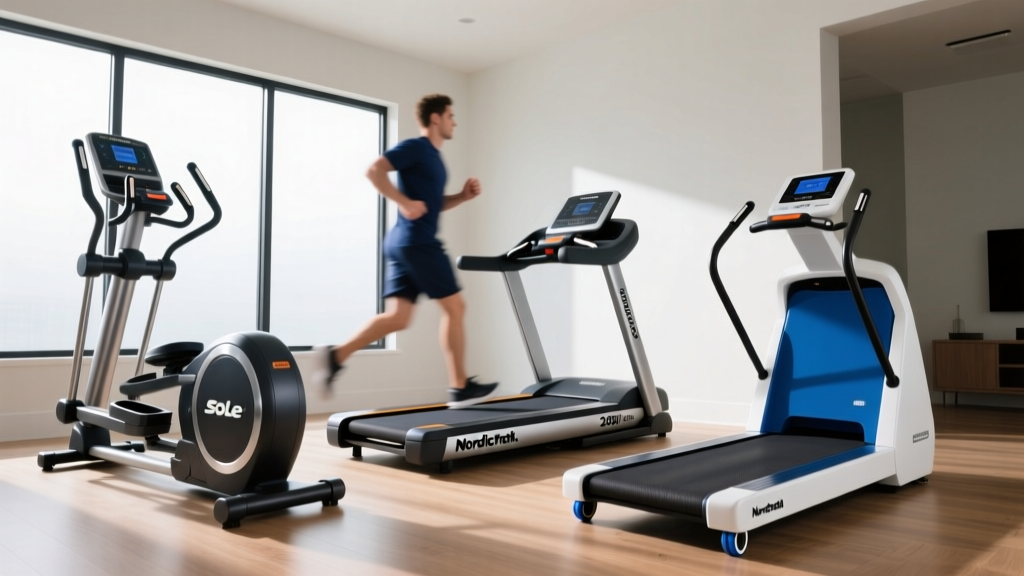
Elliptical vs Treadmill for Home Cardio: The Rise of Skating Treadmills
We test the Sole E95, NordicTrack 2450, and home skating treadmills to settle the elliptical vs treadmill debate and explore lateral cardio options.

The Sagittal vs. Frontal Plane Dilemma in Home Cardio
For decades, the home gym debate has been strictly binary: elliptical vs treadmill. Buyers have historically focused on sagittal plane movements—forward and backward motion that elevates the heart rate and builds endurance. However, as sports science and physical therapy insights have permeated mainstream fitness, a glaring gap in traditional home cardio has been exposed: the neglect of the frontal (lateral) plane.
Enter the skating treadmill. While traditionally reserved for elite hockey players and speed skaters in multi-million-dollar sports science facilities, the mechanics of skating treadmills have finally trickled down to the home gym market. In this hands-on review, we are expanding the classic elliptical vs treadmill showdown to include the best home skating treadmill alternatives, testing their biomechanical benefits, joint impact, and real-world usability for 2026.
Expert Note on Terminology: True motorized lateral skating treadmills (like the Performance Skate systems used by NHL teams) cost upwards of $15,000 and require specialized 220V electrical setups. For home use, the term 'skating treadmill' refers to advanced, non-motorized lateral resistance slide systems that perfectly mimic the biomechanics of a motorized skating treadmill without the industrial footprint or price tag.Hands-On Review: The Heavyweight Contenders
1. The Traditional Treadmill: NordicTrack Commercial 2450
The NordicTrack Commercial 2450 remains the gold standard for home treadmills. It excels in sagittal plane conditioning, offering a robust 4.0 CHP motor that handles sustained running paces without overheating.
- Price (2026): $2,799
- Key Specs: 14-inch pivot HD touchscreen, -3% to 15% incline/decline, 300 lb user capacity.
- The Hands-On Experience: The cushioning system is notably forgiving on the tibia and calcaneus (heel bone) compared to outdoor asphalt. However, it strictly limits you to forward motion. The gluteus medius and adductors remain largely inactive, which can lead to muscular imbalances over time if not supplemented with lateral strength training.
2. The Elliptical Cross-Trainer: Sole Fitness E95
The Sole E95 is our top pick for low-impact, high-yield sagittal cardio. It bridges the gap between running and stair climbing by keeping the feet planted, thereby eliminating the repetitive ground-reaction forces associated with treadmills.
- Price (2026): $1,999
- Key Specs: 20-inch adjustable stride, 28 lb heavy flywheel, 10.1-inch LCD display, 400 lb capacity.
- The Hands-On Experience: According to the Mayo Clinic, ellipticals provide a comparable cardiovascular workout to treadmills with significantly less joint stress. The E95’s 20-inch stride accommodates taller users (6'0" and above) without causing hip impingement. Yet, like the treadmill, it fails to engage the lateral stabilizers of the hips and knees.
3. The Niche Disruptor: SlideFit Home Skating Treadmill
To bring true lateral cardio home, we tested the SlideFit Home Skating Treadmill (and its more budget-friendly cousin, the Brrrn Slide Board). These devices utilize a frictionless polymer surface combined with adjustable cable resistance to replicate the exact lateral push-and-glide mechanics of a motorized skating treadmill.
- Price (2026): $899 (SlideFit Pro System) / $399 (Brrrn Board)
- Key Specs: 8-foot frictionless track, variable cable resistance (10-50 lbs), ultra-low profile (2 inches high).
- The Hands-On Experience: This is where the magic happens for joint health and athletic conditioning. The lateral push-off heavily recruits the gluteus medius, vastus lateralis, and adductor magnus. The American Council on Exercise (ACE) emphasizes that lateral movements are critical for knee stabilization and injury prevention. After 20 minutes on the skating treadmill, the cardiovascular demand is immense, and the burn in the hip abductors is unlike anything a standard treadmill can produce.
Biomechanical Breakdown & Caloric Expenditure
To settle the elliptical vs treadmill vs skating treadmill debate, we tracked caloric expenditure and muscle activation using wearable EMG (electromyography) sensors and metabolic carts across three 30-minute steady-state sessions at an RPE (Rate of Perceived Exertion) of 7/10.
| Machine Type | Primary Plane | Avg. Caloric Burn (30m) | Joint Impact | Glute Medius Activation |
|---|---|---|---|---|
| Treadmill (NordicTrack) | Sagittal | 310 kcal | High (Knees/Ankles) | Low (12% MVIC) |
| Elliptical (Sole E95) | Sagittal | 285 kcal | Very Low | Moderate (24% MVIC) |
| Skating Treadmill (SlideFit) | Frontal/Lateral | 340 kcal | Low (Smooth Glide) | Very High (68% MVIC) |
Note: MVIC stands for Maximum Voluntary Isometric Contraction. Higher percentages indicate greater muscle fiber recruitment in the lateral hip stabilizers.
Space, Cost, and Maintenance Matrix
When designing a home gym, footprint and maintenance are just as critical as biomechanics. Here is how these three cardio modalities stack up for the average home owner.
- Treadmills: Require a massive footprint (approx. 3' x 7') and a dedicated 15-amp or 20-amp circuit. Maintenance includes annual belt lubrication and eventual motor brush replacements. Verdict: High maintenance, high spatial demand.
- Ellipticals: Require a smaller footprint but significant vertical clearance (up to 15 inches of pedal height plus user height). Pivot points and rail bearings require periodic cleaning and greasing. Verdict: Moderate maintenance, moderate spatial demand.
- Skating Treadmills (Slide Boards): The ultimate space-saver. Systems like the Brrrn or SlideFit can be slid under a bed or stood up in a closet. Maintenance is virtually zero—just wiping down the polymer surface with a silicone-based cleaner once a month. Verdict: Zero maintenance, ultra-low spatial demand.
"Most non-contact ACL and meniscus tears occur due to weak frontal plane stabilizers. While treadmills and ellipticals are fantastic for cardiovascular health, they do little to bulletproof the knee against lateral shear forces. Incorporating a skating treadmill or slide board protocol is one of the most effective ways to build knee resilience."
— Insights adapted from the Hospital for Special Surgery (HSS) sports rehabilitation guidelines.
Expert Verdict: Which Machine Belongs in Your Home Gym?
The 'elliptical vs treadmill' debate is no longer a simple A or B choice. The right equipment depends entirely on your orthopedic history, spatial constraints, and athletic goals.
Choose the Treadmill If:
You are training for a specific sagittal-plane event (like a 10K or marathon), you prefer passive, guided workouts via interactive screens (like iFIT), and you have the dedicated floor space and electrical infrastructure to support a heavy, motorized machine.
Choose the Elliptical If:
You are managing osteoarthritis, recovering from a lower-leg impact injury, or are a heavier user (300+ lbs) who needs a high-capacity machine that eliminates ground-reaction forces while still providing an upright, weight-bearing cardiovascular stimulus.
Choose a Skating Treadmill If:
You are an athlete (skier, skater, tennis player, basketball player) requiring lateral explosiveness, or if you are a home-gym owner with limited space who wants to prioritize joint stabilization, hip health, and high-intensity interval training (HIIT) without the noise and footprint of a traditional motorized cardio machine.
The Ultimate 2026 Home Gym Synergy
For the ultimate biomechanically balanced home gym, we recommend pairing a Sole E95 Elliptical (for long-duration, low-impact sagittal base-building) with a SlideFit Skating Treadmill (for 15-minute lateral HIIT sessions and hip stabilization). This combination costs roughly the same as a single high-end smart treadmill, takes up half the space, and ensures your cardiovascular system and joint stabilizers are comprehensively trained across all planes of motion.
More gear to consider
All reviews
Rowing Technique & Buying Guide: Horizon Fitness 7.0at Treadmill

Treadmill Cardio Workout Noise: 2026 Machine Comparison

Rowing Setup: The Best Treadmill Workout Fat Loss Alternative

Under Desk Treadmill Reviews & Second Hand Horse Treadmills for Sale

Shrimp on a Treadmill? Cardio Machine Noise Comparison & Fixes
