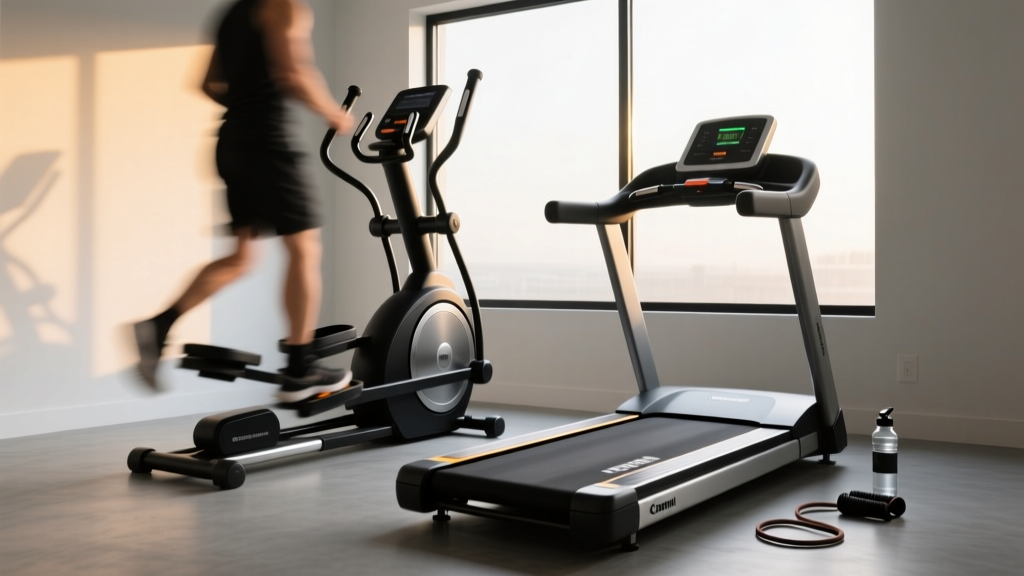
Elliptical vs Treadmill: Budget Breakdown & Pregnant Treadmill Safety
Compare elliptical vs treadmill costs, maintenance, and joint impact. Includes expert safety guidelines for pregnant treadmill use and 2026 pricing.

The True Cost of Ownership: Treadmills vs. Ellipticals
When outfitting a home gym, the debate between an elliptical and a treadmill often centers on calorie burn and personal preference. However, from a strict budget breakdown and value analysis perspective, the sticker price is merely the entry fee. To understand the true financial commitment of these cardio machines in 2026, we must evaluate upfront costs, long-term maintenance, energy consumption, and depreciation.
Let us compare two of the most popular mid-range workhorses on the market: the Sole F63 Treadmill (retailing around $1,199) and the Sole E35 Elliptical (retailing around $1,099). While the initial capital outlay is nearly identical, the five-year cost of ownership diverges significantly.
5-Year Cost of Ownership Matrix
| Cost Factor | Sole F63 Treadmill | Sole E35 Elliptical | Value Winner |
|---|---|---|---|
| Upfront Retail Price | $1,199 | $1,099 | Elliptical |
| Routine Maintenance | $120 (Silicone belt lubricant, belt replacements) | $0 (Sealed magnetic resistance, no belt) | Elliptical |
| Energy Draw (5 Yrs) | ~$210 (15-amp draw, 3.0 HP motor) | ~$35 (Low-wattage magnetic console) | Elliptical |
| Estimated Repair Risk | High (Motor controller, incline gear wear) | Low (Pivot joint bearings) | Elliptical |
| Total 5-Year Cost | $1,529 | $1,134 | Elliptical (+$395 savings) |
Treadmills require a 100% silicone lubricant applied under the belt every 150 miles to prevent friction from destroying the deck and overworking the motor. Neglecting this $15 bottle of lubricant can lead to a $400 motor burnout. Ellipticals, utilizing magnetic resistance and sealed pivot bearings, are virtually maintenance-free for the average home user.
Biomechanics and Joint Impact: Where the Value Lies
Financial value is irrelevant if the machine causes an injury that leads to physical therapy bills. The biomechanical differences between these machines dictate their long-term value for your physical health.
According to the American Council on Exercise (ACE), running on a treadmill generates ground reaction forces equivalent to 2.5 to 3 times your body weight with every footstrike. Over a 3-mile run, that equates to thousands of high-impact repetitions on your knees, hips, and lumbar spine. Conversely, an elliptical provides a closed-kinetic-chain movement. Your feet never leave the pedals, reducing joint impact forces to near zero while still eliciting a comparable cardiovascular response and caloric expenditure.
For users with pre-existing osteoarthritis, plantar fasciitis, or a history of meniscus tears, the elliptical offers superior long-term health value by preserving joint cartilage while maintaining cardiovascular conditioning.
Navigating Pregnant Treadmill Workouts vs. Elliptical Safety
A highly specific and critical use case in home cardio is exercise during pregnancy. Many expecting mothers researching a pregnant treadmill regimen are primarily concerned with maintaining cardiovascular health without compromising fetal safety. The American College of Obstetricians and Gynecologists (ACOG) strongly encourages at least 150 minutes of moderate-intensity aerobic activity per week during pregnancy, but the choice of machine matters immensely as the body changes.
Expert Insight: The Biomechanics of Pregnancy
During pregnancy, the body releases the hormone relaxin, which increases joint laxity and ligament elasticity to prepare the pelvis for childbirth. This systemic loosening makes joints more susceptible to shear forces and sprains. Furthermore, as the uterus expands, the mother's center of gravity shifts forward, altering balance and proprioception.
When evaluating pregnant treadmill safety, the primary risk is not the cardiovascular exertion, but the fall risk. A moving treadmill belt requires constant micro-adjustments in balance. If a user experiences a momentary lapse in concentration, dizziness (common in the first and third trimesters due to blood pressure fluctuations), or a trip, the moving belt can cause a severe fall.
Trimester-by-Trimester Machine Recommendation
- First Trimester (Weeks 1-12): Both machines are generally safe if you were a runner prior to pregnancy. However, fatigue and nausea may make the fixed, self-paced nature of an elliptical more comfortable.
- Second Trimester (Weeks 13-26): The center of gravity begins to shift. Transitioning from a pregnant treadmill routine to an elliptical is highly recommended to eliminate the moving-belt fall risk while accommodating widening hips and pelvic girdle pain.
- Third Trimester (Weeks 27-40): Ellipticals are the undisputed winner. The zero-impact, fixed-path motion prevents excessive pelvic floor strain and eliminates the risk of being thrown backward by a motorized belt.
"Activities with a high risk of falling or abdominal trauma should be avoided during pregnancy. If you are modifying your home gym routine, stationary, low-impact machines that support your weight and eliminate fall risks are the gold standard." — Adapted from ACOG Exercise Guidelines.
Hidden Home Gym Costs: Power and Footprint
Budgeting for cardio equipment extends beyond the machine itself; you must also budget for the space and electrical infrastructure it requires.
Electrical Infrastructure
Motorized treadmills like the NordicTrack T Series or Sole F63 require a dedicated 15-amp or 20-amp circuit. If you plug a treadmill into a shared circuit with a space heater or air conditioner, you risk tripping the breaker or causing voltage drops that can fry the treadmill's lower control board—a $250 replacement part. Ellipticals, utilizing magnetic resistance, draw minimal current (often less than 3 amps, primarily for the LCD console and cooling fan) and can be safely plugged into any standard household outlet without dedicated wiring.
Spatial Footprint and Storage
A standard folding treadmill measures roughly 78 inches long by 30 inches wide when in use, and even when folded vertically, it commands a 40-inch depth and 70-inch height. Ellipticals, particularly front-drive models like the Schwinn 430, have a smaller operational footprint (roughly 70 x 25 inches) and, crucially, cannot be folded. However, their lower profile allows them to be placed in rooms with low ceilings (under 8 feet), whereas a treadmill user running with a 4-inch incline and natural vertical bounce requires a ceiling clearance of at least 8.5 to 9 feet to avoid head strikes.
Resale Value and Depreciation
If you plan to upgrade your home gym in the future, resale value is a vital component of your budget breakdown. Treadmills suffer from steep depreciation. The secondary market is flooded with used treadmills, and buyers are inherently skeptical of used motors and worn decks. A $1,200 treadmill will typically fetch only $250 to $400 on local marketplaces after three years of use, largely due to the high cost and logistical nightmare of disassembling and transporting a 250-pound motorized machine.
Ellipticals hold their value slightly better, provided the pivot joints do not squeak. A well-maintained Sole E35 can retain 35% to 45% of its retail value after three years. The lack of a complex motor and belt system makes used buyers more confident in the machine's remaining lifespan.
Final Decision Framework
Choosing between an elliptical and a treadmill is not just about which machine burns more calories; it is about aligning the equipment with your biomechanical needs, household infrastructure, and long-term financial goals.
Invest in a Treadmill if:
- You are training for a specific outdoor running event (e.g., a marathon) and need to replicate exact pacing and incline mechanics.
- You have a dedicated home gym space with 9-foot ceilings and dedicated 20-amp electrical circuits.
- You prioritize high-intensity interval sprinting, which is biomechanically superior on a moving belt compared to an elliptical.
Invest in an Elliptical if:
- You are managing joint pain, recovering from lower-body injuries, or navigating the biomechanical shifts of pregnancy (making the elliptical vastly superior to a pregnant treadmill setup).
- You want to minimize long-term maintenance costs, energy consumption, and the risk of expensive motor repairs.
- Your home gym is located in a room with standard 8-foot ceilings and shared electrical circuits.
By looking past the initial price tag and analyzing the five-year cost of ownership, joint preservation, and specific safety profiles, the elliptical emerges as the superior value proposition for the majority of home gym users in 2026.
More gear to consider
All reviews
Under Desk Treadmill Review: NordicTrack C1250 Treadmill Care

Treadmill Incline Speed vs Rowing Machine Stroke Rate
Beating the Shin Splints Treadmill Trap: 2026 Bike Market Trends

Nautilus T614 Treadmill Review: Expert Belt Maintenance Guide

Budget Breakdown: Stationary Bike Types vs Assault Treadmill
