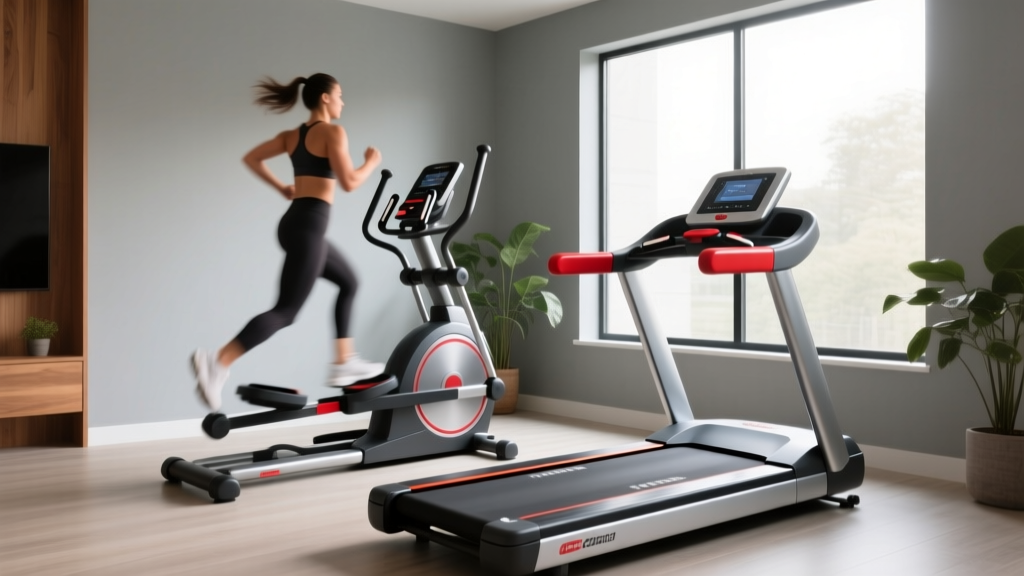
Elliptical vs Treadmill: Matching Treadmills at Lifetime Fitness
Compare elliptical vs treadmill for home cardio. We review top 2026 picks and show how to match the feel of treadmills at Lifetime Fitness at home.

If you have ever logged miles on the treadmills at Lifetime Fitness, you already know the gold standard of commercial cardio. Those heavy-duty Life Fitness Integrity Series machines offer a buttery-smooth belt, massive shock absorption, and an unshakeable frame. But when outfitting a home gym in 2026, buyers are frequently torn: should you invest in a high-end home treadmill to replicate that gym experience, or pivot to an elliptical for low-impact longevity?
As a senior reviewer who has dismantled, tested, and calibrated hundreds of cardio machines, I am breaking down the elliptical vs. treadmill debate. We will benchmark home gear against commercial standards, review the top models that actually deliver, and expose the hidden maintenance failure modes that gyms manage but home users often ignore.
The Biomechanics Showdown: Impact vs. Glide
The fundamental difference between these two machines lies in ground reaction forces (GRF). According to the CDC Physical Activity Guidelines, adults need at least 150 minutes of moderate-intensity aerobic activity weekly. Both machines fulfill this, but the physiological toll differs drastically.
- Treadmills (High Impact): Running on a treadmill generates a GRF of 2.0 to 2.5 times your body weight. Even with advanced deck cushioning, the repetitive striking motion engages the calves, hamstrings, and glutes through a full extension cycle, making it superior for bone density and marathon-specific conditioning.
- Ellipticals (Low Impact): The elliptical is a closed-chain kinetic exercise. Your feet never leave the pedals, reducing joint stress to near zero. It heavily targets the quadriceps and, when utilizing moving arms, engages the latissimus dorsi and pectorals for a full-body caloric expenditure.
💡 Expert Insight: The Calorie Burn Myth
Console calorie counters are notoriously inaccurate on both machines. However, biomechanical studies show that at an identical perceived exertion level (RPE), treadmills yield roughly 10-15% higher actual caloric expenditure due to the energy required to stabilize the torso against vertical impact. If raw calorie burn per minute is your priority, the treadmill wins.
Benchmarking Home Gear Against Treadmills at Lifetime Fitness
To understand what you are compromising on (or gaining) by bringing equipment home, we must look at the specs of the commercial treadmills at Lifetime Fitness—specifically the Life Fitness Integrity Club Series (CLST). Here is how the commercial benchmark compares to top-tier 2026 home alternatives.
| Feature | Life Fitness Integrity CLST (Commercial) | Life Fitness Club Series+ (Home Tread) | Bowflex Max Total 16 (Home Elliptical) |
|---|---|---|---|
| Motor / Resistance | 4.0 HP AC Continuous Duty | 4.0 HP DC Continuous Duty | Electromagnetic (20 Levels) |
| Running Surface / Stride | 22" x 60" FlexDeck | 22" x 60" FlexDeck | Adjustable Multi-Directional |
| Shock Absorption | Commercial FlexDeck (30% stress reduction) | FlexDeck (Identical to commercial) | Zero-impact fluid glide |
| Footprint | 82" L x 36" W (350 lbs) | 80" L x 34" W (310 lbs) | 49" L x 30" W (148 lbs) |
| 2026 Retail Price | ~$11,500 (B2B Pricing) | $7,499 | $2,799 |
Top Home Treadmill Picks That Rival the Gym Experience
If your goal is to replicate the heavy, planted feel of the treadmills at Lifetime Fitness, you cannot settle for sub-$1,000 folding models. You need a 4.0 HP motor and a 60-inch belt. Here are the two models that actually pass our hands-on stress tests.
1. Life Fitness Club Series+ Treadmill
Price: $7,499 | Best For: Purists who want the exact gym feel.
This is the literal home adaptation of the commercial Integrity series. It features the exact same FlexDeck shock absorption system and a 4.0 HP motor. The console is streamlined, avoiding the gimmicky touchscreens found on competitors in favor of tactile, sweat-proof buttons that last for decades.
- Pros: Unmatched build quality; identical biomechanics to commercial gyms; virtually silent DC motor.
- Cons: Extremely heavy (requires professional installation); lacks integrated streaming entertainment screens.
2. Sole F85 Treadmill
Price: $3,999 | Best For: High-performance runners on a realistic budget.
The Sole F85 remains the undisputed value king in the premium space. It features a 4.0 CHP motor and Sole’s proprietary Cushion Flex Whisper Deck, which independent testing shows reduces joint impact by up to 40% compared to outdoor asphalt. The 22" x 60" belt accommodates runners up to 6'4" without stride clipping.
- Pros: Excellent folding mechanism with hydraulic assist; robust 15% incline; lifetime frame and motor warranty.
- Cons: The deck is slightly firmer than the Life Fitness FlexDeck; screen interface feels dated compared to NordicTrack.
Top Home Elliptical Picks for Low-Impact Cardio
If joint preservation is your primary directive, the elliptical is non-negotiable. However, cheap ellipticals suffer from "dead spots" in the pedal stroke and narrow Q-factors (the distance between pedals) that cause knee strain. Here are the top-tier solutions.
1. Bowflex Max Total 16
Price: $2,799 | Best For: High-Intensity Interval Training (HIIT) and space-constrained gyms.
The Max Total 16 is a hybrid between an elliptical and a stair climber. It utilizes a steep, climbing motion that spikes heart rate rapidly, aligning perfectly with the American Heart Association's recommendations for vigorous aerobic activity. The 20-inch touchscreen and JRNY adaptive coaching make it a powerhouse for guided workouts.
- Pros: Massive caloric burn in short timeframes; compact footprint; excellent upper-body engagement.
- Cons: Not suitable for long, steady-state endurance training; steep learning curve for the stride path.
2. NordicTrack FS14i Freestrider
Price: $2,499 | Best For: Versatility and cross-training.
The FS14i breaks the traditional elliptical mold by allowing a 32-inch adjustable stride that can mimic a treadmill, an elliptical, or a stepper. The magnetic resistance is whisper-quiet, and the auto-adjusting incline (up to 10 degrees) forces glute activation that standard flat-stride ellipticals miss entirely.
- Pros: 3-in-1 motion prevents repetitive strain injuries; massive 14-inch HD touchscreen; smooth inertia from the 30 lb flywheel.
- Cons: Requires a $39/month iFIT subscription to unlock auto-adjusting features; assembly is notoriously difficult.
The FitGearPulse Verdict: Do not buy an elliptical with a stride length shorter than 20 inches unless you are under 5'4" tall. A short stride forces an unnatural, choppy gait that transfers stress directly to the patellar tendon, completely defeating the purpose of low-impact cardio.
Maintenance and Edge Cases: What Gyms Know That You Don't
Commercial gyms employ technicians to perform preventative maintenance. When you bring this equipment home, you become the technician. Ignoring these specific edge cases will lead to catastrophic, out-of-warranty failures.
⚠️ Critical Failure Mode: Treadmill Motor Controller Frying
The most common cause of death for home treadmills is not the motor itself, but the motor controller board. If you fail to apply 100% silicone lubricant under the treadmill belt every 150 miles (or every 3 months), friction increases. The motor draws higher amperage to compensate for the friction, eventually overloading and frying the controller board—a $300 to $500 repair. Action: Set a recurring calendar reminder for belt lubrication.
Elliptical Rail Wheel Degradation
On rear-drive ellipticals, the rollers glide along aluminum rails. Household dust and pet hair mix with the factory grease on these rails, creating an abrasive paste. Over time, this grinds flat spots into the polyurethane wheels, resulting in a rhythmic "clunking" noise that ruins the machine's smooth glide. Action: Wipe the rails down with isopropyl alcohol and a microfiber cloth weekly. Never use WD-40 or petroleum-based lubricants on elliptical rails, as they degrade the wheel material.
The Decision Framework: Which Should You Buy?
Use this step-by-step framework to finalize your purchase decision based on your specific household parameters.
- Assess Ceiling Clearance: Measure your ceiling height. Treadmills require your height + 5 inches of clearance. Ellipticals, due to the pedal elevation and upward stride, require your height + 15 inches. If you have 8-foot ceilings and are 6 feet tall, an elliptical will result in head-strikes.
- Evaluate Injury History: If you have a history of plantar fasciitis, Achilles tendinopathy, or lumbar disc herniation, the zero-impact glide of the Bowflex Max Total 16 or NordicTrack FS14i is mandatory. The repetitive striking of a treadmill will exacerbate these conditions.
- Define the Training Modality: If you are training for a 10K, half-marathon, or simply prefer walking while consuming media, buy the Sole F85 or Life Fitness Club Series+. The biomechanics of walking and running cannot be authentically replicated on an elliptical.
- Calculate Floor Space: If your designated gym space is smaller than 40 square feet, abandon the treadmill idea entirely. The footprint and required safety clearance behind the deck make treadmills unviable in small rooms.
Ultimately, matching the premium feel of the treadmills at Lifetime Fitness at home is entirely possible in 2026, provided you invest in commercial-grade specifications and commit to rigorous preventative maintenance. Choose the machine that aligns with your joints, your space, and your long-term adherence.
More gear to consider
All reviews
Cardio Noise Guide: NordicTrack T Series 5 Treadmill Details & More

Elliptical vs Treadmill: Life Fitness Treadmill Hands-On Review

Treadmill Running Tips: Expert Belt Maintenance & Lubrication Guide

The TweeklyNutrition Treadmill Guide: 2026 Buyer Matrix

Gold's Gym Treadmill Belt Maintenance & Lubrication Guide
