Elliptical vs Treadmill Layouts & How to Lubricate Treadmill Belt
Compare elliptical and treadmill spatial requirements for home gyms, covering ceiling clearance, safety zones, and maintenance access layouts.

The Volumetric Reality of Home Cardio Layouts
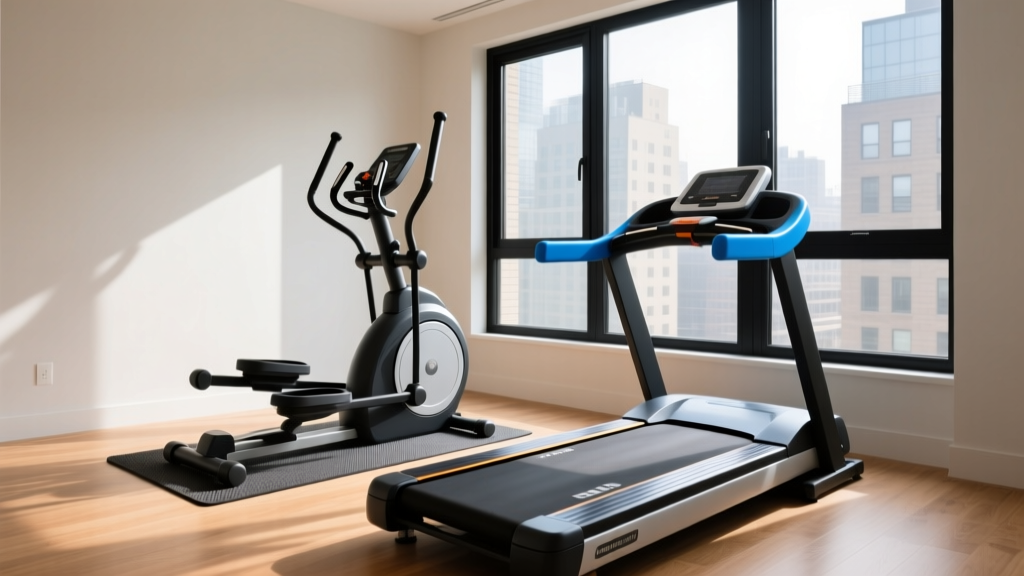
Designing a home gym in 2026 requires a shift from two-dimensional floor planning to three-dimensional volumetric mapping. When debating an elliptical vs treadmill for home cardio, most buyers focus solely on the static footprint—the length and width of the machine's base. However, true space optimization demands that we evaluate the Z-axis (vertical clearance), dynamic operational zones, and hidden maintenance perimeters. A machine that technically fits in an alcove may become functionally obsolete if spatial constraints prevent safe usage or routine upkeep.
This guide deconstructs the spatial geometry of premium cardio equipment, comparing the layout prerequisites of modern treadmills and ellipticals. We will examine ceiling height variables, safety drop zones, structural vibration transfer, and the often-ignored lateral clearances required for essential machine maintenance.
The Z-Axis Dilemma: Vertical Clearances and Headroom
The most common layout failure in home cardio design is ignoring the user's apex height during peak exertion. Treadmills and ellipticals interact with vertical space in fundamentally different ways.
Treadmill Incline Geometry
When a treadmill elevates to its maximum incline, the rear of the deck raises significantly. For instance, the NordicTrack Commercial 2450 (priced around $2,799) features a 15% incline capability. At maximum elevation, the rear deck lifts approximately 12 to 14 inches. If your ceiling is a standard 8 feet (96 inches), a user who is 6 feet tall (72 inches) will have their head within 10 inches of the ceiling when running at the rear of the deck. This creates a claustrophobic environment and poses a severe safety risk if the user trips forward or jumps upward.
Elliptical Step-Up and Stride Arc
Ellipticals introduce a permanent vertical offset. The pedal height at its lowest point on a machine like the Sole E95 (approximately $1,499) sits about 14 inches off the ground. Add the user's height, and you immediately consume 14 inches of overhead clearance before any movement occurs. Furthermore, the vertical oscillation of the stride arc means the user's head will bob up and down by 3 to 5 inches during use. For rooms with sloped ceilings or basement drop-ceilings, an elliptical requires a strict vertical mapping of the user's highest stride point to prevent impact injuries.
The X and Y Axes: Dynamic Footprints and Safety Zones
Static dimensions are irrelevant if the machine cannot be used safely. The Consumer Product Safety Commission (CPSC) heavily emphasizes the necessity of operational clearance zones, particularly for motorized cardio equipment.
- Treadmill Rear Drop Zone: You must maintain a minimum of 30 inches of unobstructed space behind the treadmill, though 60 inches is the gold standard for high-speed running. If a user loses balance and is ejected off the back, this zone prevents catastrophic impacts against walls, desks, or glass windows.
- Elliptical Lateral Swing: Ellipticals do not require a rear drop zone, but they demand lateral freedom. The Q-factor (the horizontal distance between pedals) and the width of the moving arms mean you need at least 15 to 20 inches of clearance on both the left and right sides to prevent knuckle impacts and allow for natural biomechanical sway.
Maintenance Access: The Hidden Spatial Requirement
Space optimization is not just about fitting the machine; it is about servicing it. Many homeowners push their cardio equipment flush against walls or wedge them into tight corners to maximize floor space, inadvertently creating a maintenance nightmare.
Expert Insight: Routine maintenance is the single biggest factor in extending the lifespan of your cardio investment. Designing a layout that blocks access to service panels or deck components will inevitably lead to premature motor failure and voided warranties.
This is especially critical for treadmill owners. Knowing how to lubricate treadmill belt assemblies requires at least 24 inches of lateral clearance on both sides of the machine. To properly apply 100% silicone lubricant, you must comfortably kneel beside the deck, lift the edge of the running belt, and reach toward the center to spread the fluid evenly. If your treadmill is wedged into a corner with only 6 inches of side clearance, performing this essential 20-minute quarterly maintenance becomes a logistical impossibility, leading to deck friction, excessive amperage draw, and eventual control board burnout. Conversely, ellipticals utilize sealed magnetic resistance and pivot bearings; while they require occasional joint greasing, they do not demand the sprawling lateral access that treadmill deck maintenance requires.
Comparative Layout Matrix: Treadmill vs. Elliptical
The following matrix outlines the precise spatial requirements for integrating these machines into a modern home gym layout.
| Spatial Metric | Motorized Treadmill (e.g., Sole F80) | Front-Drive Elliptical (e.g., Bowflex M9) |
|---|---|---|
| Static Base Footprint | 82" L x 33" W | 76" L x 30" W |
| Minimum Ceiling Clearance | User Height + 18" (for incline/safety) | User Height + 22" (for step-up/stride arc) |
| Rear Safety Drop Zone | 30" minimum (60" recommended) | 12" (for ventilation and power cord) |
| Lateral Maintenance Access | 24" on both sides (for belt lubrication) | 15" on both sides (for arm swing/pivot lube) |
| Power Outlet Proximity | Within 6 feet (front-left typically) | Within 6 feet (rear or side depending on model) |
Flooring, Vibration, and Structural Load Layouts
According to the American Council on Exercise (ACE), proper flooring integration is a vital component of equipment layout, directly impacting acoustics and structural integrity.
Treadmill Impact and Matting
Treadmills generate high-impact, rhythmic harmonic vibrations. Placing a treadmill directly on hardwood or laminate without a high-density EVA foam mat will result in micro-scratches and noise transfer to rooms below. Your layout must account for a mat that extends at least 4 inches beyond the machine's perimeter on all sides to catch dust and sweat. Furthermore, treadmills should ideally be placed on the ground floor or directly over load-bearing walls to mitigate the dynamic load of a 200+ lb user running at 8 MPH.
Elliptical Stability and Leveling
Ellipticals operate on a smooth, continuous elliptical path, meaning they generate significantly less vertical impact. However, they are highly sensitive to uneven floors. If your home gym is located in a basement with a sloped concrete floor or a garage with drainage gradients, the elliptical will rock laterally during use, accelerating wear on the rail wheels. Your spatial layout must include provisions for adjustable leveling feet, and in some cases, custom shimming under the machine's stabilizers to ensure a perfectly true horizontal plane.
Quick Decision Framework for Compact Rooms
- Choose a Treadmill if: Your room has a low ceiling (under 8 feet), you have ample length for a rear drop zone, and you can commit to maintaining 24-inch lateral clearances for belt servicing.
- Choose an Elliptical if: Your room has high or vaulted ceilings, you lack the linear depth for a treadmill safety zone, and you want a machine that can be positioned closer to walls without sacrificing critical maintenance access.
Final Thoughts on Spatial Optimization
The decision between an elliptical and a treadmill for home cardio should never be made solely on the basis of calorie burn or joint impact. The physical geometry of your available space dictates which machine will remain safe, functional, and serviceable over its 10-to-15-year lifespan. By mapping your room's volumetric constraints and respecting the hidden maintenance perimeters, you ensure your 2026 home gym is an optimized sanctuary for long-term cardiovascular health.
More gear to consider
All reviews
Upright, Recumbent & Spin Bikes: Are Sole Treadmills Good?

NordicTrack T 7.5 Series Treadmill Layout & Compact Cardio Options
Manual vs Motorized Treadmills: Setup with RUNN Treadmill Sensor

Rowing Machine Setup & Technique to Complement Treadmill Training

NordicTrack 2450 Treadmill Review: 2026 Feature Comparison Guide
