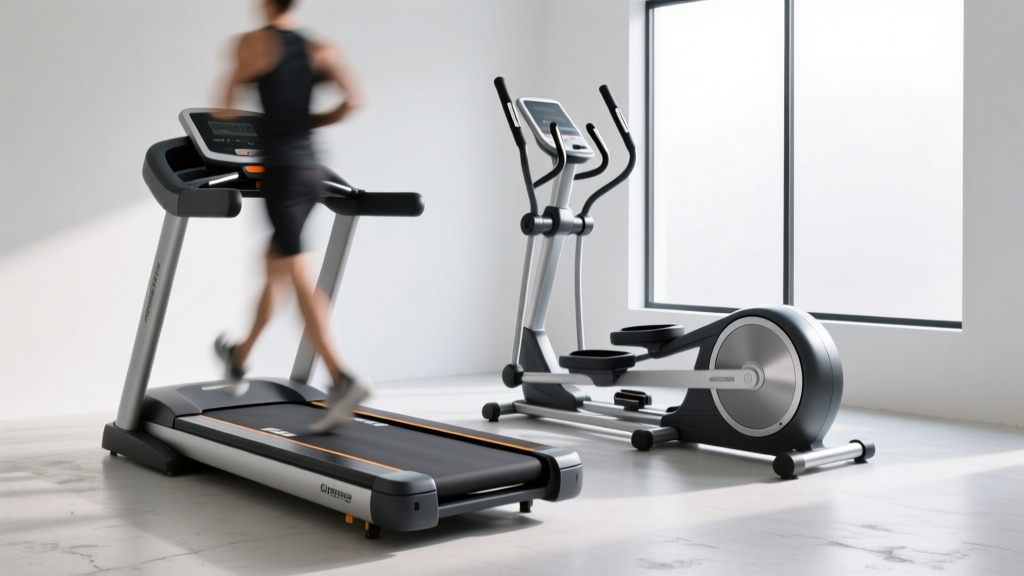
Elliptical vs Treadmill Care: Maintaining Your HIIT Program Treadmill
Compare elliptical vs treadmill maintenance costs and longevity. Learn expert care tips to protect your investment, especially for a HIIT program treadmill.

The Hidden Cost of Home Cardio: Beyond the Price Tag
When consumers debate the merits of an elliptical vs treadmill for home cardio, the conversation almost exclusively revolves around joint impact, calorie burn, and interactive screen sizes. However, as a senior equipment technician, I can tell you that the true differentiator between these two cardio staples is long-term maintenance and mechanical longevity. This is especially critical if your weekly regimen includes executing a demanding hiit program treadmill routine. High-Intensity Interval Training places exponential stress on drive systems, motors, and structural joints. According to biomechanical research highlighted by the American Council on Exercise (ACE), the rapid acceleration and deceleration phases inherent in HIIT workouts generate massive kinetic and thermal loads on fitness equipment. If you are investing $1,500 to $3,000 in a premium machine in 2026, understanding the maintenance realities of both platforms is essential to protect your investment.
The Mechanical Toll: Elliptical vs. Treadmill Wear and Tear
To understand maintenance, we must first look at the mechanical architecture of both machines. A treadmill is fundamentally a motorized conveyor belt. When you run, your body weight (often 150 to 250 lbs) strikes the deck with a force equivalent to 2.5 times your body weight. This impact transfers directly through the belt, into the deck, and down to the motor and rollers.
Conversely, an elliptical machine utilizes a closed-chain kinetic movement. Your feet never leave the pedals, eliminating the harsh impact strikes. Instead of a motor driving a belt beneath you, an elliptical relies on a heavy flywheel (often 20 to 32 lbs) and magnetic resistance. While the elliptical spares the user's joints, it introduces a complex network of pivot points, track wheels, and crank arms that require distinct mechanical attention.
Maintaining Your HIIT Program Treadmill: A Deep Dive
Running a hiit program treadmill routine is the ultimate stress test for home fitness equipment. When you command a treadmill like the NordicTrack Commercial 1750 or the Sole F80 to jump from a 3.0 mph walking pace to a 10.0 mph sprint in a matter of seconds, the Direct Current (DC) motor experiences a massive amperage spike. Furthermore, when you abruptly slow down, the motor acts as a dynamic brake, generating significant heat in the Motor Control Board (MCB).
1. Belt Tension and Deck Lubrication
Friction is the silent killer of treadmill motors. If the belt is dry, the motor must work up to 40% harder to maintain speed under your body weight. Over time, this excessive amp draw will fry the MCB or burn out the motor windings.
- Lubrication Schedule: For a standard walking routine, lubricate the deck every 6 months or 150 miles. For a rigorous HIIT schedule, you must lubricate every 3 months or 75 miles.
- The Right Lubricant: Use only 100% pure silicone treadmill lubricant. Never use petroleum-based products like WD-40, which will dissolve the belt backing and ruin the deck.
- Tension Check: You should be able to lift the edge of the belt about 2 to 3 inches off the deck. If it is too tight, it chokes the motor; if too loose, it will slip dangerously during sprint intervals.
2. Motor Hood Vacuuming
Dust and pet hair act as thermal insulators. During high-speed intervals, the motor generates heat that must be dissipated by an internal cooling fan. If the fan blades are caked in dust, the motor overheats, triggering thermal shutdowns. Every 90 days, unplug the machine, remove the motor hood (usually 4 to 6 Phillips-head screws), and use a vacuum with a soft brush attachment to clear the debris.
Elliptical Longevity: Pivot Points, Rails, and Drive Systems
While ellipticals like the Sole E95 or Bowflex Max Trainer M9 do not suffer from the same motor-strain issues as treadmills during HIIT, their mechanical complexity introduces different failure modes. The primary enemies of an elliptical are micro-dust accumulation and joint desiccation.
Track Wheels and Rails
Rear-drive and front-drive ellipticals utilize polyurethane track wheels that glide along aluminum or steel rails. During a vigorous HIIT session, the lateral forces can cause these wheels to degrade if the tracks are dirty. Dust mixes with the factory grease to form an abrasive paste, leading to flat spots on the wheels and a pronounced 'clunking' noise during the stride.
- Wipe down the rails with a damp microfiber cloth after every third workout.
- Once a month, apply a light coat of PTFE (Teflon-based) spray to the rails to ensure smooth gliding.
- Inspect the polyurethane wheels for uneven wear; replace them in pairs every 3 to 5 years depending on usage.
Pivot Joints and Crank Arms
The articulating arms and pedal joints rely on sealed bearings. Unlike treadmills, you should never apply liquid oil to these joints, as it attracts dust and degrades the seals. Instead, listen for squeaks. A squeak usually indicates a loose bolt rather than a dry joint. Use a hex key to tighten all pivot bolts every 6 months, as the harmonic vibrations from high-cadence interval training will slowly back them out.
5-Year Cost of Ownership & Maintenance Matrix
To provide a clear decision framework, we have modeled the 5-year maintenance costs for a premium treadmill versus a premium elliptical, assuming the user performs 4 hours of cardio per week, with at least 30% of that time dedicated to high-intensity intervals. Programming guidelines from the National Academy of Sports Medicine (NASM) suggest that high-velocity movements drastically accelerate equipment degradation if ignored.
| Maintenance Factor | Premium Treadmill (e.g., Sole F80) | Premium Elliptical (e.g., Sole E95) |
|---|---|---|
| Initial Retail Price (2026 Avg) | $1,199 - $1,499 | $1,499 - $1,899 |
| Routine Lubrication / Cleaning | $45 (Silicone over 5 years) | $20 (PTFE spray & cloths) |
| Wear-and-Tear Part Replacements | $120 (1x Belt replacement) | $85 (1x Track wheel set) |
| Major Component Failure Risk | High (MCB or Motor: $250-$400) | Low (Alternator/Sensor: $120) |
| Estimated 5-Year Upkeep Cost | $165 (Excluding major failure) | $105 (Excluding major failure) |
Real-World Troubleshooting & Failure Modes
Even with meticulous care, high-intensity cardio machines will occasionally throw error codes. Understanding these can save you an unnecessary $150 service call fee.
Treadmill Error: Speed Sensor (E1 or E01) If your treadmill abruptly stops and displays an E1 code during a sprint interval, the speed sensor has likely lost its reading. This is rarely a broken sensor. More often, the vibration from heavy footfalls has shifted the magnet on the front roller out of alignment with the optical sensor. Fix: Remove the hood, locate the sensor near the front roller, and realign it to sit exactly 1/8th of an inch from the magnet.
Elliptical Issue: Magnetic Resistance Stuck on High If your elliptical feels like you are pedaling through wet concrete regardless of the console setting, the servo-motor that controls the magnetic brake has likely lost its calibration or stripped a plastic gear. Fix: Unplug the machine for 5 minutes to force a hard reboot of the console. If the issue persists, the servo-motor (usually a $45 part) must be replaced, as the internal plastic teeth strip under high-torque, low-cadence hill intervals.
The Final Verdict on Home Cardio Longevity
When choosing between an elliptical and a treadmill, your maintenance tolerance should heavily influence your decision. If you are deeply committed to a hiit program treadmill routine and want the authentic biomechanics of sprinting, a treadmill is unmatched. However, you must commit to a strict regimen of silicone lubrication, belt tensioning, and motor hood cleaning to prevent catastrophic MCB failure. If you prefer a 'set it and forget it' approach with lower mechanical friction and fewer high-cost failure points, a heavy-duty elliptical offers superior long-term longevity with significantly less routine upkeep. Ultimately, the best machine is the one you will not only use consistently but maintain diligently over the next decade.
More gear to consider
All reviews
NordicTrack E3800 Treadmill vs Curved Manual: Beginner Guide

NordicTrack C 700 Treadmill Setup & Walking Pad Review

Motor Size Guide: Horizon Fitness T202 Studio Series Treadmill

Star Trac 10TRx FreeRunner Treadmill Noise Test vs Top Rivals
Senior Running on Treadmill: Foot Drop Issues Guide 2026
