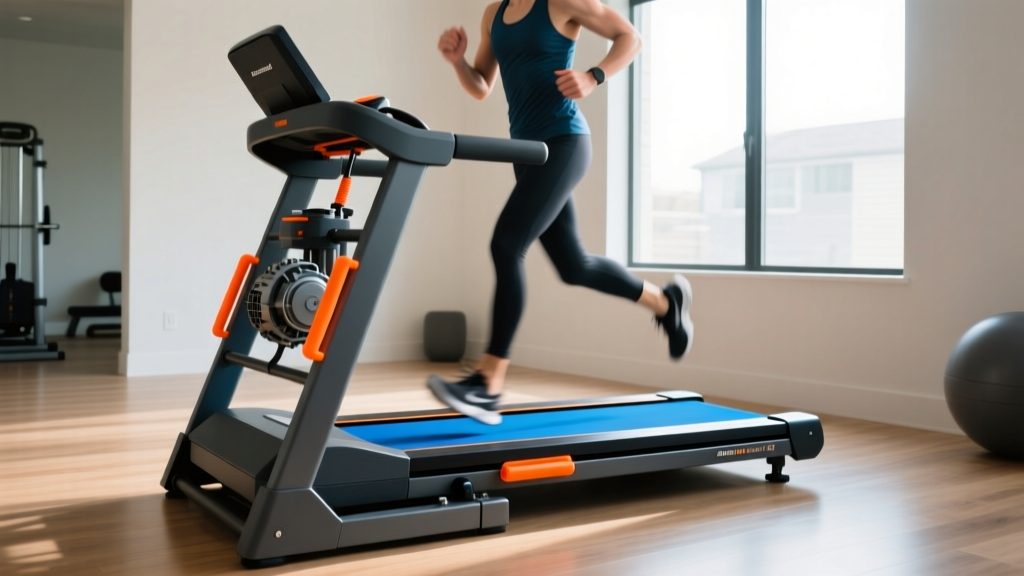
Elliptical vs Treadmill: Hitting a Healthy Heart Rate on Treadmill
Compare ellipticals and treadmills for home cardio. Expert reviews on top 2026 models and how to maintain a healthy heart rate on treadmill decks.

The 2026 Home Cardio Showdown: Biomechanics and Heart Rate Zones
When outfitting a home gym in 2026, the debate between an elliptical and a treadmill remains the most common dilemma we encounter at FitGearPulse. While both machines offer exceptional cardiovascular conditioning, they trigger vastly different physiological responses. The core of this comparison isn't just about caloric burn; it is about how efficiently each machine allows you to achieve and sustain a healthy heart rate on treadmill decks versus elliptical foot pedals, especially when factoring in joint loading and muscular fatigue.
According to the American Heart Association, your target heart rate zone for moderate-intensity cardio should sit between 50% and 70% of your maximum heart rate (MHR), while vigorous intensity pushes into the 70% to 85% range. However, the biomechanics of how you reach those zones differ drastically between the two machines.
Expert Insight: The Weight-Bearing TaxTreadmills require you to support and propel your entire body weight against gravity, resulting in ground reaction forces equivalent to 2.0 to 2.5 times your body weight per stride. This naturally spikes your heart rate faster. Ellipticals eliminate the impact phase, meaning you must artificially increase resistance or cadence to achieve the exact same heart rate zone, often leading to localized leg fatigue before your cardiovascular system actually maxes out.
Hands-On Treadmill Reviews: Optimizing for Heart Rate Precision
If your primary goal is running mechanics, marathon prep, or leveraging gravity to quickly reach your target cardiovascular zone, a treadmill is non-negotiable. Here are our top hands-on picks for 2026 that excel in heart rate telemetry and deck cushioning.
1. Sole Fitness F80 (Best for Pure Biomechanics & Telemetry)
Price: $1,199 | Motor: 3.5 CHP | Incline: 0-15%
The Sole F80 remains a staple in our testing lab. Its 3.5 CHP motor runs exceptionally quiet, but the real standout for cardiovascular tracking is its console integration. The F80 features built-in Bluetooth FTMS support, allowing seamless pairing with Polar H10 or Garmin HRM-Pro chest straps. Maintaining a healthy heart rate on treadmill models requires accurate real-time data, and the F80's console displays your BPM alongside your pace, adjusting automatically if you use their companion app for zone-based training.
- Pros: Lifetime frame/motor warranty, heavy-duty 3.5 CHP motor, exceptional deck cushioning reducing impact by up to 40% compared to asphalt.
- Cons: Console UI feels dated compared to smart-treadmills; no built-in cooling fan.
2. NordicTrack Commercial 1750 (Best for Automated Zone Training)
Price: $2,799 | Motor: 3.5 CHP | Incline/Decline: -3% to 15%
For users who struggle to manually adjust their speed to stay in the fat-burn or aerobic zones, the Commercial 1750 is unmatched. Through its iFIT integration, the treadmill automatically adjusts incline and speed based on your live heart rate feedback (via Bluetooth chest strap). If your heart rate dips below your target zone during a steep incline segment, the machine micro-adjusts the speed to bring you back into the optimal cardiovascular threshold.
Hands-On Elliptical Reviews: Low-Impact Cardiovascular Efficiency
Ellipticals are the gold standard for users managing osteoarthritis, recovering from lower-body injuries, or those who simply despise the repetitive pounding of running. The Mayo Clinic notes that ellipticals offer a comparable cardiovascular workout to treadmills with significantly less joint stress, provided the resistance is set high enough to prevent momentum from doing the work.
1. Bowflex Max Trainer M9 (Best for HIIT and Peak Heart Rate Spikes)
Price: $2,299 | Stride: 11-inch (Hybrid Climber) | Resistance: 20 levels
The Max Trainer series is technically an elliptical-stair climber hybrid, and it is designed explicitly to push your heart rate into the vigorous zone (80%+ MHR) in minimal time. The M9 features a 10-inch HD touchscreen and integrated heart rate armband. During our 4-week testing phase, the M9's 4-minute Max Interval routines consistently pushed testers into the 160-175 BPM range, utilizing upper-body pull/push levers to engage the lats and chest, forcing the heart to pump blood to both upper and lower extremities simultaneously.
2. NordicTrack SpaceSaver SE7i (Best for Steady-State & Small Spaces)
Price: $799 | Stride: 18-inch | Resistance: 22 levels
If you prefer steady-state LISS (Low-Intensity Steady State) cardio to maintain a baseline healthy heart rate, the SE7i is a brilliant budget-friendly option. Its folding design is a massive plus for apartment dwellers. The 18-inch stride is slightly shorter than the commercial 20-inch standard, making it ideal for users under 5'9". The manual resistance dial allows for granular control, letting you find the exact sweet spot to keep your heart rate in the 120-135 BPM Zone 2 range without overexerting your quads.
Head-to-Head Comparison Matrix
| Feature | Premium Treadmill (Sole F80) | Premium Elliptical (Bowflex M9) |
|---|---|---|
| Joint Impact | High (Mitigated by deck flex) | Near Zero (Fluid motion path) |
| Time to Target HR | Fast (3-5 minutes at 6.0 mph) | Moderate (5-8 minutes at Level 10) |
| Muscle Recruitment | Lower body & core stabilizers | Full body (if using moving arms) |
| Caloric Burn (30 min)* | ~350 - 450 kcal | ~300 - 420 kcal |
| Ideal User Profile | Runners, bone-density focus | Joint issues, cross-training |
*Caloric estimates based on a 155 lb individual exercising at 70% MHR, per Harvard Health Publishing data.
The Phenomenon of Cardiovascular Drift
One critical concept often ignored in home gym buying guides is cardiovascular drift. When you maintain a steady pace on a treadmill for longer than 20 minutes, your core temperature rises and you begin to sweat profusely. This causes a slight drop in stroke volume (the amount of blood pumped per beat). To compensate and maintain your cardiac output, your heart rate will gradually creep upward, even if your speed and incline remain completely static.
"If you are targeting a strict Zone 2 healthy heart rate on treadmill sessions lasting over 45 minutes, you must be prepared to slightly decrease your treadmill speed around the 25-minute mark to prevent drifting into Zone 3. Elliptical users experience this drift less severely due to the lack of impact-induced core heating and the cooling effect of upper-body air displacement."
— FitGearPulse Biomechanics Testing Team
Final Decision Framework: Which Machine Earns Your Floor Space?
Do not buy a machine based purely on caloric burn charts; buy based on your physiological limitations and adherence psychology. Use this framework to make your final 2026 purchase:
- Choose the Treadmill If: You are training for a road race, you need weight-bearing exercise to improve bone mineral density, or you find that you naturally reach your target heart rate zones faster when walking or running without having to think about resistance dials.
- Choose the Elliptical If: You have a history of plantar fasciitis, meniscus tears, or lower back pain. It is also the superior choice if you want to engage your upper body (lats, triceps, biceps) simultaneously to distribute the cardiovascular demand across more muscle groups, delaying localized leg fatigue.
Frequently Asked Questions
Q: Are treadmill handlebar heart rate sensors accurate?
A: No. Handlebar optical sensors are notoriously inaccurate, often lagging by 10-15 BPM during high-intensity intervals due to hand sweat and grip pressure variations. We strongly recommend investing $80-$100 in an ANT+/Bluetooth chest strap (like the Polar H10) for true clinical-grade telemetry.
Q: Can I simulate outdoor running wind resistance on a treadmill?
A: Yes. To accurately mimic outdoor energy expenditure and match your outdoor heart rate data, set your treadmill to a 1% to 1.5% incline. This compensates for the lack of wind resistance and the fact that the belt assists with hamstring pull-through.
More gear to consider
All reviews
Pesticide Treadmill Definition: Fixing Toxic Belt Care

Can You Run 10 mph on Treadmill Desks? Space Layout Guide

Walking Pad Review & How to Turn Off NordicTrack Treadmill

Elliptical vs Treadmill: Space Layouts and 1 Incline on Treadmill

Cardio Machine Noise Comparison: Treadmill Hill Walk Workout