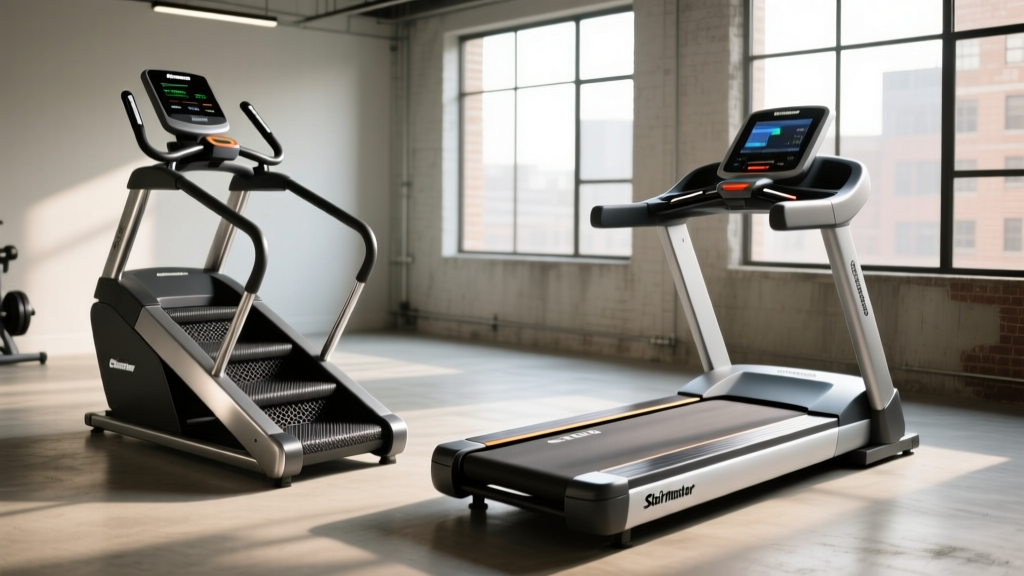
StairMaster vs Incline Treadmill: 2026 Buyer's Guide
Deciding between a StairMaster and an incline treadmill? Our 2026 buyer's guide compares biomechanics, top models, and ROI to help you choose.

The Biomechanical Divide: Muscle Activation and Joint Load
When outfitting a high-performance home gym in 2026, the debate of StairMaster vs incline treadmill remains one of the most contested decisions among cardio enthusiasts. Both machines promise exceptional cardiovascular conditioning and lower-body hypertrophy, but they achieve these results through fundamentally different biomechanical pathways. Understanding these differences is critical before committing to a $3,000+ equipment purchase.
The StairMaster (specifically the StepMill line, which features a rotating staircase) forces continuous concentric and eccentric muscle contractions against gravity. According to biomechanical analyses reviewed by the American Council on Exercise (ACE), climbing stairs elicits roughly 24% higher activation in the gluteus maximus and vastus lateralis compared to walking on a flat surface. However, the deep knee flexion required to clear each 8-inch step places significant shear force on the patellofemoral joint.
Conversely, an ultra-incline treadmill (capable of 30% to 40% grades) shifts the emphasis to the posterior chain—specifically the hamstrings, glutes, and calves—while maintaining a closed-kinetic-chain walking motion. The Mayo Clinic notes that incline walking significantly reduces the impact shock associated with running, making it a superior choice for individuals managing mild osteoarthritis or recovering from meniscus repairs, as the knee never undergoes the extreme flexion angles required by a StepMill.
StairMaster vs Incline Treadmill: Core Feature Comparison Matrix
To visualize the hardware and experiential differences, we have compiled a direct comparison matrix based on the current 2026 flagship specifications from leading manufacturers.
| Specification | StairMaster StepMill (SM5) | Premium Incline Treadmill (e.g., X32i) |
|---|---|---|
| Max Incline / Grade | Fixed vertical climb (simulates ~65% grade) | Up to 40% incline (motorized deck) |
| Footprint (L x W) | 46" L x 28" W (Compact) | 70" L x 40" W (Expansive) |
| Machine Height | 76" (Requires high ceilings) | 76.5" (Deck raises at front) |
| Joint Impact | Moderate-High (Deep knee flexion) | Low (Continuous walking gait) |
| Primary Muscle Focus | Quads, Glutes, Calves | Glutes, Hamstrings, Calves |
| Average Price Range | $3,899 - $4,499 | $3,999 - $4,999 |
2026 Flagship Showdown: SM5 vs. X32i
To ground this comparison in reality, let us examine the two undisputed heavyweights of the home cardio market: the StairMaster SM5 and the NordicTrack X32i.
The Gold Standard StepMill: StairMaster SM5
The SM5 remains the commercial-grade benchmark. Priced at approximately $4,299, it features a 7-inch LCD display and a heavy-duty alternator that generates its own resistance based on user cadence. The 8-inch step height is non-negotiable, which is excellent for athletic conditioning but unforgiving for shorter users (under 5'3") who may struggle to maintain a natural hip alignment at higher speeds. The SM5's 315 lb weight provides immense stability, eliminating the lateral wobble found in cheaper pedal-based stair climbers.
The Ultra-Incline Behemoth: NordicTrack X32i
Retailing around $4,499, the X32i offers a staggering 40% incline and a -6% decline, powered by a massive 4.25 CHP motor. The 22-inch running belt width is a standout feature, accommodating natural arm-swing and lateral movement during steep climbs. Unlike the SM5, the X32i allows for precise speed and grade micro-adjustments via the handgrip controls, making it ideal for interval training where transitioning from a 5% recovery jog to a 35% power-hike requires instantaneous motor response.
The Hidden Dealbreakers: Spatial and Electrical Realities
Most buying guides ignore the logistical nightmares of installing commercial-grade cardio equipment. Before adding either machine to your cart, evaluate your space against these strict requirements.
CRITICAL SPATIAL WARNING: The StairMaster SM5 stands 76 inches tall. If you are 6 feet tall (72 inches), your head will be at 148 inches while standing on the bottom step. As you climb, you remain at this elevation. Therefore, an 8-foot (96-inch) ceiling is physically impossible for the SM5. You need a minimum ceiling height of 9 feet to accommodate the machine, the user, and a safe 10-inch overhead clearance for arm swing.
Electrical infrastructure is equally demanding. The Centers for Disease Control and Prevention (CDC) recommends 150 minutes of vigorous aerobic activity weekly, meaning your machine will see heavy, sustained use. The X32i's 4.25 CHP motor, when pushing a 200+ lb user up a 40% incline at 2.5 mph, operates under maximum torque. This draws upwards of 18 amps. Plugging this into a standard residential 15-amp circuit shared with lighting or a television will trip the breaker mid-workout. A dedicated 20-amp circuit is mandatory for ultra-incline treadmills.
The FitGearPulse Decision Framework
Use this rapid-filter framework to determine which machine aligns with your physiological profile and training goals.
Choose the StairMaster (StepMill) If:
- You prioritize space efficiency: The 46" x 28" footprint fits comfortably in tight apartment gyms or narrow basement alcoves.
- Your goal is quad-dominant hypertrophy: The vertical climb isolates the anterior chain better than any walking motion.
- You want zero motor maintenance: StepMills use magnetic alternators and gravity; there is no treadmill belt to lubricate, tension, or realign.
- You have 9+ foot ceilings: You possess the vertical clearance required for safe operation.
Choose the Incline Treadmill If:
- You have knee or lower back sensitivities: The closed-chain walking motion avoids the deep, loaded knee flexion of stair climbing.
- You want versatile programming: Decline walking (eccentric quad loading) and flat running are impossible on a StepMill.
- You are training for alpine hikes or rucking: Simulating specific trail grades (15%-35%) with a weighted vest translates perfectly to outdoor mountain sports.
- You share the equipment with users of varying heights: Treadmills accommodate everyone from 4'10" to 6'8" without overhead clearance issues.
Frequently Asked Questions
Which machine burns more calories per hour?
In a vacuum, the StairMaster edges out the incline treadmill. Maintaining a cadence of 60 steps-per-minute on a StepMill requires lifting your entire body weight vertically 8 inches per step, yielding approximately 650-850 calories per hour for a 180 lb individual. A 35% incline walk at 3.0 mph burns roughly 550-750 calories. However, users can typically sustain incline walking for 60-90 minutes, whereas StepMill fatigue often forces sessions to cap at 30-45 minutes, making total session caloric expenditure roughly equal.
Can I use a weighted vest on both machines?
Yes, but with caveats. Rucking on a 30% incline treadmill with a 20-30 lb vest is highly effective for posterior chain conditioning and mimics military/tactical training. Using a weighted vest on a StepMill exponentially increases patellofemoral joint compression. If you incorporate weighted StepMill sessions, limit the vest to 10-15 lbs and reduce your step cadence to avoid Achilles tendon overload.
How do maintenance requirements compare?
Incline treadmills require strict maintenance. The running belt must be lubricated with 100% silicone every 150-200 miles, and the deck will eventually require flipping or replacement after 5,000+ miles of friction. The StairMaster SM5 requires virtually zero user maintenance aside from wiping down the handrails and occasionally checking the tension of the internal drive chain, making it the superior choice for "set it and forget it" reliability.
More gear to consider
All reviews
Wahoo Treadmill Review & 2026 Compact Cardio Market Trends
Walking Pad Comparison: Setup, Installation & Treadmill Wattage
Air Bike vs Assault Bike: Value & Deer Run Z10 Treadmill Reviews

Curved vs Motorized: Incline Treadmill Benefits for Beginners

Under Desk Treadmill Review: Office Space vs Assault Runner Treadmill
