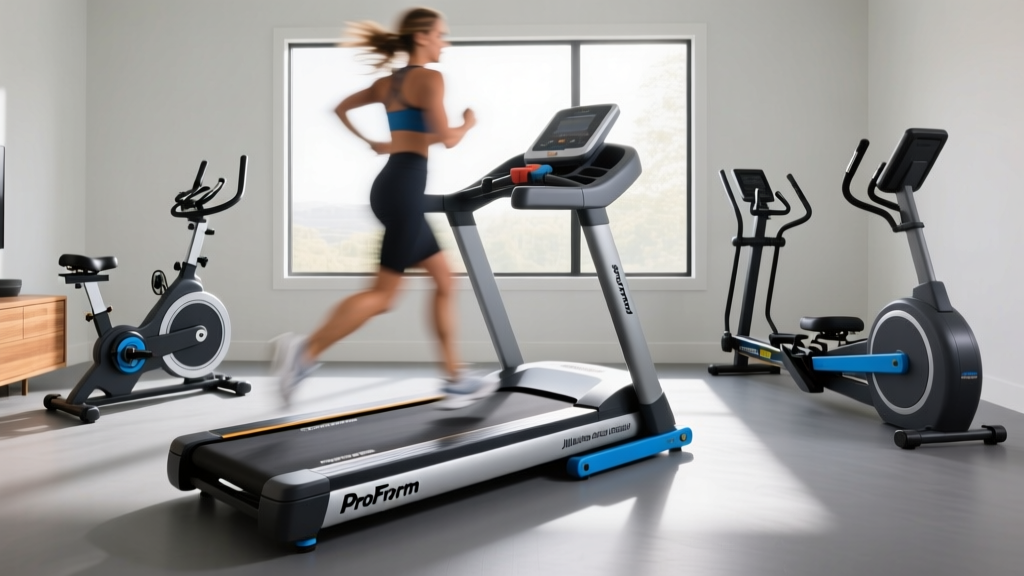
Treadmill Buying Guide 2026: Elliptical Trainer vs Treadmill Calories
Compare elliptical trainer vs treadmill calories, then master our 2026 treadmill buying guide with deep feature matrices, motor specs, and real pricing.

The Great Debate: Elliptical Trainer vs Treadmill Calories
When outfitting a home gym for maximum fat loss and cardiovascular conditioning, buyers inevitably hit a crossroads: the elliptical trainer vs treadmill calories debate. Which machine actually torches more energy per session? The answer isn't a simple binary; it depends heavily on biomechanics, user weight, and voluntary exertion levels.
According to metabolic data published by Harvard Health Publishing, running on a treadmill generally yields a higher caloric expenditure than using an elliptical at a moderate pace. However, the elliptical's perceived exertion is often lower, meaning users might inadvertently work harder on a treadmill simply because the machine demands more mechanical output from the user's body weight.
30-Minute Calorie Burn Matrix (Moderate vs. Vigorous Effort)
| User Weight | Elliptical (Moderate) | Treadmill (Walking 3.5 mph) | Treadmill (Running 6 mph) |
|---|---|---|---|
| 125 lbs | 270 kcal | 180 kcal | 300 kcal |
| 155 lbs | 335 kcal | 223 kcal | 372 kcal |
| 185 lbs | 400 kcal | 266 kcal | 444 kcal |
Data sourced from Harvard Medical School metabolic equivalents (METs) chart.
Expert Insight: A pivotal study published in the National Library of Medicine found that when users match their Rate of Perceived Exertion (RPE) and heart rate on both machines, the caloric burn is nearly identical. The treadmill wins on raw potential because it is easier to push a user into a high-intensity anaerobic zone (e.g., sprinting at 10 mph) compared to pedaling an elliptical at maximum resistance.Why Choose a Treadmill for Your 2026 Home Gym?
If the calorie math pushes you toward a treadmill, you must also consider the physiological benefits. The Cleveland Clinic notes that treadmills are weight-bearing exercises. The repetitive impact of your feet striking the deck stimulates osteogenesis (bone growth), which is critical for maintaining bone mineral density as you age. Ellipticals, being low-impact, do not provide this specific skeletal benefit.
Furthermore, if your goal is to train for a 5K, marathon, or simply improve your functional walking gait, the biomechanical specificity of a treadmill is irreplaceable. You are training the exact neuromuscular pathways required for over-ground locomotion.
The 2026 Treadmill Feature Comparison Matrix
Once you have decided that the treadmill's caloric and skeletal benefits outweigh the low-impact appeal of the elliptical, the real challenge begins: navigating the inflated marketing specs of the fitness industry. Below is a no-nonsense comparison of three top-tier treadmills dominating the 2026 market, selected for their durability, motor reliability, and deck engineering.
| Feature / Spec | Sole F80 (Best Value) | Horizon 7.4 AT (Best for HIIT) | NordicTrack Commercial 1750 (Best Tech) |
|---|---|---|---|
| 2026 Retail Price | $1,299 | $1,499 | $1,899 |
| Motor Size | 3.5 CHP | 3.5 CHP | 3.5 CHP (Self-Cooling) |
| Belt Dimensions | 22" x 60" | 22" x 60" | 22" x 60" |
| Incline / Decline | 0% to 15% | 0% to 15% | -3% to 15% |
| Top Speed | 12 mph | 12 mph | 12 mph |
| Max User Weight | 375 lbs | 350 lbs | 300 lbs |
| Deck Cushioning | Cushion Flex Whisper Deck | Variable Response Cushioning | FlexSelect (Adjustable) |
Decoding Treadmill Specs: What Actually Matters
When shopping for a treadmill, brands will throw a barrage of acronyms and numbers at you. Here is how to separate engineering reality from marketing fiction.
Continuous Horsepower (CHP) vs. Peak Horsepower
Never buy a treadmill based on "Peak Horsepower." Peak HP merely measures the maximum electrical draw the motor can sustain for a fraction of a second before tripping a breaker. You must look for Continuous Horsepower (CHP), which measures the motor's ability to dissipate heat and maintain torque during a 60-minute workout.
- Walkers (Under 3.5 mph): 2.5 CHP minimum.
- Joggers (3.5 to 6.0 mph): 3.0 CHP minimum.
- Runners & Heavy Users (6.0+ mph or 200+ lbs): 3.5 to 4.0 CHP minimum.
Belt Dimensions and Deck Engineering
A 20-inch wide belt is sufficient for walking, but the moment you transition to a run, your lateral foot splay increases. A 22-inch width is the non-negotiable standard for runners in 2026. Length matters just as much: tall users (over 5'10") require a minimum 60-inch belt length to accommodate a full stride without clipping the front motor housing.
Edge Case Warning - Adjustable Cushioning: Machines like the NordicTrack 1750 offer adjustable deck stiffness. While great for road-runners wanting a firm surface, running on a fully rigid deck at 8+ mph for extended periods drastically increases tibial shockwave transmission. Always soften the deck for high-mileage recovery runs.Known Failure Modes and Edge Cases to Avoid
Treadmills are high-stress mechanical devices. Based on repair technician data and long-term user reports, here are the most common failure modes and how your buying decision can prevent them:
- Motor Control Board (MCB) Burnout: The MCB regulates power from the wall to the drive motor. The #1 cause of MCB failure is deck friction. If you fail to apply 100% silicone lubricant to the belt every 150 miles, the friction increases the amp draw. The MCB overheats and fries. Buying Tip: Look for models with integrated belt-lubrication reminders or easy-access deck lips (like the Sole F80) to ensure maintenance isn't a chore.
- Incline Motor Gear Stripping: Budget treadmills use plastic gears in the incline actuator. If you frequently use auto-incline interval programs that rapidly shift from 0% to 15%, the sudden directional torque will strip plastic teeth. Buying Tip: Ensure the manufacturer specifies a steel-reinforced incline actuator or a heavy-duty lift motor.
- Drive Belt Slippage: Over time, the ribbed drive belt connecting the motor to the front roller stretches. If a treadmill requires constant manual tensioning, the roller bearings are likely misaligned from the factory.
Final Verdict: Matching the Machine to Your Metabolism
The elliptical trainer vs treadmill calories debate ultimately resolves in favor of the treadmill for users seeking maximum caloric ceiling, weight-bearing bone benefits, and running specificity. However, the elliptical remains the undisputed king for users with severe joint degradation, plantar fasciitis, or lower back pathologies who still need to maintain a high cardiovascular output.
If your physiology and goals align with the treadmill, do not compromise on the drivetrain. Investing in a 3.5 CHP motor with a 22" x 60" belt—such as the Sole F80 for budget-conscious runners or the Horizon 7.4 AT for HIIT enthusiasts—ensures your machine will survive the grueling caloric expenditure you demand of it well into the next decade.
More gear to consider
All reviews
Life Fitness T5 Treadmill Review: Motor Specs & Setup Guide

Retro Walking Treadmill Belt Maintenance & Lubrication Guide

Rowing Machine Buying Guide & Technique vs T10 9B Reflex Treadmill

Quiet Setup: Noise Levels & A Ten Minute Treadmill Workout Guide
Maintaining Your Weslo Treadmill Cadence G-40 & Compact Cardio