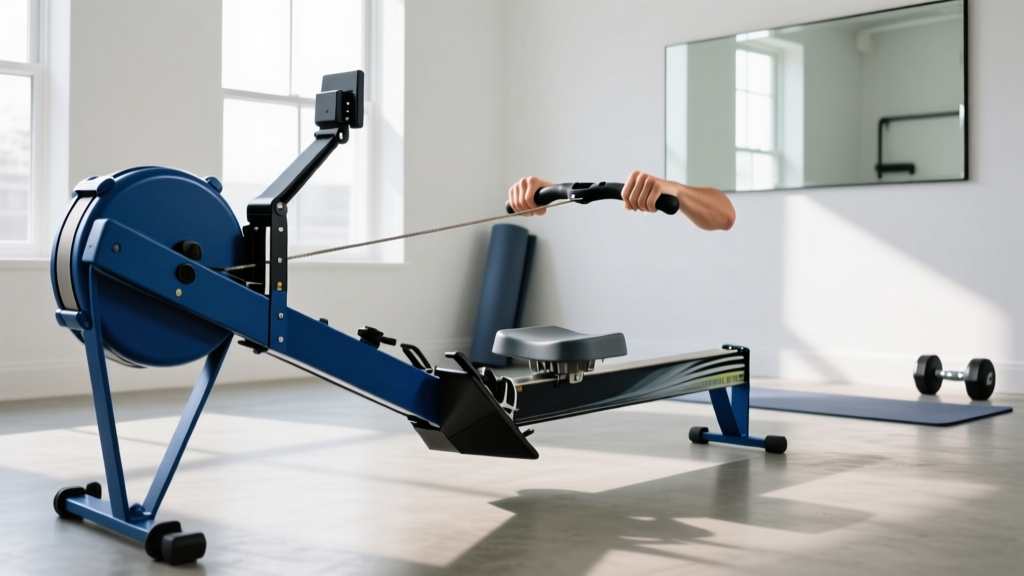
Rowing Machine Buying Guide: The 'Plane on a Treadmill' Resistance Myth
Discover how the 'plane on a treadmill' physics puzzle explains rowing machine resistance. Our 2026 guide compares top models and breaks down technique.

The Physics of the Catch: Why the 'Plane on a Treadmill' Matters for Rowing
You have likely encountered the famous physics thought experiment: If a plane is on a treadmill that perfectly matches the plane's speed in the opposite direction, can it take off? The answer is yes. Unlike a car, which relies on driving wheels against the ground to create forward momentum, an airplane generates thrust by pushing against the air. The treadmill merely spins the free-wheeling landing gear faster; it cannot hold the plane back from its fluid medium.
As counterintuitive as it may seem, this exact principle of fluid dynamics and thrust-based propulsion is the ultimate framework for understanding rowing machine resistance. When shopping for a cardio machine in 2026, consumers are often confused by the difference between air, water, and magnetic rowers. By applying the 'plane on a treadmill' analogy, the mechanics of indoor rowing become instantly clear, allowing you to make a highly informed purchasing decision.
Expert Insight: A magnetic rower operates like a car on a treadmill—the resistance is a fixed mechanical brake applied to the flywheel, regardless of your speed. An air or water rower operates like the airplane. You are generating thrust against a fluid medium. The faster and harder you pull, the exponentially greater the resistance becomes. You cannot outpace the fluid; you must conquer it.2026 Rowing Machine Market Matrix: Thrust vs. Brake
The indoor rowing market has shifted dramatically over the last few years. Notably, the Peloton Row was discontinued, leaving a gap in the interactive magnetic space, while hybrid and gamified water rowers have surged in popularity. Below is a comparative breakdown of the top contenders on the market, evaluated on resistance mechanics, footprint, and long-term durability.
| Model | Resistance Type | Est. Price (2026) | Max User Weight | Storage Footprint |
|---|---|---|---|---|
| Concept2 RowErg | Air (Thrust-based) | $1,000 | 500 lbs | 25" x 27" (Upright) |
| Ergatta Rower | Water (Fluid Thrust) | $2,200 | 350 lbs | 23" x 23" (Upright) |
| Hydrow Wave | Electromagnetic (Brake) | $1,200 | 300 lbs | Cannot store upright |
| Echelon Row-Complete | Magnetic (Brake) | $800 | 300 lbs | 22" x 54" (Folded) |
Mastering the Drag Factor: Stop Setting the Damper to 10
The most common failure mode for novice rowers on air machines like the Concept2 is setting the side damper lever to 10, assuming it acts like the highest gear on a bicycle. This is a fundamental misunderstanding of fluid mechanics.
The damper does not control resistance; it controls air volume. Think of it as the size of the airplane's engine intake. A setting of 10 allows maximum air into the flywheel housing, which causes the flywheel to decelerate faster between strokes. This forces you to apply exponentially more force on the next catch just to get the wheel moving again.
According to the official Concept2 Drag Factor guidelines, elite Olympic rowers typically set their drag factor between 110 and 130 (which usually corresponds to a damper setting of 3 to 5). Setting the damper to 10 (drag factor 150+) does not build more muscle; it simply alters the biomechanical load, placing dangerous sheer stress on the lumbar spine before the leg drive can fully engage.
Step-by-Step Technique: The Biomechanics of the Stroke
Whether you are using a fluid-thrust air rower or a fixed-brake magnetic machine, the human body must act as the transmission. The American Council on Exercise (ACE) emphasizes that rowing is a power-endurance movement, not an upper-body pull. The correct power distribution is 60% legs, 20% core, and 20% arms.
1. The Catch (Position Zero)
- Shins: Vertical (90 degrees). Do not compress your knees past your ankles, as this forces the pelvis into posterior tilt, rounding the lower back.
- Arms: Fully extended, lats engaged, shoulders relaxed away from the ears.
- Torso: Hinged forward at the hips at roughly 11 o'clock.
2. The Drive (The Thrust Phase)
This is where the 'plane on a treadmill' analogy peaks. You must push the footplates away with explosive leg drive before the arms bend. The sequence is: Legs open, then hips swing back, then arms pull to the lower sternum. If you pull with your arms first, you 'slip the clutch,' losing the connection to the flywheel's fluid resistance.
3. The Finish
The handle rests lightly at the lower ribcage. The wrists are flat, the core is braced, and the legs are fully extended but not hyper-locked at the knees.
4. The Recovery (The Reset)
The recovery takes exactly twice as long as the drive (a 1:2 ratio). Sequence: Arms extend, hips hinge forward past the knees, then the knees bend to glide back to the catch. If you bend your knees before the handle passes them, you will have to awkwardly lift the handle over your knees, destroying your rhythm and wattage output.
Real-World Maintenance and Edge Cases
Cardio machines are long-term investments, and each resistance type carries specific maintenance edge cases that buyers rarely consider until year two of ownership.
Warning: Never use WD-40 on an air rower chain. WD-40 is a solvent, not a lubricant. It will strip the factory grease, attract micro-abrasive dust, and cause the chain to stretch and snap. Use purified mineral oil or 20W motor oil, applied via a paper towel every 50 hours of use.
- Air Rowers (Chain & Sprocket): Over time, nickel-plated chains stretch. If your Concept2 chain begins to skip over the cog during high-wattage sprint intervals, it is time for a replacement chain kit (approx. $35). Additionally, the monorail wheels will accumulate track dust, causing the seat carriage to stutter. Wipe the stainless steel track with isopropyl alcohol weekly.
- Water Rowers (Algae & Seal Degradation): Water rowers provide a beautiful, organic whoosh, but the polycarbonate tank is susceptible to UV degradation and algae. You must drop a chlorine purification tablet into the tank every 6 months. Never use bleach, as it will corrode the rubber O-rings and cause catastrophic leaking onto your hardwood floors.
- Magnetic Rowers (Brake Dust & Belt Tension): Magnetic rowers use a Kevlar or nylon belt connected to a magnetic brake. While virtually silent, the internal belt can lose tension over 3-4 years, resulting in a 'slipping' sensation at the catch. This usually requires opening the flywheel housing to adjust the idler pulley tensioner.
The Final Verdict: Choosing Your Medium
If your goal is pure, unadulterated performance tracking, competitive racing, and a machine that will outlive you, the Concept2 RowErg remains the undisputed king of the 'thrust-based' air rowers. Its PM5 monitor is the global standard for ergometer scoring.
However, if you prioritize aesthetic integration into a living space and prefer the tactile, heavy-water feel of a boat on a river, the Ergatta offers a brilliant gamified interface built on a water-resistance chassis. Just remember: whether you choose air, water, or magnetic, you are the engine. Respect the physics, protect your lumbar spine, and let the fluid dynamics do the work.
More gear to consider
All reviews
Cardio Machine Noise Comparison: Speed Training on Treadmill at Home
ProForm XP 542e Treadmill vs Under Desk Treadmills: Office Review

Air Bike vs Assault Bike & Lifespan TR1200i Treadmill Budget

Walking Pad vs ProForm XP Treadmill: Review, Mistakes & Fixes
Stair Climber Machine Home Guide: Fixing Apps for Treadmill Walking
