Elliptical vs Life Fitness F1 Smart Folding Treadmill for Small Spaces
Compare the elliptical vs Life Fitness F1 Smart Folding Treadmill for home cardio. Discover space optimization, clearance math, and layout strategies.

The Spatial Reality: Active vs. Stored Footprints
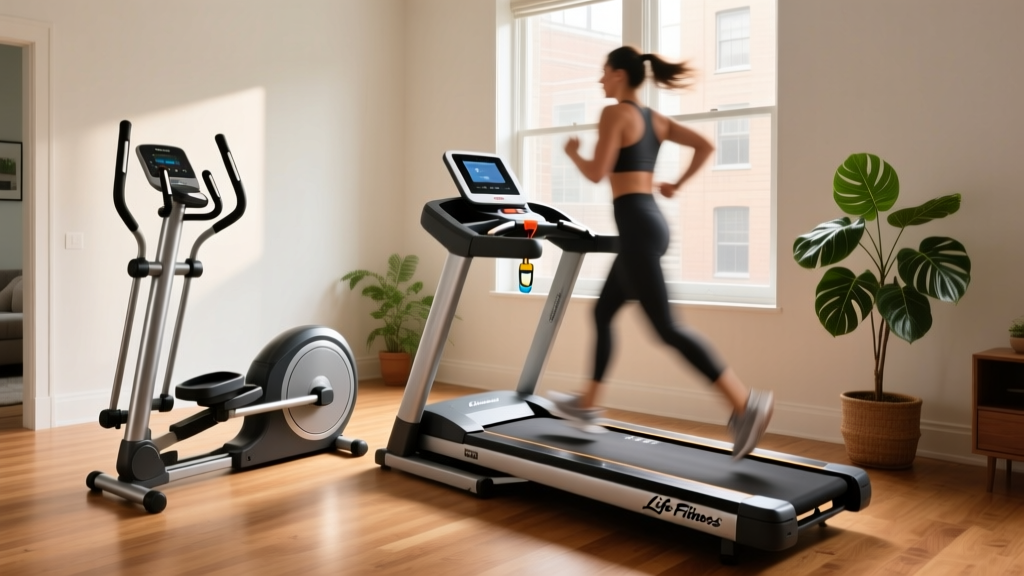
When homeowners debate the merits of an elliptical vs treadmill for home cardio, the conversation usually revolves around joint impact or calorie burn. However, from a space optimization and interior layout perspective, the true differentiator is the human-machine spatial envelope. In 2026, premium home gym design isn't just about the square footage a machine occupies while folded; it is about the dynamic space required during peak exertion, traffic flow, and structural loading.
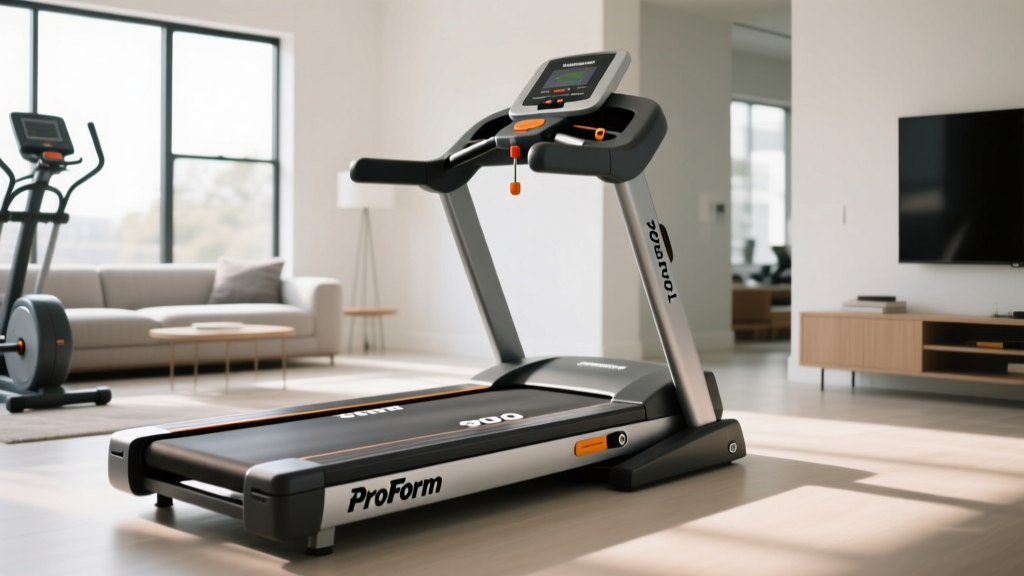
To illustrate this, we are comparing the spatial dynamics of a standard compact cross-trainer against a premium folding model: the Life Fitness F1 Smart Folding Treadmill. While the F1 is renowned for its commercial-grade running surface and smart console integration, its physical footprint demands a highly strategic approach to room layout.
💡 Pro Layout Insight: Never measure just the machine. A runner on a treadmill requires lateral sway space for arm drive and balance recovery. An elliptical user is locked into a fixed sagittal path, drastically reducing the required lateral clearance zone.Dimensional & Dynamic Comparison Matrix
| Metric | Life Fitness F1 Smart Folding Treadmill | Standard Compact Elliptical (e.g., Sole E25) |
|---|---|---|
| Active Footprint (L x W) | 80" x 34" | 71" x 24" |
| Folded / Stored Footprint | 47" x 34" (Deck raised to 61" H) | N/A (Static profile) |
| Human Lateral Sway Zone | +12" per side (Running arm swing) | +4" per side (Fixed path) |
| Machine Weight | ~250 lbs | ~155 lbs |
| Deck / Pedal Step-Up Height | ~8.5" (Deck height) | ~10" to 14" (Pedal apex) |
Vertical Clearance: The Ceiling Trap
The most common failure mode in home cardio layout design is ignoring vertical clearance. Treadmills and ellipticals interact with ceiling height in fundamentally different ways.
The Life Fitness F1 Smart Folding Treadmill features an 8.5-inch deck height to accommodate its heavy-duty motor and folding hinge mechanism. When a 6-foot-tall user runs on this deck, their head is elevated, and the natural biomechanical bounce of a running stride adds another 3 to 4 inches of vertical displacement. Therefore, the minimum safe ceiling height for the F1 is the user's height plus 15 inches. In a room with standard 8-foot (96-inch) ceilings, a user taller than 6'9" will experience claustrophobia or head-strike risk during sprints.
Conversely, an elliptical's step-up height is dynamic. While the pedal apex might reach 14 inches, the user's head remains relatively level without vertical bounce. The rule of thumb for ellipticals is user height plus 10 inches.
"When designing multi-use spaces, we always map the 'maximum vertical excursion' of the primary user. A folding treadmill doesn't just need floor space to fold; it requires a 61-inch vertical clearance arc to safely deploy the deck without striking wall-mounted shelving or smart-home thermostats."
— Interior Fitness Layout Guidelines, 2026
The "Folding" Reality Check: Gas-Assist vs. Daily Use
Marketing materials often position folding treadmills as daily space-savers. However, when analyzing the Life Fitness F1 Smart Folding Treadmill (priced around $3,499 - $3,999), we must apply a realistic spatial lens. The F1 weighs approximately 250 pounds. While it utilizes a hydraulic gas-assist shock to make lifting the deck manageable, it is not a "flip-up-and-down" machine like a 60-pound walking pad.
How to Layout for the F1's Folding Mechanism
- The Multi-Use Room Strategy: Place the F1 in a guest room or home office. Fold it vertically (47" x 34" footprint) only when hosting guests or needing floor space for yoga. The 61" folded height means it can tuck neatly behind a standard 30"-high desk or sofa.
- The Dedicated Gym Strategy: If the machine lives in a dedicated gym space, do not plan to fold it daily. The mechanical wear on the hinge and the sheer physical friction of moving a 250-lb base make daily folding impractical. Instead, use the folding feature to allow for deep floor cleaning or equipment rearrangement once a month.
- The Clearance Arc: Always leave a 40-inch semi-circle behind the treadmill. This is the physical swing radius required to safely lower the heavy running deck without trapping fingers or damaging baseboards.
Floor Loading, Vibration, and Acoustic Layout
According to the Mayo Clinic, ellipticals significantly reduce impact forces on weight-bearing joints compared to treadmills. But what does this mean for your home's structural layout?
Running on the Life Fitness F1 generates peak impact forces of 2.5 to 3 times your body weight. In a second-floor bedroom or bonus room, this translates to low-frequency acoustic vibration that will travel through floor joists. An elliptical generates near-zero impact vibration.
Subfloor & Matting Requirements
- For the F1 Treadmill (Upper Floors): Require a 3/4" thick vulcanized rubber mat (minimum 4' x 7') placed over a high-density acoustic underlayment. Do not place the F1 directly on luxury vinyl plank (LVP) flooring, as the concentrated static weight of the leveling feet (over 60 PSI per foot) will dent the LVP over time.
- For Ellipticals: A standard 1/4" PVC equipment mat is sufficient to protect against sweat and minor scuffs, as the weight distribution is broader and dynamic impact is negligible.
Three Space-Optimized Layout Blueprints
Choosing between an elliptical and the Life Fitness F1 ultimately depends on your room's geometry. The American Council on Exercise (ACE) emphasizes that equipment placement must prioritize safety zones and natural light. Here are three layout frameworks:
1. The Galley Layout (Narrow Rooms / Hallways)
Winner: Elliptical. In a room less than 8 feet wide, an elliptical's 24-inch width and fixed lateral path allow you to place it against a wall with only 6 inches of breathing room. The F1's 34-inch width, plus the runner's arm swing, requires a minimum room width of 10 feet to prevent the user from striking the wall during high-cadence runs.
2. The Corner Anchor (Square Spare Bedrooms)
Winner: Life Fitness F1 (Folded). If the room serves dual purposes, angle the F1 in a corner facing the room's entrance. When folded, its 47" x 34" base acts as a monolithic pillar that can be flanked by tall bookshelves or a wardrobe, effectively hiding the machine's industrial aesthetic.
3. The Focal Point (Open Concept Basements)
Winner: Life Fitness F1 (Deployed). In open spaces, the F1's premium console and 20" x 55" running surface command attention. Position it facing a window or a wall-mounted TV. Ensure a 36-inch walkway behind the machine for safe mounting/dismounting and cable management routing.
Final Verdict: Choosing Based on Your Room's Geometry
If your primary constraint is lateral width and ceiling height, or if the machine is going on an upper floor with noise-sensitive occupants below, the elliptical is the undisputed champion of spatial efficiency and acoustic discretion.
However, if you demand commercial-grade running biomechanics and have a room that can accommodate a 58-inch active width zone (machine + sway), the Life Fitness F1 Smart Folding Treadmill is a masterclass in premium engineering. Its folding capability shouldn't be viewed as a daily space-saving trick, but rather as a strategic architectural tool that allows a massive, 250-pound cardio powerhouse to temporarily vanish when your living space demands flexibility.
More gear to consider
All reviews
Elliptical vs Treadmill: Apple Watch Accuracy & Budget Guide

NordicTrack C1900 Treadmill vs Home Stair Climber: 2026 Guide
Folding Treadmill for Small Spaces: Country Treadmill Classes Guide

The TweeklyNutrition Treadmill Guide: 2026 Buyer Matrix
Troubleshooting True Treadmill PS800 Noise & Cardio Comparisons