Elliptical vs HCCSport Treadmill: 2026 Home Cardio Budget Breakdown
Compare the 5-year cost of an elliptical vs the HCCSport treadmill. Discover which home cardio machine delivers the best ROI, space efficiency, and value.

The Home Cardio Dilemma: Upfront Costs vs. Long-Term Value
As we navigate the fitness equipment landscape in 2026, inflation and supply chain shifts have permanently altered the pricing tiers of home cardio machines. Premium smart-treadmills and connected ellipticals now routinely exceed the $2,500 mark, pushing budget-conscious consumers toward two distinct paths: the ultra-affordable folding treadmill market and the traditional mid-tier elliptical market. For buyers trying to maximize their fitness budget, the debate often narrows down to a specific, highly rated budget option—like the HCCSport treadmill—versus a reliable workhorse elliptical, such as the Schwinn 430.
But looking solely at the retail price tag is a financial trap. True value analysis requires calculating the 5-year Total Cost of Ownership (TCO), factoring in electricity draw, maintenance consumables, floor protection, and even biomechanical wear-and-tear. In this comprehensive budget breakdown, we pit the elliptical against the HCCSport treadmill to determine which machine actually deserves a spot in your home gym.
💡 The Bottom Line Up Front: The HCCSport treadmill wins on immediate upfront cost and space efficiency, making it ideal for walkers and light joggers in small apartments. However, the mid-range elliptical dominates in long-term durability, zero-maintenance requirements, and joint preservation, offering a superior 5-year ROI for dedicated daily cardio users.Contender 1: The HCCSport Treadmill (Budget & Space Analysis)
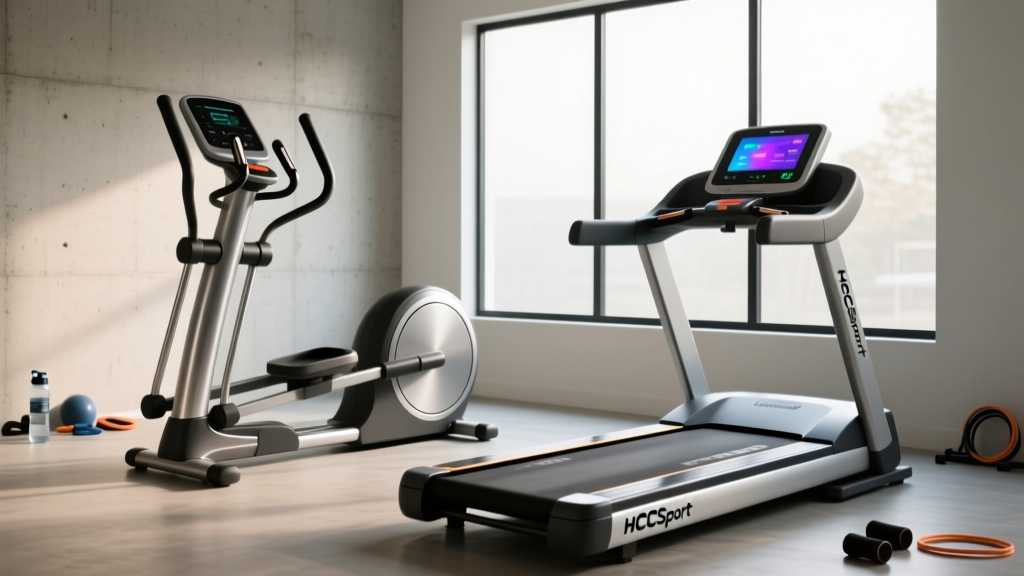
The HCCSport brand has carved out a massive niche in the budget fitness space by offering feature-dense machines at entry-level prices. The most popular model for home comparison is the HCCSport 3.25 HP Folding Treadmill, which typically retails between $380 and $450 depending on seasonal sales.
Upfront Pricing and Specifications
- Retail Price: ~$399
- Motor: 3.25 Peak HP (approx. 1.5 Continuous Duty HP)
- Running Surface: 15" x 43" (Optimal for walking/jogging; restrictive for tall runners)
- Weight Capacity: 300 lbs
- Incline: Manual or motorized 15% (depending on exact sub-model)
From a pure capital expenditure standpoint, the HCCSport treadmill is a massive winner. You are getting a motorized belt, digital tracking, and a folding hinge for the price of a few months at a commercial gym. However, budget treadmills utilize smaller rollers (typically 1.5" to 1.75" in diameter). Smaller rollers generate more friction and heat, which directly impacts the lifespan of the belt and the continuous duty motor if pushed to its limits.
Contender 2: Mid-Range Ellipticals (The Joint-Friendly Investment)
To provide a fair value comparison, we must look at the direct mid-range competitor: the Schwinn 430 Elliptical. Priced around $649 to $749, it represents the baseline for commercial-grade build quality in a residential setting.
Upfront Pricing and Specifications
- Retail Price: ~$699
- Drive System: 18 lb High-Inertia Flywheel (Front-drive)
- Stride Length: 20" (Accommodates users up to 6'4")
- Resistance: 20 levels of magnetic resistance
- Footprint: 70" L x 25" W (Non-folding)
The elliptical demands a higher initial buy-in and permanently claims a 12-square-foot footprint in your room. Yet, what you are paying for is a sealed magnetic resistance system and heavy-duty pivot bearings. Unlike a treadmill belt that experiences thousands of pounds of cumulative friction and impact force, an elliptical's drivetrain operates in a near-frictionless magnetic field.
5-Year Cost of Ownership Matrix
To understand the true financial impact of your purchase, we mapped out the hidden costs associated with both machines over a 60-month period of moderate use (4 hours per week).
| Cost Category | HCCSport 3.25 HP Treadmill | Schwinn 430 Elliptical |
|---|---|---|
| Base Retail Price | $399 | $699 |
| Shipping / Assembly | $0 (Free shipping / DIY 1 hr) | $0 (Free shipping / DIY 2 hrs) |
| Equipment Mat (Required) | $45 (Heavy rubber for impact) | $35 (Standard PVC mat) |
| Electricity (5 Years) | $115 (1.5 CHP motor draw) | $12 (Console/Low-draw alternator) |
| Maintenance Consumables | $40 (100% Silicone lube x 4) | $0 (Sealed bearings) |
| Estimated Repair Risk | $120 (Control board/belt swap) | $0 |
| 5-Year Total Cost | $719 | $746 |
| Resale Value (Year 5) | $50 (Local pickup only) | $200 (Holds brand value) |
| Net 5-Year Cost | $669 | $546 |
Analysis: While the HCCSport treadmill saves you $300 on day one, the elliptical actually becomes the cheaper machine by Year 4 when factoring in electricity, mandatory silicone lubrication, and the significantly higher resale value of name-brand ellipticals.
Hidden Costs: Energy Draw and Maintenance Protocols
One of the most overlooked aspects of home cardio budgeting is the electrical and maintenance footprint. According to the American Council on Exercise (ACE), the biomechanical efficiency of the machine directly correlates to its energy consumption and mechanical degradation.
The Treadmill Energy & Friction Tax
A 1.5 Continuous Horsepower (CHP) treadmill motor draws roughly 1,100 to 1,300 watts under load. If you run your HCCSport treadmill for 4 hours a week, you are consuming approximately 220 kWh annually. At the 2026 national average of $0.17 per kWh, that is roughly $37 a year just in electricity. Furthermore, treadmill belts require 100% silicone lubrication every 30 to 40 miles of use. Failure to lubricate the deck increases friction, which forces the motor to draw excess amperage, eventually tripping the thermal breaker or frying the lower control board—a common failure mode in budget treadmills past the 2-year mark.
The Elliptical Efficiency Advantage
Ellipticals utilize magnetic resistance. The flywheel spins past magnets to create drag, meaning there is zero physical friction generating heat or requiring lubrication. The only electricity required is to power the LCD console and the electromagnetic servo that adjusts the resistance magnets. Many modern ellipticals even use self-generating alternators. Your electrical cost for an elliptical is practically negligible, and the mechanical maintenance is limited to wiping down the rails and checking crank arm bolts once a year.
Biomechanics and the "Medical" Budget
When analyzing value, we must also consider the physical toll on the body. The Mayo Clinic notes that while both machines provide excellent cardiovascular conditioning, the impact forces differ drastically.
"Elliptical machines offer a low-impact aerobic workout. Unlike running on a treadmill, which can exert significant force on your joints, an elliptical machine allows your feet to stay on the pedals, reducing the stress on your knees, hips, and lower back."
Running on a budget treadmill with a thinner deck (the HCCSport utilizes a standard 15mm MDF deck with basic elastomer cushions) transfers up to 2.5 times your body weight into your joints with every footstrike. Over a 5-year period, this repetitive impact can lead to shin splints, plantar fasciitis, or patellar tendonitis—especially if your form degrades due to fatigue. The cost of a single physical therapy copay or specialized orthotics ($200–$500) instantly wipes out the upfront savings of choosing the budget treadmill over the joint-friendly elliptical.
Space Efficiency: The Apartment Dweller's Tie-Breaker
Budgeting isn't just about dollars; it's about spatial economics. If you live in a 700-square-foot apartment, the permanent 70-inch footprint of an elliptical might force you to rearrange your entire living room, potentially costing you "spatial sanity."
The HCCSport treadmill features a hydraulic-assisted folding deck. When folded, it reduces its footprint to roughly 30" x 25", allowing you to roll it into a closet or slide it under a bed. If spatial constraints are your primary limiting factor, the HCCSport treadmill wins the value proposition by default, as a machine you can easily store is a machine you will actually use.
The Final Verdict: Which Machine Wins Your Budget?
🏆 Buy the HCCSport Treadmill If:
- Your strict upfront budget is capped at $450.
- You are primarily a walker or light jogger (under 6 mph).
- You live in a small apartment and require a folding mechanism.
- You are committed to a strict maintenance schedule (lubricating the belt every 6 weeks).
🏆 Buy the Mid-Range Elliptical If:
- You want the lowest 5-year Total Cost of Ownership.
- You suffer from knee, hip, or lower back sensitivities.
- You plan on doing high-intensity interval training (HIIT) where heavy magnetic resistance is required.
- You want a "buy it and forget it" machine with zero belt lubrication or motor-board anxiety.
Ultimately, the HCCSport treadmill is a phenomenal disruptor in the budget cardio space, proving that you do not need to spend $1,500 to get a reliable walking and jogging platform at home. However, for users who view home fitness as a lifelong, daily habit, the mid-range elliptical remains the undisputed champion of long-term financial and biomechanical value.
More gear to consider
All reviews
Under Water Treadmill vs Rowing Machine: 2026 Guide

Interval Walking Treadmill Belt Maintenance for Small Spaces
Folding Treadmill with Laptop Stand: 2026 Budget Review
Prevent Shin Splints From Treadmill: Rowing Machine Guide

ProForm Treadmill Issues? Upright, Recumbent & Spin Bike Care