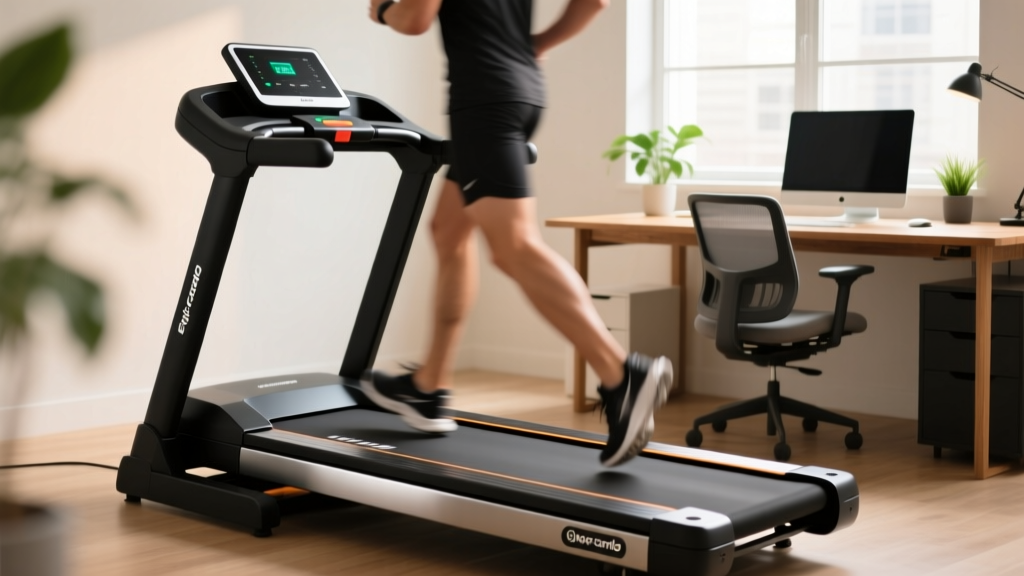
Elliptical vs Treadmill Care: What Was It Originally Invented For?
Discover what the treadmill was originally invented for and how its heavy-duty history impacts modern elliptical vs treadmill maintenance and longevity.

When outfitting a home gym in 2026, the debate between an elliptical and a treadmill usually centers on calorie burn, joint impact, or interactive programming. However, as a senior equipment technician, I look at these machines through a different lens: mechanical stress and long-term longevity. To truly understand the maintenance demands of modern home cardio equipment, we first have to look back at the mechanical DNA of these machines. If you have ever wondered what was the treadmill originally invented for, the answer reveals exactly why modern treadmills require such rigorous, heavy-duty maintenance compared to their elliptical counterparts.
The Historical Blueprint: In 1818, English engineer Sir William Cubitt invented the 'tread-wheel' as a penal device. Prisoners were forced to climb the outside of a massive, continuous cylinder to crush grain and pump water. It was designed to harness human weight for continuous, grinding, high-friction labor. (Source: Wikipedia - Treadwheel)
While you are no longer grinding grain at Brixton Prison, the modern motorized treadmill still operates on this exact mechanical principle: a high-friction, high-impact, load-bearing surface driven by continuous rotational force. The elliptical, conversely, was patented by Larry Miller in 1995 specifically to eliminate this punishing impact. According to Mayo Clinic fitness guidelines, low-impact machines like ellipticals drastically reduce the ground reaction forces that degrade both human joints and machine components. Let us break down how this historical divergence dictates your 2026 maintenance routine.
The Mechanical Burden: Impact vs. Glide
When comparing an elliptical vs treadmill for home cardio, the primary differentiator in longevity is kinetic friction and vertical load. Every time your foot strikes a treadmill deck, you generate a ground reaction force equivalent to 1.5 to 3 times your body weight. This force drives the running belt into the wooden deck, creating immense friction that the motor must constantly fight against. Over time, this friction generates heat, degrades the belt, and warps the deck.
An elliptical machine, such as the popular Bowflex Max M9 or NordicTrack SpaceSaver SE7i, operates on a closed kinetic chain. Your feet never leave the pedals. The mechanical stress is transferred to pivot bearings, crank arms, and guide rails rather than a friction-heavy belt system. Consequently, the failure modes of these two machines are entirely different.
Treadmill Maintenance Protocol: Managing the Grind
Because the treadmill is the spiritual successor to Cubitt's heavy-duty tread-wheel, its maintenance must focus on friction reduction and motor cooling. High-end 2026 models like the Sole F80 or NordicTrack Commercial 2450 feature 3.0 to 4.0 CHP (Continuous Horsepower) motors, but even these robust engines will burn out if the belt-to-deck friction is ignored.
1. The 150-Mile Silicone Rule
The most critical treadmill maintenance task is lubrication. You must use 100% pure silicone treadmill lubricant. Never use WD-40, household oils, or lithium grease on a treadmill deck; these will melt the belt backing and destroy the deck's phenolic coating.
⚠ WARNING: Applying petroleum-based lubricants will void your manufacturer warranty and cause the rubber belt to delaminate within weeks. Always verify the bottle says '100% Silicone'.- Frequency: Apply 1 ounce of silicone under the belt every 150 miles or every 3 months.
- Application: Loosen the rear roller bolts, lift the belt, and apply the silicone in a zig-zag pattern from the center outward.
2. The Belt Tension 'Lift Test'
A belt that is too tight will overwork the motor and drain the control board's capacitors. A belt that is too loose will slip, causing the deck to burn. Perform the 'Lift Test' monthly: reach under the center of the belt and lift it. It should rise exactly 2 to 3 inches off the deck. If it lifts higher, tighten the rear roller bolts a quarter-turn clockwise.
3. Motor Hood Vacuuming
Treadmill motors act as vacuums, sucking in dust, pet hair, and carpet fibers. Every 6 months, unplug the machine, remove the plastic motor hood (usually 4 Phillips-head screws), and use a soft brush attachment to vacuum the motor fins and the drive belt area. Overheating is the number one cause of lower control board failure, which costs between $150 and $300 to replace.
Elliptical Maintenance Protocol: Precision and Bearings
Because ellipticals rely on gliding mechanics rather than friction, their maintenance is less about lubrication and more about alignment, bearing health, and debris removal. According to Johns Hopkins Medicine, the smooth, low-impact nature of ellipticals is ideal for joint preservation, and mechanically, it preserves the machine's drive system as well.
1. Rail and Wheel Hygiene
On rear-drive ellipticals, the pedal arms roll along aluminum guide rails via polyurethane wheels. In a home gym environment, airborne dust mixes with sweat drippings to create a highly abrasive, salty paste on these rails. This paste acts like sandpaper, flattening the wheels and causing the machine to 'bump' or 'click' during use.
- Wipe down the guide rails weekly with a microfiber cloth dampened with isopropyl alcohol (not household glass cleaner, which leaves a sticky residue).
- Inspect the polyurethane wheels every 6 months. If they have developed flat spots, they must be replaced (typically a $40-$60 parts cost).
2. Pivot Point Lubrication
While the rails stay dry, the mechanical pivot points (where the pedal arms connect to the crank and the upright handles) require grease. Every 6 months, apply a small dab of white lithium grease to the shoulder bolts and pivot bearings. Wipe away any excess to prevent dust accumulation.
3. Crank Arm Torque Checks
The repetitive, circular motion of an elliptical can slowly back out the crank arm bolts over time. Once a year, use a torque wrench to ensure the main drive crank bolts are tightened to the manufacturer's specification (usually between 30-40 Nm). A loose crank arm will strip the spindle, turning a $5 tightening job into a $250 drive-axle replacement.
Longevity and Cost of Ownership Matrix
To help you decide which machine fits your willingness to perform maintenance, here is a data-driven comparison based on average home-use metrics (3-4 hours per week) for mid-to-high-tier 2026 models.
| Metric | Treadmill (e.g., Sole F80) | Elliptical (e.g., Bowflex Max M9) |
|---|---|---|
| Expected Lifespan | 7 - 12 Years | 10 - 15+ Years |
| Primary Failure Point | Motor / Lower Control Board | Console / Pivot Bearings |
| Annual Maintenance Cost | $30 - $50 (Silicone, belts) | $10 - $20 (Grease, cleaning supplies) |
| Major Repair Cost (Avg) | $250 - $500 (Deck/Belt/Motor) | $100 - $200 (Drive belt/Wheels) |
| Joint Impact Force | High (1.5x - 3x Bodyweight) | Low (Near Zero Ground Reaction) |
Environmental Factors: The Silent Machine Killers
Regardless of whether you choose the historical heavy-duty grind of a treadmill or the modern precision glide of an elliptical, your home gym environment plays a massive role in longevity. In 2026, many home gyms are located in basements or garages where humidity fluctuates.
💡 Pro-Tip: The Sweat Corrosion FactorHuman sweat is highly acidic and saline. When it drips onto the exposed steel pivot points of an elliptical or the motor hood screws of a treadmill, it causes rapid galvanic corrosion. Always keep a dedicated gym towel draped over the console and handlebars, and wipe down all exposed metal joints with a damp (water-only) cloth immediately after heavy sweat sessions.
Furthermore, never place a treadmill directly on a thick carpet without a high-density EVA foam equipment mat. Thick carpet restricts the airflow to the underside of the treadmill motor housing, causing the motor to run 15% to 20% hotter, drastically shortening its lifespan.
Final Verdict: Which Machine Wins on Longevity?
When answering the question of elliptical vs treadmill for home cardio from a purely mechanical and longevity standpoint, the elliptical is the clear winner. Because it lacks a high-friction belt, a wooden deck, and a massive drive motor fighting against vertical impact, there are simply fewer parts subjected to catastrophic wear and tear. An elliptical can easily outlive a treadmill by 3 to 5 years with significantly less financial investment in replacement parts.
However, if your fitness goals require the specific biomechanics of running, the treadmill remains an indispensable tool. By respecting its heavy-duty origins—understanding what the treadmill was originally invented for and treating it like the high-friction industrial machine it is—you can easily extend its lifespan past the decade mark through strict adherence to silicone lubrication, belt tensioning, and motor hygiene.
More gear to consider
All reviews
Ditching the Treadmill Routine 12 3 30: Rowing Machine Setup Guide
Treadmill Drawing & Space Analysis: 2026 Folding Treadmill Review

Air Bike vs Assault Bike & NordicTrack Treadmill Dimensions

Small Space Folding Treadmill Review for the Guy Running on a Treadmill

Treadmill Motor HP Guide: Sustaining a 7.0 Treadmill Pace