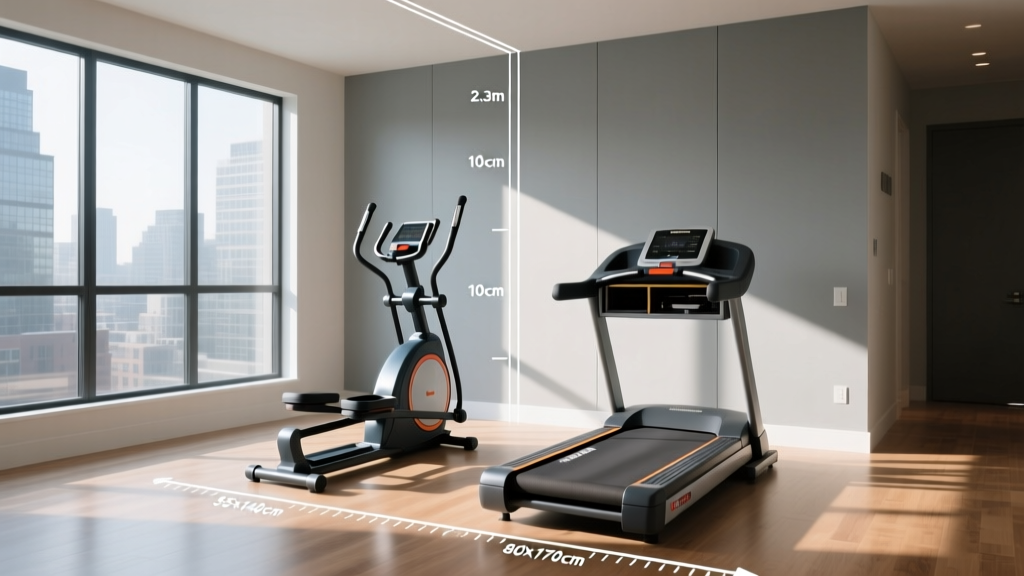
Elliptical vs Gym Treadmill: Home Space Layout Guide
Compare elliptical and gym treadmill footprints, ceiling clearances, and folding mechanisms to optimize your home cardio layout in 2026.

The Spatial Reality: Beyond the Brochure Dimensions
When homeowners decide to upgrade from a lightweight walking pad to a heavy-duty, commercial-style gym treadmill or a premium elliptical, the conversation usually revolves around motor horsepower, stride length, and interactive screens. However, as a fitness equipment layout specialist, I can tell you that the most common point of failure in home gym design is spatial geometry. A machine that looks perfect on a website can completely paralyze the flow of a 12x12 spare bedroom or violate the ceiling clearance of a finished basement.
In 2026, home cardio integration is about architectural harmony. Choosing between an elliptical and a gym treadmill requires a rigorous analysis of operational footprints, vertical step-up heights, structural floor loading, and safety corridors. This guide strips away the marketing fluff and provides the exact measurements, clearance formulas, and layout blueprints you need to make the right spatial decision for your home.
The Geometry of Movement: Static vs. Operational Footprints
Brochure dimensions are notoriously misleading. They typically list the 'static footprint'—the physical space the machine occupies when folded or at rest. But cardio equipment requires an 'operational footprint' that accounts for human biomechanics and safety buffers.
The Gym Treadmill Spread
A standard commercial-grade gym treadmill features a 20-inch by 60-inch running belt. However, the motor hood adds 12 to 15 inches to the front, and the side uprights and handrails push the total width to 34–37 inches. More importantly, the user's natural arm swing and lateral drift during a sprint require an additional 6 inches of lateral clearance on both sides to prevent knuckle-scraping against walls or furniture.
The Elliptical Stride Envelope
Ellipticals dictate space through their stride length (typically 18 to 20 inches) and crank mechanism. Front-drive ellipticals, like the Precor EFM835, have a longer horizontal footprint but a lower profile. Rear-drive models, such as the NordicTrack SpaceSaver SE9i, are more compact horizontally but require significant vertical clearance. Furthermore, the user's lateral sway on an elliptical is generally narrower than a runner's arm swing, allowing you to place an elliptical roughly 4 inches closer to a side wall than a treadmill.
⚠️ The Rear Safety Corridor Rule:According to fitness facility safety guidelines endorsed by the American Council on Exercise (ACE), you must maintain a minimum 36-inch clear drop-zone behind any motorized treadmill. If a user trips at 8 MPH, they will be ejected backward. Ellipticals, being low-impact and non-ejecting, only require a 12-inch rear clearance for maintenance access and ventilation.
The Vertical Clearance Trap: Calculating Ceiling Math
Nothing ruins a home gym investment faster than a user's head striking the ceiling during an incline sprint or a high-resistance elliptical climb. You must calculate the 'Peak User Height' based on the machine's elevation mechanics.
Treadmill Incline Geometry
A premium gym treadmill like the Matrix T75 offers a 15% incline. At maximum incline, the front of the deck rises approximately 12 inches. The deck itself sits 8 inches off the floor to house the motor and rollers. Therefore, the running surface at the front is 20 inches off the ground. Formula: User Height + 20 inches (deck/incline) + 5 inches (head clearance) = Minimum Ceiling Height. For a 6-foot (72-inch) user, you need a ceiling of at least 97 inches (8 feet, 1 inch).
Elliptical Step-Up Height
Ellipticals do not incline the deck, but they elevate the user via the pedal crank. A standard front-drive elliptical has a 'step-up height' of 10 to 15 inches at the peak of the stride. Formula: User Height + 15 inches (pedal peak) + 5 inches (head clearance) = Minimum Ceiling Height. For the same 6-foot user, the requirement is 92 inches (7 feet, 8 inches). This makes ellipticals vastly superior for basement gyms or rooms with low-hanging HVAC ductwork.
Structural Load, Vibration, and Floor Joists
Space optimization isn't just about square footage; it's about where the floor can safely support the dynamic load of the machine. Biomechanical studies highlighted by the Mayo Clinic note that running on a treadmill generates ground reaction forces equivalent to 2.5 to 3 times your body weight. A 200-pound runner creates a localized impact force of up to 600 pounds per footfall, occurring hundreds of times per minute.
If your gym is on a second floor with standard 16-inch on-center wooden joists, a heavy gym treadmill will cause severe harmonic vibration, rattling light fixtures and disturbing rooms below. Conversely, the Cleveland Clinic emphasizes the closed-kinetic-chain, low-impact nature of ellipticals. Because your feet never leave the pedals, the dynamic load is virtually equal to the static weight of the machine plus the user, making ellipticals the only safe choice for upper-floor layouts without structural reinforcement.
2026 Heavy-Duty Model Comparison Matrix
Below is a spatial comparison of top-tier cardio machines currently dominating the home market, analyzing their true operational demands.
| Machine Model (2026) | Type | Static Footprint (W x L) | Operational Clearance Needed | Weight & Floor Load | Est. Price |
|---|---|---|---|---|---|
| Sole F80 | Gym Treadmill (Folding) | 37' x 82' | 84' W x 130' L (incl. 36' drop zone) | 280 lbs (High Impact) | $1,199 |
| Matrix T75 | Gym Treadmill (Folding) | 34' x 80' | 82' W x 128' L | 345 lbs (High Impact) | $2,499 |
| NordicTrack SE9i | Rear-Drive Elliptical | 32' x 80' | 40' W x 92' L (12' rear buffer) | 225 lbs (Low Impact) | $1,299 |
| Bowflex Max Trainer M9 | Compact Elliptical/Stepper | 30' x 49' | 38' W x 65' L | 150 lbs (Low Impact) | $2,299 |
Power Routing and Cable Management Layouts
A frequently overlooked aspect of spatial design is power delivery. Gym treadmills with 4.0 CHP motors and massive HD touchscreens draw significant current, often requiring a dedicated 15-amp or 20-amp circuit to prevent tripping breakers when the motor surges during incline transitions. When mapping your room layout, the treadmill must be positioned within 4 feet of a grounded outlet to avoid using extension cords, which are a severe trip hazard and a violation of electrical safety codes for high-draw fitness equipment. Ellipticals, particularly magnetic resistance models, draw significantly less power and can often be placed further from outlets or even utilize self-generating power systems in premium 2026 models.
Room-Specific Layout Blueprints
The Garage Gym (High Ceilings, Concrete Slab)
Winner: Gym Treadmill. Garages typically feature 9-to-10-foot ceilings and concrete slabs that can absorb infinite impact force without vibration transfer. You can safely run a Matrix T75 at a 15% incline without spatial anxiety. Position the treadmill facing the garage door or a window to prevent the claustrophobic feeling of staring at a drywall partition during long endurance runs.
The Finished Basement (Low Ceilings, Support Pillars)
Winner: Elliptical. Basements often suffer from 7-foot to 8-foot ceilings, exposed HVAC ducts, and load-bearing pillars. A gym treadmill's incline mechanics and 8-inch deck height make it a head-strike liability here. A low-step-up elliptical like the Bowflex Max Trainer M9 fits perfectly into tight alcoves between support pillars, utilizing vertical space efficiently while keeping the user's head safely below the ductwork.
The Second-Floor Spare Bedroom (Standard Joists, Shared Walls)
Winner: Elliptical (with anti-vibration mat). Placing a 300-pound gym treadmill on a second-floor bedroom is an acoustic and structural nightmare for anyone in the rooms below. The harmonic resonance of a runner's footstrike will travel through the joists. An elliptical eliminates the impact force entirely. Place the machine in the corner of the room, directly over the intersection of the floor joists and the load-bearing wall, to maximize structural rigidity and minimize floor deflection.
Final Verdict: Let Your Architecture Decide
The debate between an elliptical and a gym treadmill shouldn't be settled solely by your fitness goals; it must be mediated by your floor plan. If your space offers robust structural support, high ceilings, and a generous 10-foot by 12-foot footprint with a 36-inch rear safety corridor, a commercial-grade gym treadmill remains the unmatched king of cardiovascular conditioning and bone-density loading. However, if you are designing a gym in a basement, an upper-level bedroom, or a tight urban apartment where every square inch and ceiling inch is heavily contested, the modern elliptical provides a biomechanically smooth, structurally safe, and spatially efficient alternative that refuses to compromise on calorie expenditure.
More gear to consider
All reviews
Is Walking Barefoot on a Treadmill Good for You? Cardio Care

NordicTrack T Series 8 Treadmill vs Rowers: Beginner Cardio Guide

Folding Treadmill Small Space Review & Heavy Duty Surge Protector

What Are Treadmills vs Stair Climbers? Home Buyer Guide
Kotia Treadmill Review: Best Budget Folding Pick for Small Spaces?
