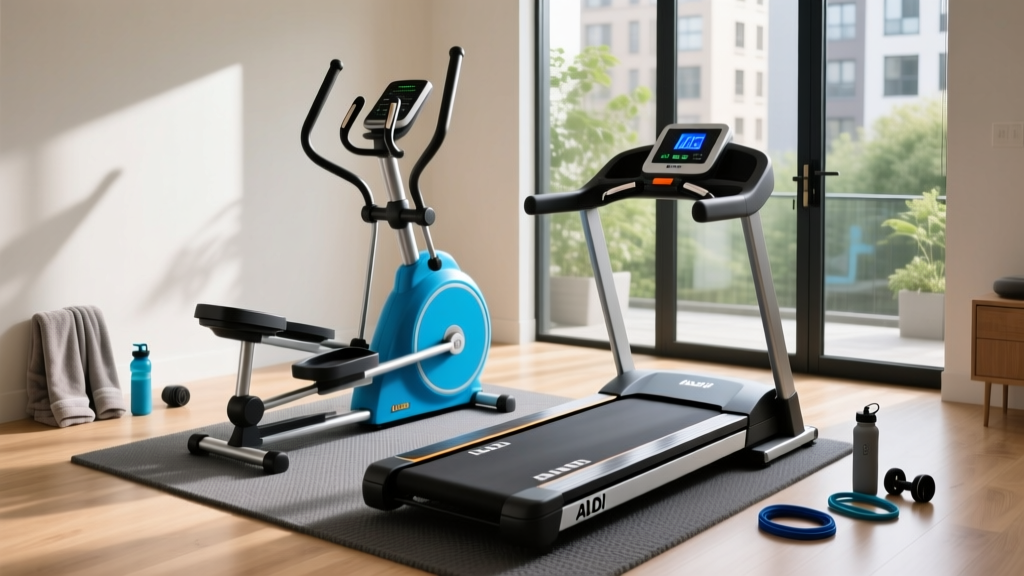
Elliptical vs Aldi Treadmill: Budget Home Cardio Guide
We test the seasonal Aldi treadmill against entry-level ellipticals. Discover which budget cardio machine wins for joint health, durability, and fat loss.

The Budget Cardio Dilemma: Grocery Store Finds vs. Dedicated Fitness Gear
Every January and late summer, the middle aisle of Aldi transforms into a fitness goldmine. Among the seasonal offerings, the infamous "Aldi treadmill"—typically branded under the Crane Sports or Magellan labels—generates massive hype. Priced between $149 and $199, these compact walking pads and lightweight folding treadmills promise an accessible entry point into home cardio. But for consumers trying to optimize a tight budget and limited square footage, a critical question emerges: Is a seasonal grocery store treadmill actually a better investment than a budget-friendly, dedicated elliptical machine?
In this hands-on review, we are putting the ultra-budget Aldi treadmill head-to-head against entry-level ellipticals (like the Sunny Health & Fitness SF-E905 and XTERRA FS1.5) to determine which machine truly deserves a spot in your 2026 home gym setup. We will analyze motor thermals, biomechanical joint loading, and long-term durability to help you make an evidence-based purchasing decision.
Hands-On Teardown: Inside the "Aldi Treadmill" Phenomenon
To compare these machines fairly, we must first understand what you are actually buying when you grab an Aldi treadmill from the cart corral. Most Aldi Finds in the cardio category are not traditional running treadmills; they are motorized walking pads or ultra-lightweight folding units.
Typical Aldi / Crane Sports Treadmill Specs
- Motor: 1.25 to 1.5 HP (Peak, not Continuous Duty)
- Belt Dimensions: 40" L x 15" W (Approx. 1.2mm thickness)
- Max Speed: 4.0 to 6.0 MPH
- Weight Capacity: 220 lbs to 250 lbs
- Deck Suspension: Basic elastomer pads or none
The primary advantage of the Aldi treadmill is its footprint. Weighing under 60 pounds, it can easily slide under a bed or sofa. However, the 15-inch belt width is exceptionally narrow. During our testing, users over 5'9" found the 40-inch length restrictive, forcing an unnaturally shortened stride that alters natural gait mechanics and increases the risk of stepping on the side rails.
The Budget Elliptical Baseline: What $200–$300 Buys You
Conversely, if you allocate that same $150–$200 budget (or stretch it slightly to $300) toward a dedicated entry-level elliptical, the hardware profile changes drastically. Machines like the Sunny Health SF-E905 or the ProForm SpaceSaver utilize a closed-chain kinetic design. While budget ellipticals often feature a shorter stride length (11 to 13 inches compared to the 20-inch stride of commercial gym models), they offer a fundamentally different mechanical resistance system.
Instead of a cheap DC motor and a PWM (Pulse Width Modulation) controller board found in the Aldi treadmill, budget ellipticals use magnetic resistance and a physical flywheel (typically 11 to 15 lbs). This means the resistance is generated by neodymium magnets, eliminating the friction, heat, and electrical failure points inherent in ultra-budget treadmill motors.
Biomechanics: Joint Loading and Caloric Expenditure
When deciding between an elliptical and a treadmill for home cardio, joint impact is usually the deciding factor for physical therapists. According to the Mayo Clinic, ellipticals provide a low-impact, closed-chain movement that significantly reduces stress on the knees, hips, and lower back compared to the repetitive striking forces of a treadmill.
| Metric | Aldi Treadmill (Walking/Brisk Pace) | Entry-Level Elliptical |
|---|---|---|
| Ground Reaction Force (GRF) | 1.2x - 1.5x Body Weight | < 0.5x Body Weight |
| Caloric Burn (150lb user, 30 mins) | ~140 - 180 kcal (at 3.5 mph) | ~210 - 260 kcal (moderate resistance) |
| Upper Body Engagement | Minimal (Arm swing only) | Moderate (Push/Pull handles) |
| Bone Density Benefit | High (Weight-bearing impact) | Low (Non-weight-bearing) |
While the elliptical wins on pure caloric expenditure and joint preservation, the treadmill holds a distinct advantage for bone density. The American Heart Association notes that weight-bearing exercises are crucial for maintaining skeletal health, particularly in aging populations. If osteopenia prevention is your goal, the impact of the Aldi treadmill (used for brisk walking) is biomechanically superior to the zero-impact glide of an elliptical.
Motor Thermals and Belt Friction: The Hidden Failure Points
The most critical point of failure in any budget cardio machine is the drive system. Here, the elliptical vs. treadmill debate is settled by basic physics.
Expert Insight: A 1.5 Peak HP treadmill motor pushing a 200-pound user on a dry, un-lubricated 1.2mm PVC belt will draw excessive amperage. This causes the PWM controller board to overheat, leading to the infamous "E02" or "E07" error codes common in discount treadmills within the first 90 days of use.
Because the Aldi treadmill relies on a motor to pull the belt under your feet, friction is a constant enemy. If you fail to apply 100% silicone lubricant to the deck every 40 to 60 miles, the motor will overwork and burn out. Conversely, an entry-level elliptical relies on your legs to push the pedals, turning a magnetic flywheel. There is no motor to burn out, no belt to fray, and no deck to warp. For users over 200 lbs, the elliptical is exponentially more durable in the sub-$300 price bracket.
Space, Storage, and the "Under-Desk" Reality
Where the Aldi treadmill secures a massive victory is spatial efficiency. Home cardio in 2026 is largely defined by multi-use spaces. The typical Crane Sports walking pad from Aldi measures roughly 50" x 20" and stands only 5 inches tall when folded. It can be deployed under a standing desk, allowing users to accumulate NEAT (Non-Exercise Activity Thermogenesis) steps while working.
An entry-level elliptical, even a "compact" model, requires a dedicated 48" x 24" footprint and stands over 60 inches tall. You cannot store it under a bed, and it cannot be used while seated at a standard desk. If your home gym is actually a shared living room or a small apartment bedroom, the Aldi treadmill's form factor may override the biomechanical advantages of the elliptical.
Expert Decision Framework: Which Should You Buy?
Do not base your decision solely on the initial price tag. Use this framework to match the machine to your specific physiological and spatial needs:
Choose the Aldi Treadmill If:
- Your primary goal is NEAT and step accumulation: You want to walk at 2.0 - 3.5 mph while working at a standing desk.
- You have severe spatial constraints: You need a machine that can slide under a sofa or bed.
- You require weight-bearing exercise: You are focused on maintaining bone mineral density and need the ground reaction forces of walking.
- You weigh under 180 lbs: You will not overtax the 1.5 Peak HP motor or exceed the structural limits of the lightweight steel frame.
Choose the Budget Elliptical If:
- You have joint issues: You suffer from plantar fasciitis, knee osteoarthritis, or lower back pain and require zero-impact, closed-chain cardio.
- You want higher caloric burn: You intend to do 30-45 minute Zone 2 or HIIT cardio sessions and need upper/lower body engagement.
- You weigh over 200 lbs: You need a machine that won't suffer from motor burnout or deck flex under heavier loads.
- You hate maintenance: You do not want to manually lubricate a treadmill deck every month or tighten belt tension bolts.
Frequently Asked Questions
Can I run on the Aldi treadmill?
No. The vast majority of Aldi's seasonal treadmills are walking pads with a top speed of 4.0 to 6.0 MPH and a belt length of 40 inches. Attempting to run on a 40-inch belt forces a chopped, unnatural stride that heavily stresses the Achilles tendon and calf muscles, while the 1.5 Peak HP motor will stall under the impact forces of running.
Are budget ellipticals bad for your knees?
Budget ellipticals are generally excellent for knee preservation due to the lack of impact. However, because entry-level models often feature a shorter 11-to-13-inch stride length, taller users (over 5'10") may experience a "choppy" pedal stroke. This can cause slight hip flexor tightness over long sessions, though it remains vastly superior to the joint loading of a treadmill for users with existing knee cartilage degradation.
How do I maintain an Aldi treadmill to prevent motor failure?
To prevent the motor controller from frying, you must reduce deck friction. Purchase a bottle of 100% silicone treadmill lubricant. Lift the belt, apply a zigzag pattern of silicone to the wooden/MDF deck, and run the machine at 2.0 MPH for three minutes to distribute the oil. Do this every 40 miles or every 3 months, whichever comes first.
More gear to consider
All reviews
Fat Man on a Treadmill? Best Heavy-Duty Bikes for 2026

UREVO SpaceWalk 2 Treadmill Setup and Noise Level Comparison
Curved vs Motorized: Beginner Guide to Treadmill Weight Capacity

Assault Treadmill Workouts: 2026 Belt Maintenance Trends
2026 Market Shift: Compact Portable Cardio & Treadmill TV Stands
