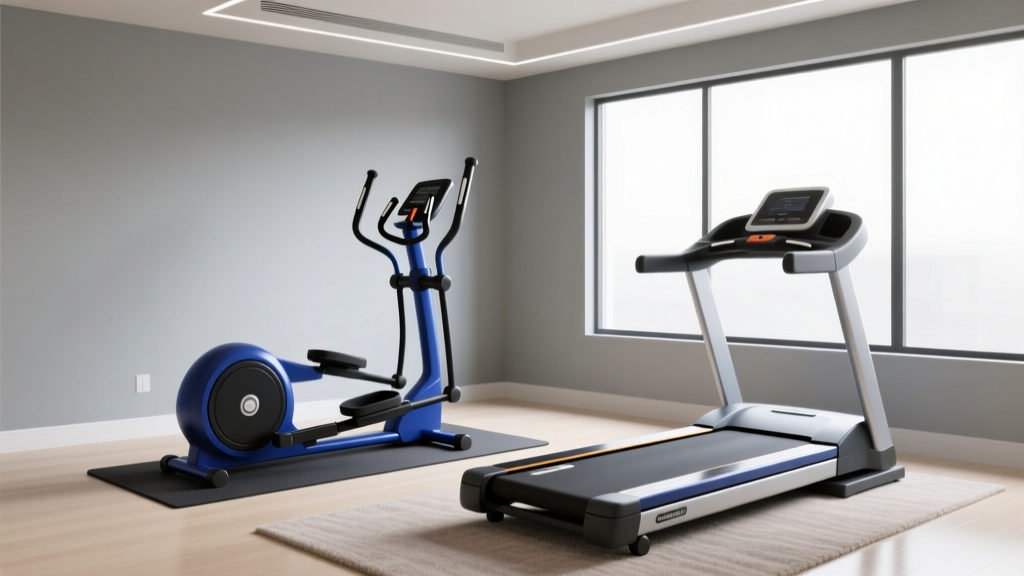
Elliptical vs Treadmill Layout: Can a Treadmill Go on Carpet?
Compare elliptical vs treadmill for home gym layouts. Learn space requirements, ceiling clearance, and if a treadmill can go on carpet safely.

Designing a home gym in 2026 requires more than just picking the cardio machine with the best interactive display; it demands a rigorous evaluation of your spatial geometry, flooring infrastructure, and traffic flow. When debating the classic elliptical vs treadmill for home cardio, most buyers focus purely on biomechanics or calorie burn. However, as spatial optimization experts, we must look at the physical reality of your room. A machine that perfectly matches your fitness goals might be a structural nightmare for your spare bedroom.
Below, we break down the exact spatial requirements, flooring constraints, and layout strategies for both machines, answering one of the most critical installation questions we receive: can a treadmill go on carpet?
The Spatial Showdown: Footprint vs. Operational Clearance
The 'footprint' of a machine is merely its static dimensions. The 'operational clearance' is the actual space required to use the machine safely without kicking a wall or trapping yourself against a door. According to Consumer Reports, failing to account for operational clearance is the leading cause of home gym equipment returns and safety incidents.
| Dimension / Metric | Premium Treadmill (e.g., NordicTrack 1750) | Premium Elliptical (e.g., Sole E95) |
|---|---|---|
| Static Length | 81 inches | 82 inches |
| Static Width | 38 inches | 31 inches |
| Front Clearance (Safety Dismount) | 24 inches minimum | 12 inches minimum |
| Rear Clearance (Belt Ejection) | 30 inches minimum | 18 inches (for rear-drive stride) |
| Lateral Clearance (Arm Swing) | 12 inches each side | 24 inches each side (moving arms) |
Expert Insight: While the elliptical has a slightly narrower static width, its moving handlebars demand significantly more lateral clearance. If you are placing your machine in a narrow hallway or a tight alcove (less than 6 feet wide), a treadmill is actually the superior spatial choice, provided you have the length.
Flooring Dynamics: Can a Treadmill Go on Carpet?
This is the most frequent layout question we field from renters and homeowners with wall-to-wall carpeting. The short answer is: No, a treadmill should never be placed directly on carpet without a specialized barrier.
While an elliptical can technically sit on carpet (though not ideally), treadmills present unique mechanical vulnerabilities when placed on plush or even medium-pile flooring.
⚠️ Motor Suffocation & Static Risks
Treadmill motors rely on internal fans that pull air through vents located near the base of the deck. Carpet fibers act as an insulator and a physical choke-point, suffocating the motor and leading to premature thermal shutdown. Furthermore, the continuous friction of the treadmill belt generates significant static electricity. On carpet, this static can arc into the machine's lower control board, frying the console—a repair that typically costs between $250 and $400.
The Elliptical Point-Load Factor
Ellipticals do not have the same motor-suction issues, but they suffer from 'point-load' damage. An elliptical weighing 220 lbs, combined with a 180 lb user in mid-stride, concentrates over 400 lbs of dynamic force onto four small leveling feet. On carpet, these feet will crush the pad, dent the subfloor, and cause the machine to wobble violently during high-resistance intervals.
The 2026 Flooring Solution: For both machines, you must invest in a high-density vulcanized rubber mat (at least 3/8-inch thick). For treadmills on carpet, a mat like the Supermats 13GS (approx. $110) is non-negotiable. It distributes the weight, prevents carpet fibers from entering the belt track, and grounds the static charge.
Vertical Real Estate: The Ceiling Height Trap
When optimizing a room layout, vertical space is frequently ignored until the user's head grazes the ceiling fan. The Mayo Clinic notes that ellipticals provide superior low-impact benefits for joint health, but they come with a hidden spatial tax: vertical clearance.
- Treadmill Step-Up Height: The deck of a standard folding treadmill sits 8 to 10 inches off the floor. Add your height, plus 2 inches for running bounce. (Formula: Ceiling Height - User Height - 12 inches > 0).
- Elliptical Pedal Arc: Elliptical pedals sit 12 to 15 inches off the ground at their lowest point. However, at the peak of the stride, the pedal can rise an additional 10 to 14 inches.
If you are 6'0" (72 inches) and want to use a rear-drive elliptical with a 14-inch peak pedal height, you need a minimum ceiling height of 86 inches (7'2") just to maintain a 2-inch safety buffer. Treadmills are vastly superior for rooms with low ceilings, such as finished basements or attic conversions.
Room Layout & Traffic Flow Strategies
Integrating heavy cardio equipment into a multi-use space requires strategic placement. Follow this step-by-step layout protocol to optimize your room's flow:
- Map the Door Swing: Never place a machine in the swing radius of an inward-opening door. If a user falls or needs to dismount quickly, an obstructed exit is a severe hazard.
- Window Proximity & Glare: Position treadmills perpendicular to windows. Facing a window causes severe screen glare on interactive touchscreens, while facing away casts a shadow on the display. Ellipticals are less dependent on screens for pacing, making them more flexible near natural light sources.
- Acoustic Zoning: Treadmills generate rhythmic, low-frequency impact vibrations that travel through floor joists. If your gym is on a second floor above a living area, place the treadmill on an interior load-bearing wall, never in the center of the room. Ellipticals, being zero-impact, are the mandatory choice for upper-floor apartments or shared townhomes.
- The 'Visual Weight' Rule: Treadmills are visually massive and dominate a room. To prevent the space from feeling cramped, place the treadmill in the furthest corner from the entryway. Ellipticals, with their open-frame designs, can be placed closer to the center of the room without creating a claustrophobic effect.
Final Verdict: Matching Machine to Room Geometry
Choosing between an elliptical and a treadmill for home cardio shouldn't be decided by fitness metrics alone; it must be dictated by your architectural constraints.
Choose the Treadmill if: Your room has low ceilings (under 8 feet), narrow lateral width (under 6 feet), or if you are installing the machine on a ground-floor concrete slab where impact noise is not an issue. Just remember that if you are asking, can a treadmill go on carpet?, the answer requires a heavy-duty rubber mat to protect your investment.
Choose the Elliptical if: You have high ceilings (8.5 feet or more), wide open lateral space for moving handlebars, or if your home gym is located on an upper floor where impact vibration would disturb household members below.
By respecting the operational clearances, flooring dynamics, and vertical requirements outlined above, you will create a home cardio space in 2026 that is both structurally sound and optimized for long-term fitness success.
More gear to consider
All reviews
Flex Select Treadmill Buying Guide: Feature Comparison & Fixes

Assault vs Air Bike & Horizon Fitness T101 Connect Treadmill
Stair Climber Guide: Home Cardio vs Treadmill ECG Test Singapore Price

Nordic Track Treadmill T6.5s vs Under Desk Pads: 2026 Office Value
