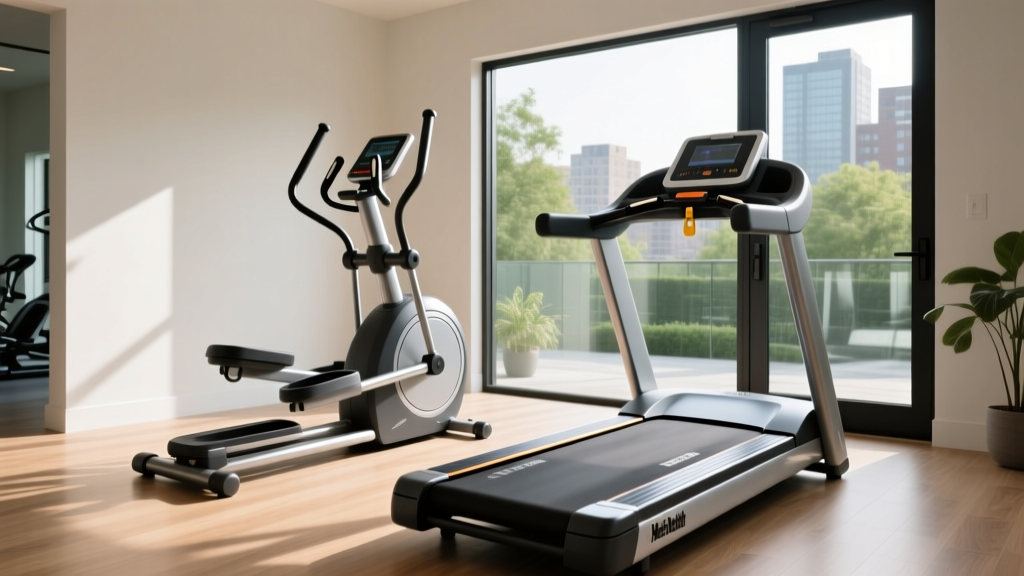
Elliptical vs Treadmill: Maintenance & Treadmill Calorie Loss
Compare elliptical vs treadmill for home cardio. Discover maintenance tips, longevity costs, and how upkeep impacts true treadmill calorie loss.

The Home Cardio Debate: Beyond the Showroom Floor
When outfitting a home gym, the debate between an elliptical and a treadmill usually centers on joint impact versus weight-bearing bone density. However, as of 2026, the most critical factor separating a lifelong fitness investment from an expensive clothes rack is long-term mechanical maintenance. At FitGearPulse, we evaluate cardio equipment not just on day one, but on day one thousand. How a machine degrades directly affects its biomechanical output, its longevity, and—crucially—the accuracy of your performance metrics, including your treadmill calorie loss calculations.
While the CDC Physical Activity Guidelines recommend at least 150 minutes of moderate-intensity aerobic activity weekly, achieving this consistently requires reliable equipment. In this deep-dive guide, we compare the maintenance realities, edge-case failure modes, and long-term costs of mid-range treadmills (like the Sole F80 or NordicTrack T Series) versus ellipticals (like the Schwinn 430 or Bowflex Max Trainer series), revealing how mechanical wear secretly sabotages your fitness data.
The Mechanical Reality: Friction vs. Rotation
To understand maintenance, you must first understand the primary forces acting on each machine. Treadmills are high-friction environments. The continuous sliding of a PVC or urethane belt over a wooden or composite deck generates significant heat and physical wear. Ellipticals, conversely, operate on rotational mechanics, relying on pivot bearings, drive belts, and magnetic resistance systems.
Treadmill Degradation Vectors
- Belt and Deck Friction: Without proper lubrication, the coefficient of friction increases, forcing the motor to draw more amps to maintain speed.
- Stretch and Slippage: Over 200-300 miles, the belt's cotton/polyester core stretches, leading to roller slippage.
- Dust Ingestion: The motor's cooling fan acts as a vacuum, pulling dust and pet hair into the motor control board (MCB) housing.
Elliptical Degradation Vectors
- Pivot Point Wear: The pedal arms and crank joints endure high-torque lateral forces, causing factory grease to break down and plastic bushings to warp.
- Rail Pitting: For rear-drive ellipticals with wheels on tracks, microscopic dust embeds into the rail, causing a grinding sensation.
- Drive Belt Stretch: The internal ribbed belt connecting the pedals to the flywheel can lose tension, resulting in a 'dead spot' at the top of the pedal stroke.
Maintenance Matrix: Time, Cost, and Effort
Below is a comparative breakdown of the annual maintenance required to keep a mid-range treadmill ($1,000–$1,800) and a mid-range elliptical ($800–$1,500) operating at factory specifications.
| Maintenance Task | Machine Type | Frequency | Time Required | Estimated Annual Cost |
|---|---|---|---|---|
| Belt Lubrication (100% Silicone) | Treadmill | Every 150 miles / 3 months | 10 minutes | $12 - $15 |
| Belt Tension & Alignment Adjustment | Treadmill | Every 6 months | 15 minutes | $0 (Requires Allen wrench) |
| Motor Hood Vacuuming | Treadmill | Every 3 months | 5 minutes | $0 |
| Pivot Point Greasing (White Lithium) | Elliptical | Every 6 months | 20 minutes | $8 - $12 |
| Rail Cleaning & Silicone Wipe | Elliptical (Rear-Drive) | Monthly | 5 minutes | $10 |
| Drive Belt Tensioning | Elliptical | Annually | 45 minutes (Requires partial disassembly) | $0 |
The Hidden Metric: How Wear Alters Treadmill Calorie Loss
Many home gym users obsess over maximizing their treadmill calorie loss, but few realize that mechanical degradation can completely invalidate the numbers flashing on their console. To understand why, we must look at how consoles calculate energy expenditure.
Most treadmills use algorithms based on the American College of Sports Medicine (ACSM) metabolic equations, which estimate calories burned using Metabolic Equivalent of Task (MET) values factored against your inputted body weight, belt speed, and incline angle. However, this assumes the machine is perfectly calibrated.
The Slippage Effect and False Data
When a treadmill belt stretches and loses tension, the front drive roller can slip against the belt during the high-impact phase of your footstrike. The machine's optical encoder measures the RPMs of the motor flywheel, not the actual distance the belt travels. If the roller slips by just 3% per stride, the console might register that you ran 3.0 miles at 6.0 MPH, while you actually traveled 2.91 miles. Because the console calculates treadmill calorie loss based on the artificially inflated distance and speed, your reported caloric burn can be overestimated by 5% to 9%. You are effectively eating back 'ghost calories' that you never actually burned.
Elliptical Inefficiency: The Under-Reported Burn
Ellipticals face the opposite problem. They calculate energy expenditure by measuring the electrical wattage generated or consumed by the magnetic braking system. If the pedal arm pivot bearings dry out and mechanical friction increases, your body must work significantly harder to push through the 'dead spots' in the pedal ellipse. Your actual biological treadmill calorie loss equivalent (your metabolic output) skyrockets due to this mechanical inefficiency, but the console's wattage sensor only measures the magnetic brake load. Consequently, a poorly maintained elliptical will severely under-report your actual caloric expenditure.
'Accurate fitness tracking relies on mechanical calibration. A machine fighting its own friction alters user biomechanics and invalidates console algorithms, leading to significant discrepancies in reported energy expenditure.' — American Council on Exercise (ACE) Continuing Education Insights.
Edge Cases and Catastrophic Failures
Routine maintenance prevents catastrophic edge-case failures that often total budget and mid-range cardio machines. Here are the most common fatal flaws we see in home gyms by year three.
WARNING: Treadmill MCB FailureThe Motor Control Board (MCB) regulates power to the drive motor. When a treadmill deck is starved of silicone lubrication, the friction generates excessive heat, which is pulled directly into the motor hood. Combined with household dust, this heat bakes the MCB's capacitors. An MCB replacement typically costs between $180 and $320 for parts alone, and often requires a certified technician. A $12 bottle of silicone prevents this $300+ failure mode.
The Elliptical Plastic Bushing Shear
On ellipticals priced under $900 (such as entry-level models from Horizon or ProForm), manufacturers often use high-density plastic bushings instead of sealed steel ball bearings at the main crank and pedal arm joints. Over 18 to 24 months of heavy use, the lateral torque causes these bushings to oval out and eventually shear. When this happens, the pedal arm develops a severe side-to-side wobble, rendering the machine unsafe for knee and hip joints. While some bushings can be replaced for $30, the labor involves completely dismantling the drivetrain.
Longevity Verdict: Which Survives the Home Gym Environment?
When adhering to the American Heart Association's recommendations for consistent cardiovascular health, your equipment must be ready when you are. The choice between an elliptical and a treadmill ultimately comes down to your willingness to perform mechanical upkeep.
- Choose the Treadmill If: You prioritize weight-bearing bone density, prefer the biomechanics of outdoor running, and are diligent about vacuuming the motor hood and lubricating the deck every 90 days. A well-maintained mid-range treadmill (like the Sole F80) will easily last 7 to 10 years, providing highly accurate treadmill calorie loss metrics and superior cardiovascular conditioning.
- Choose the Elliptical If: You require low-impact rehabilitation, have limited floor space (for compact models), and prefer a 'set it and forget it' maintenance schedule. While you must occasionally grease the pivot points, ellipticals lack the high-heat, high-friction deck environment that kills treadmill motors. A quality magnetic elliptical can easily surpass a decade of use with minimal mechanical intervention.
Ultimately, the true cost of home cardio isn't just the sticker price; it's the time and money invested in preserving the machine's integrity. By understanding the mechanical realities of your equipment, you ensure that every drop of sweat translates into accurate data and genuine cardiovascular progress.
More gear to consider
All reviews
Best "Butt Treadmill" Showdown: Incline vs. Curved Manual (2026)
Vision Fitness T8500 Treadmill: 2026 Premium Buying Guide

Walking Pad Setup: Avoid the Classic Treadmill Cartoon Chaos

Is the WellFit Treadmill Legit? 2026 Portable Cardio Analysis

Starting Treadmill Running vs Stair Climber: Home Guide & Mistakes
