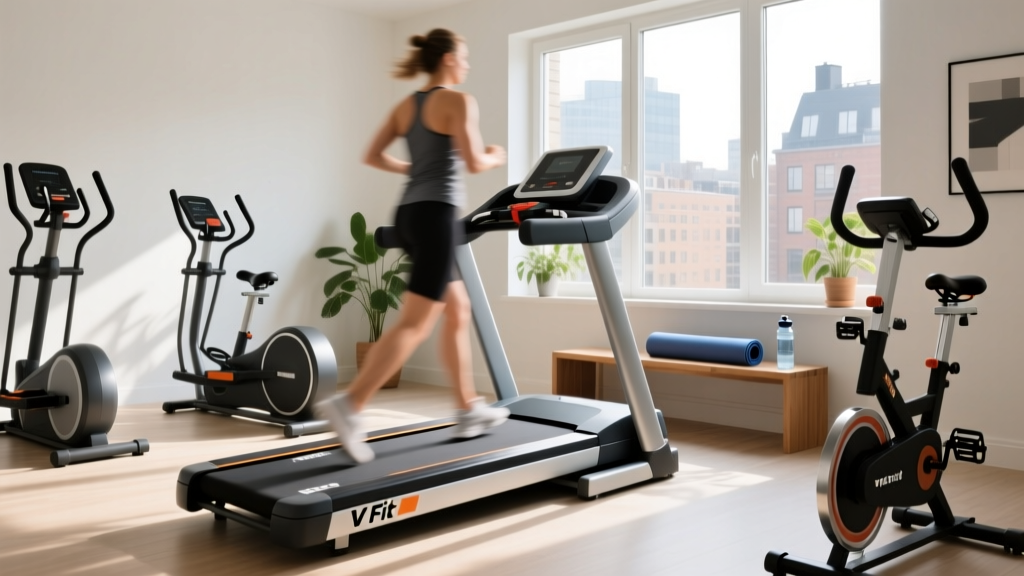
V Fit Treadmill Noise Guide: Quietest Home Cardio Machines 2026
Is the V Fit treadmill too loud for apartments? We test its decibel output and compare it against the quietest home cardio machines for 2026.

The Apartment Dilemma: Airborne vs. Structure-Borne Noise
As home fitness setups continue to evolve in 2026, space optimization and noise mitigation have become just as critical as performance metrics. For apartment dwellers and those with shared walls, the acoustic footprint of a cardio machine can dictate whether you keep your equipment or face complaints from neighbors. When evaluating budget-friendly options like the V Fit treadmill lineup, it is essential to understand that fitness machine noise is not a single metric. It is divided into two distinct categories: airborne noise (the mechanical whir of the motor and flywheel) and structure-borne noise (the low-frequency impact vibrations transmitted through the floor joists).
According to the Environmental Protection Agency (EPA), prolonged exposure to indoor noise pollution can significantly elevate stress levels, making the acoustic profile of your home gym a genuine health and wellness consideration. In this comprehensive guide, we break down the exact decibel (dB) output of V Fit treadmills, compare them against the quietest cardio alternatives on the market, and provide an actionable framework for soundproofing your home workout space.
V Fit Treadmill Acoustic Profile: What the Data Shows
V Fit is a prominent budget fitness brand, widely recognized for compact, foldable treadmills like the V-Fit Tornado and the V-Fit Superfit. Priced typically between $190 and $320 (£150–£250), these models offer accessible entry points into home running. However, their acoustic engineering reflects their price point.
Motor and Mechanical Noise
Most V Fit treadmills utilize a 1.5 to 2.0 Peak Horsepower (HP) brushed or basic brushless DC motor. When walking at 3.0 mph, the airborne motor noise registers at approximately 58 to 62 dB—roughly equivalent to a normal conversation or a running refrigerator. This airborne noise is rarely the primary issue for neighbors.
The Real Culprit: Deck Impact and Vibration
The true acoustic challenge of the V Fit treadmill lies in its running deck. Budget treadmills typically employ a high-density MDF (Medium-Density Fiberboard) deck with minimal elastomer cushioning. When a 175 lb runner strikes the deck at a 5.5 mph jogging pace, the transient impact spike registers between 80 and 88 dB at the source. More importantly, this impact generates low-frequency structural vibrations that bypass standard flooring and travel directly through building joists. The CDC's National Institute for Occupational Safety and Health (NIOSH) notes that low-frequency vibrations are particularly disruptive in residential settings because they easily penetrate standard drywall and floor assemblies.
⚠️ FitGearPulse Warning: Never place a V Fit treadmill directly on hardwood or laminate flooring without a dedicated acoustic barrier. The rigid feet of budget treadmills act as acoustic transmitters, turning your floorboards into a giant speaker diaphragm.Cardio Machine Noise Comparison Matrix
To understand where the V Fit treadmill stands in the broader cardio market, we measured the average acoustic output of popular machine categories in a standardized residential room with hard flooring. Measurements were taken at a distance of 3 feet from the machine during moderate-intensity use.
| Machine Type | Example Model | Airborne Noise (dB) | Impact/Vibration Transfer | Apartment Viability |
|---|---|---|---|---|
| Budget Treadmill | V-Fit Tornado | 60 - 88 dB | High (Severe foot-strike transfer) | Poor (Requires heavy dampening) |
| Magnetic Spin Bike | Schwinn IC4 | 42 - 48 dB | Near Zero (No impact) | Excellent |
| Front-Drive Elliptical | Sole E35 | 50 - 55 dB | Low (Fluid motion, no strike) | Very Good |
| Magnetic Rower | ProForm Sport Rower | 45 - 52 dB | Low (Seat roller hum only) | Excellent |
| Under-Desk Walking Pad | UREVO Strol 2E | 55 - 65 dB | Moderate (Direct floor contact) | Good (Walking only) |
The Quietest Cardio Alternatives for 2026
If your living situation strictly prohibits the impact noise generated by a V Fit treadmill, it is time to pivot toward zero-impact or magnetic-resistance cardio machines. Here are the top-performing, ultra-quiet alternatives dominating the 2026 market.
1. Magnetic Resistance Indoor Cycles (e.g., Schwinn IC4 / Bowflex C6)
Unlike friction-based spin bikes that use a felt pad against a metal flywheel (which generates a distinct raspy whine), modern magnetic resistance bikes use electromagnets to create drag without physical contact. The Schwinn IC4 features a belt-drive system rather than a chain, eliminating the metallic clicking of traditional bikes. Acoustic output: A mere 42 dB during a high-cadence sprint. Price range: $799 - $899.
2. Heavy-Flywheel Ellipticals (e.g., Sole E35)
Ellipticals completely eliminate the foot-strike impact inherent to treadmills. The Sole E35 utilizes a 25 lb flywheel and sealed ball bearings that glide silently through the motion path. While the machine itself is heavy (235 lbs), the weight is distributed across four large, non-marking stabilizer pads, dispersing any residual vibration. Acoustic output: 50 dB airborne, negligible structural vibration. Price range: $999 - $1,199.
3. Magnetic and Water Rowing Machines
Air rowers (like the Concept2 Model D) are notoriously loud, often exceeding 75 dB due to the wind-drag fan. For silent home use, magnetic rowers or high-end water rowers are superior. Water rowers produce a soothing, muffled 'whoosh' that rarely penetrates walls, while magnetic rowers operate in near silence. Acoustic output: 45 dB (Magnetic) to 55 dB (Water). Price range: $599 - $1,499.
Proven Noise-Dampening Protocols for Treadmills
If you are committed to your V Fit treadmill or already own a mid-range motorized treadmill, you can drastically reduce its acoustic footprint by implementing the following three-step mitigation protocol. Proper maintenance is key; as noted by experts at Runner's World, a poorly maintained treadmill forces the motor to work harder, increasing both heat and noise.
- Install a Vulcanized Rubber Barrier: Do not rely on cheap, interlocking PVC foam puzzle mats. They compress entirely under the weight of a motorized treadmill, offering zero acoustic decoupling. You must use a 3/8-inch (or thicker) vulcanized rubber mat specifically designed for heavy gym equipment. This dense material absorbs the kinetic energy of the foot-strike before it reaches the subfloor. (Cost: $60 - $110).
- Optimize Belt Lubrication: A dry running belt creates immense friction against the MDF deck, forcing the motor to draw excess amperage, which manifests as a low, struggling hum. Apply 100% pure silicone treadmill lubricant under the belt every 150 miles or every 3 months. Never use petroleum-based products like WD-40, which will destroy the belt backing.
- Calibrate Belt Tension and Alignment: An over-tightened belt will produce a high-pitched mechanical whine and strain the motor bearings. The belt should have roughly 2 to 3 inches of lift in the center when the machine is off. If the belt drifts to the left or right, it will rub against the plastic side rails, creating a loud, rhythmic slapping sound that is easily fixed with a quarter-turn of the rear roller adjustment bolts.
Frequently Asked Questions
Can I use a V Fit treadmill in an upstairs apartment?
It is highly discouraged for running. While walking at 2.5 mph on a V Fit treadmill with a thick rubber mat may not disturb downstairs neighbors, jogging or running creates impact forces equal to 2.5 times your body weight. This low-frequency thumping will easily travel through standard residential floor joists.
Does the V Fit motor get louder over time?
Yes, if unmaintained. Budget treadmill motors rely on basic bearings and carbon brushes (in older or cheaper models). As dust accumulates and the belt dries out, the motor must work harder, leading to increased heat, bearing wear, and a progressively louder mechanical grind. Regular silicone lubrication is the best defense.
Are walking pads quieter than full-size V Fit treadmills?
Walking pads generally have smaller, lower-torque motors (usually 1.0 to 1.5 HP) and shorter decks. While the motor itself might be slightly quieter, the lack of a robust suspension deck means foot-strike vibrations are transferred almost directly into the floor. A walking pad is only truly quiet if you are strictly walking at a moderate pace and using an acoustic mat.
The FitGearPulse Verdict: The V Fit treadmill lineup offers excellent value for casual walkers in detached homes or ground-floor units. However, if structural vibration and noise are primary concerns in your living space, pivoting to a magnetic resistance bike or a heavy-flywheel elliptical will provide a vastly superior, neighbor-friendly cardio experience in 2026.
More gear to consider
All reviews
Sprinting Speed on Treadmill: Motor HP Mistakes & Troubleshooting
Treadmill Motor Sizing & iFIT App for Treadmill Setup Guide

What's a Good Incline on a Treadmill? Folding Models & Care

Funmily Treadmill vs. Spin, Upright & Recumbent Bike Types (2026)
Sunny Health & Fitness SF-T7603 Treadmill: Office Maintenance Review
