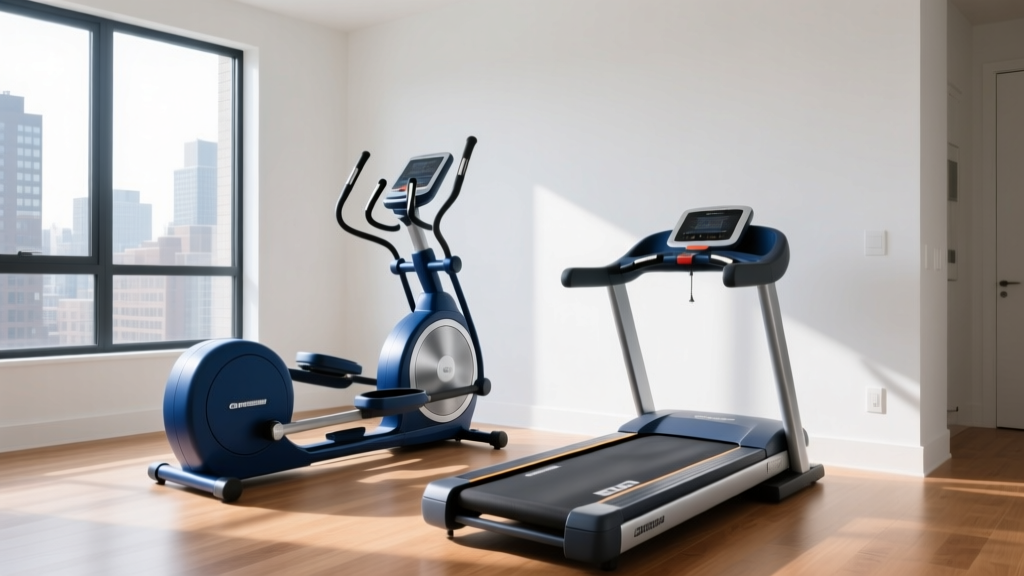
Elliptical vs Treadmill: Are Treadmills Accurate for Distance?
Comparing ellipticals and treadmills for home layouts. We explore space optimization and answer: are treadmills accurate for distance tracking?

The Home Gym Geometry Dilemma in 2026
When designing a dedicated home cardio zone, the debate between an elliptical and a treadmill extends far beyond joint impact and caloric burn. As home fitness layouts become more sophisticated in 2026, spatial geometry, traffic flow, and data fidelity are the true deciding factors. You are not just buying a machine; you are integrating a massive piece of mechanical engineering into your living space. Furthermore, as athletes and casual users alike demand precise metrics for their training zones, a critical question frequently arises: are treadmills accurate for distance compared to their elliptical counterparts? This guide breaks down the exact spatial requirements, safety buffers, and telemetry accuracy of both machines to help you optimize your home layout.
Spatial Geometry: Footprints and Vertical Clearances
Before evaluating data accuracy, your room's physical dimensions will likely make the decision for you. Treadmills and ellipticals interact with three-dimensional space in fundamentally different ways.
The X and Y Axis: Floor Footprint
Most premium home treadmills, such as the Sole F80 (priced around $1,499 in 2026) or the NordicTrack Commercial 1750 ($2,499), require a dedicated floor footprint of approximately 78 inches long by 35 inches wide. Ellipticals like the Sole E35 ($1,399) boast a slightly narrower width of 29 inches but often require a longer operational footprint of up to 82 inches to accommodate the full forward extension of the stride pedals and arm levers.
- Treadmills demand strict rectangular clearance but keep the user contained within the side rails.
- Ellipticals require lateral buffer space. The moving arm levers and the natural side-to-side sway of the user during high-resistance climbs mean you must add at least 6 to 8 inches of clearance on both sides to prevent drywall scuffs.
The Z Axis: Ceiling Height and Incline Physics
This is where most home gym planners fail. A standard treadmill deck sits 8 to 10 inches off the floor. When you add a 15% motorized incline, the front of the deck raises an additional 10 to 12 inches. If you are 6 feet tall (72 inches), your total operational height at maximum incline becomes roughly 94 inches. If your basement ceiling is 8 feet (96 inches), you have a mere 2 inches of headroom, which feels claustrophobic and dangerous during a sprint. Ellipticals, conversely, keep the user's feet at a fixed 12-to-15-inch step-up height regardless of the resistance or simulated incline, making them the undisputed champions of low-ceiling environments.
Are Treadmills Accurate for Distance? (The Calibration Reality)
To answer the core question—are treadmills accurate for distance—we must look at how these machines calculate telemetry. Treadmills do not use GPS; they use a mathematical formula based on the belt's physical length and the number of motor revolutions. When a treadmill is brand new, this distance tracking is highly accurate, typically falling within a 1% margin of error.
However, rubber belts stretch. Over the first 6 to 12 months of heavy use, a standard 2-ply treadmill belt can stretch by up to 2 or 3 inches. If the machine's internal computer still assumes the original, shorter belt length, it will overestimate your distance. A 3-mile run on an uncalibrated, stretched belt might actually be 2.92 miles. Furthermore, as highlighted by the American Heart Association, accurate tracking is vital for maintaining targeted cardiovascular zones, making routine calibration a necessity for serious runners.
The Elliptical 'Ghost Mile' Phenomenon
Ellipticals calculate distance based on flywheel RPMs and a factory-programmed stride length (usually 20 inches). Because there is no physical belt covering a set distance, ellipticals are notorious for 'ghost miles.' If a user 'floats' over the pedals without pressing through the full range of motion, or if their body weight forces the pedals down faster than the flywheel's natural momentum, the console will register distance that does not accurately reflect the biomechanical work performed. In comparative tests, ellipticals tend to overestimate distance by 5% to 10% compared to actual GPS-tracked equivalent work.
| Metric | Motorized Treadmill | Front-Drive Elliptical |
|---|---|---|
| Distance Calculation | Belt length x Motor revolutions | Flywheel RPM x Fixed stride formula |
| Out-of-Box Accuracy | 98% - 99% | 90% - 95% |
| Degradation Over Time | Belt stretch causes 1-3% overestimation | Bearing wear causes slight RPM lag |
| User Calibration Required? | Yes (Annually) | No (Factory locked) |
Step-by-Step: How to Calibrate Treadmill Distance
If you suspect your treadmill is lying to you about your mileage, perform this 10-minute calibration test:
- Measure the Belt: Use a tape measure to find the exact length of the running surface. Multiply this by the width to understand the total surface area, but focus on the length.
- Mark the Belt: Place a piece of brightly colored chalk or tape on the belt and a corresponding mark on the side rail.
- The 6-Minute Test: Set the treadmill to exactly 5.0 MPH. Start a stopwatch. At 5.0 MPH, the belt travels 440 feet per minute. Over exactly 6 minutes, it should travel 2,640 feet (0.5 miles).
- Count Revolutions: Count how many times your chalk mark passes the rail in 6 minutes. Multiply the revolutions by your measured belt length. If the total distance is higher or lower than 2,640 feet, consult your owner's manual to adjust the internal potentiometer or software calibration multiplier.
Traffic Flow and Safety Buffers
Optimizing a home gym layout requires strict adherence to safety zones. According to the Centers for Disease Control and Prevention, creating a safe environment is paramount to preventing household injuries during vigorous physical activity. For treadmills, the ASTM International safety standard strongly recommends a minimum clearance of 39 inches (1 meter) directly behind the machine. If a user falls, the belt will not immediately stop, and the space behind the treadmill is the 'eject zone.' Placing a treadmill flush against a wall or a heavy dumbbell rack is a severe safety hazard that can result in catastrophic friction burns or blunt force trauma.
The Eject Zone Rule: Never compromise the 39-inch rear clearance for a treadmill. If your room is 120 inches long, and your treadmill is 78 inches long, you only have 42 inches of rear space. This leaves almost zero room for the user to stand behind the machine and plug it in. Ellipticals do not require a rear eject zone, making them vastly superior for narrow galley rooms or apartment bedrooms.The Folding Illusion: Real-World Storage
Many buyers assume a folding treadmill solves their space optimization issues. While hydraulic folding treadmills like the Horizon Fitness 7.4 do fold the deck up to a 90-degree angle, the footprint is rarely reduced by half. The console remains extended, and the base footprint stays exactly the same. You gain vertical clearance for walking past it, but you do not reclaim the floor space. Furthermore, unfolding a 250-pound machine daily leads to hydraulic cylinder failure within 3 to 5 years.
Ellipticals rarely fold, but many are equipped with heavy-duty transport wheels. Because the center of gravity on an elliptical is heavily biased toward the rear flywheel, a user can tilt the machine back and roll it into a corner or closet. If true space reclamation is your goal, a compact all-in-one cable machine or a smart indoor cycling bike (like the Peloton Bike+) will outperform both treadmills and ellipticals in a micro-apartment layout.
Final Verdict: Matching Machine to Room Geometry
Choosing between an elliptical and a treadmill requires a ruthless assessment of your room's geometry and your tolerance for data maintenance. As noted by experts at the Mayo Clinic, consistency in your aerobic routine is the ultimate driver of cardiovascular health, and you will only use a machine that fits seamlessly into your life and home.
- Choose the Treadmill if: You have a room with ceilings over 8.5 feet, a dedicated 39-inch rear safety buffer, and you are willing to perform annual belt calibrations to ensure your distance tracking remains accurate for marathon training blocks.
- Choose the Elliptical if: You are dealing with low basement ceilings, narrow walls where lateral sway is manageable, and you prioritize zero-impact, low-maintenance daily movement over hyper-accurate GPS-equivalent distance tracking.
By respecting the spatial demands and understanding the mechanical realities of distance tracking, you can build a 2026 home cardio zone that is both architecturally sound and metrically reliable.
More gear to consider
All reviews
Marcy Treadmill vs Rowing Machine: Beginner Guide
Why Does Getting Off a Treadmill Feel Weird? Air vs Assault Bike Layouts

True HRC Treadmill Buying Guide: Features & 2026 Comparison

The Treadmill of Production Theory: Motor HP Mistakes & Fixes

Rowing Technique & Buying Guide vs Lifestyler Expanse 600 Treadmill
