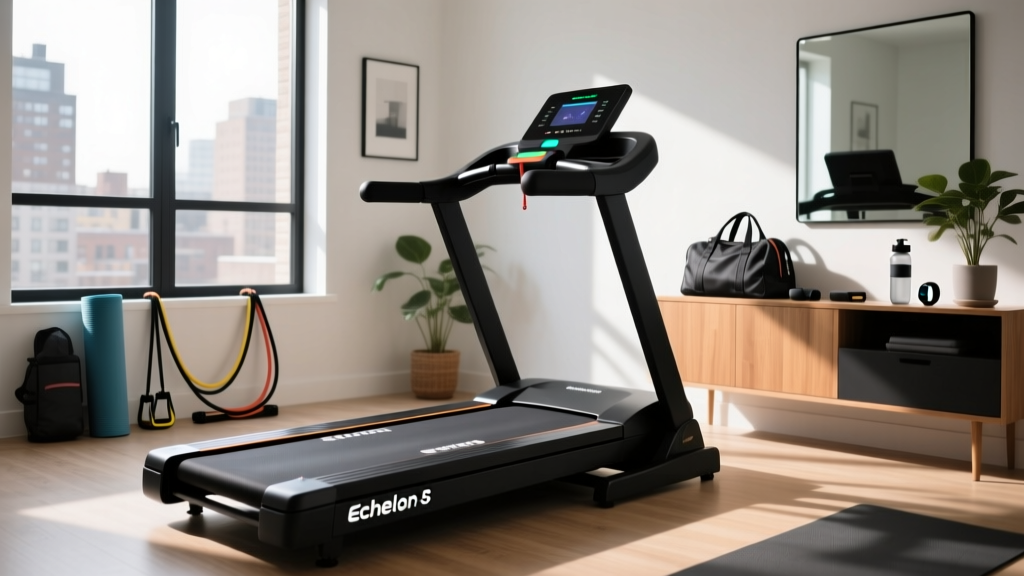
Echelon Stride-6 Treadmill vs High-HP Motors: Sizing Guide
Compare the Echelon Stride-6 treadmill motor against 3.5 CHP models. Learn how peak HP, continuous duty, and user weight impact treadmill lifespan.

When shopping for a home cardio setup in 2026, the sheer volume of technical specifications can be overwhelming. Among the most misunderstood metrics is motor size. Compact, space-saving models like the Echelon Stride-6 treadmill have surged in popularity for apartment dwellers and casual walkers, but how does its motor architecture compare to traditional, full-sized folding treadmills? Understanding the difference between marketing-driven horsepower claims and actual mechanical output is the difference between a machine that lasts a decade and one that burns out its control board in six months.
In this head-to-head guide, we are putting the Echelon Stride-6 up against the industry-standard 3.5 CHP (Continuous Horsepower) class—represented by the Sole F80—to break down exactly how motor sizing, flywheel mass, and thermal limits dictate your treadmill's lifespan. According to the Consumer Reports Treadmill Buying Guide, matching the motor's continuous duty rating to your specific body weight and workout intensity is the single most critical factor in preventing premature mechanical failure.
The Great Motor Debate: Peak HP vs. Continuous CHP
Before comparing specific models, we must dismantle the most common marketing illusion in the fitness industry: Peak Horsepower (HP). Many budget and compact treadmills advertise a "2.0 HP" or "1.5 HP" motor. However, this number represents the absolute maximum output the motor can achieve for a fraction of a second before the internal windings overheat.
Callout: The Golden Rule of Treadmill Motors
Peak HP is a measure of maximum instantaneous torque. CHP (Continuous Horsepower) is the measure of work the motor can sustain indefinitely without exceeding its thermal threshold. Always buy based on CHP, not Peak HP.
The Echelon Stride-6 is typically equipped with a 1.5 Peak HP motor. In real-world continuous duty terms, this translates to roughly 0.75 to 1.0 CHP. This is perfectly adequate for its intended use case: walking and light jogging for users under 180 pounds. However, when subjected to the sustained friction and impact of a 220-pound runner, a 1.5 Peak HP motor will rapidly exceed its thermal limits, leading to the failure modes we will explore later.
Head-to-Head: Echelon Stride-6 vs. Sole F80 (3.5 CHP Class)
To understand the practical implications of motor sizing, we are comparing the compact Echelon Stride-6 against a traditional heavyweight, the Sole F80, which features a robust 3.5 CHP motor. This comparison highlights the engineering trade-offs between spatial efficiency and mechanical endurance.
| Specification | Echelon Stride-6 | Sole F80 (3.5 CHP Class) |
|---|---|---|
| Motor Rating | 1.5 Peak HP (~0.85 CHP) | 3.5 Continuous HP (CHP) |
| Motor Controller | Standard PWM, basic heat sink | Heavy-duty PWM, active cooling fan |
| Flywheel Mass | Lightweight (Compact design) | Heavy (High rotational inertia) |
| Max User Weight | 300 lbs (Optimal under 180 lbs) | 375 lbs (Sustains up to 300+ lbs) |
| Top Speed | 8.0 MPH | 12.0 MPH |
| 2026 Retail Price | ~$599 | ~$1,199 |
The Physics of Motor Strain: Amp Draw and Heat
Why does a 3.5 CHP motor last longer than a 1.5 Peak HP motor, even when both are moving a 180-pound user at 6 MPH? The answer lies in electrical engineering—specifically, amp draw and $I^2R$ (current squared times resistance) heat losses.
When your foot strikes the treadmill deck, it creates a momentary spike in friction. The motor must instantly draw more electrical current (amps) from your wall outlet to maintain the belt's speed. According to Runner's World treadmill testing methodology, heavier runners and those who scuff their feet generate significantly higher amp spikes.
- The Echelon Stride-6 Scenario: Because the motor is smaller and lacks a massive flywheel to carry rotational momentum, a 200-pound user jogging at 6 MPH will force the motor to pull near its maximum amperage (often 12-15 amps) continuously. This high current generates immense heat in the copper windings.
- The 3.5 CHP Scenario: A larger motor has thicker copper windings (lower electrical resistance) and a heavier flywheel. The flywheel's kinetic energy helps push the belt through the foot-strike friction zone. The same 200-pound user might only cause the 3.5 CHP motor to pull 6-8 amps, running significantly cooler.
Failure Modes: What Actually Breaks First?
Contrary to popular belief, the physical motor windings rarely melt. The true victim of an undersized motor is the Motor Control Board (MCB). The MCB uses Pulse Width Modulation (PWM) and heavy-duty MOSFET transistors to regulate power to the motor. When a compact treadmill like the Stride-6 is pushed beyond its continuous duty limits, the following cascade failure occurs:
- Thermal Throttling: The internal temperature of the MCB exceeds 105°F. The system's thermal protection kicks in, momentarily cutting power to the belt, resulting in a dangerous "stutter" or hesitation while running.
- MOSFET Burnout: If the user ignores the stuttering and continues to run, the sustained high-amp draw causes the silicon junctions inside the MOSFETs to literally melt and short-circuit. The treadmill will trip your home's circuit breaker or blow the MCB's internal fuse.
- Belt Friction Acceleration: Undersized motors struggle to pull the belt over the deck. This excess friction glazes the underside of the belt and dries out the silicone lubricant prematurely, creating a vicious cycle of increasing amp draw.
"The most common reason compact treadmills are returned for 'motor failure' within the first year is actually MCB burnout caused by users exceeding the continuous thermal limits of the PWM controller, not the motor itself." — Independent Fitness Equipment Repair Technician Insights, 2025.
The Hidden Variable: Flywheel Mass
Motor size does not exist in a vacuum; it is intrinsically linked to the front roller and flywheel mass. The Echelon Stride-6 is engineered for foldability and lightweight transport. Consequently, its front roller is relatively narrow and light. A light flywheel requires the motor to do 100% of the work to overcome the inertia of the user's foot strike. High-HP traditional treadmills utilize heavy, oversized front rollers that act as mechanical batteries, storing kinetic energy and smoothing out the load on the motor. This is why a 3.5 CHP machine feels "smoother" at 8 MPH than a compact machine, even if the compact machine is technically capable of reaching that speed.
The Verdict: Which Motor Class Fits Your Biomechanics?
Choosing between the Echelon Stride-6 and a high-HP traditional treadmill is not about which machine is "better" in a vacuum; it is about aligning the machine's mechanical limits with your biomechanical reality.
Buy the Echelon Stride-6 (1.5 Peak HP) If:
- Your primary exercise is walking (2.0 to 4.5 MPH) or very light jogging.
- You weigh under 180 pounds.
- You live in a small apartment and require a machine that folds flat and can be rolled into a closet.
- Your budget is strictly capped around the $600 mark.
- You are diligent about lubricating the deck with 100% silicone every 3 months to minimize amp draw.
Invest in a 3.0+ CHP Traditional Treadmill If:
- You run at speeds above 6.0 MPH for intervals or distance training.
- You weigh over 200 pounds (the impact force and friction will quickly overwhelm a sub-2.0 CHP motor).
- You plan to use the machine for more than 3 hours per week.
- You have the dedicated floor space for a permanent, full-sized folding deck.
Ultimately, the Echelon Stride-6 is a triumph of spatial engineering, offering excellent value for walkers and light joggers in space-constrained environments. However, treating it like a high-HP marathon trainer will inevitably result in thermal failure. Respect the continuous duty limits, maintain your deck lubrication, and your compact treadmill will serve you reliably for years to come.
More gear to consider
All reviews
2026 Trends: Maintaining a Treadmill with 400 lb Capacity Belt
Todo Treadmill Trend 2026: Under Desk Office Reviews

Air Bike vs Assault Bike Guide & UREVO SpaceWalk E4 Treadmill Care
ProForm 490 C Treadmill vs Under Desk Treadmills: Office Review

Fulmly Treadmill vs. Top Compact Rivals: 2026 Buying Guide
