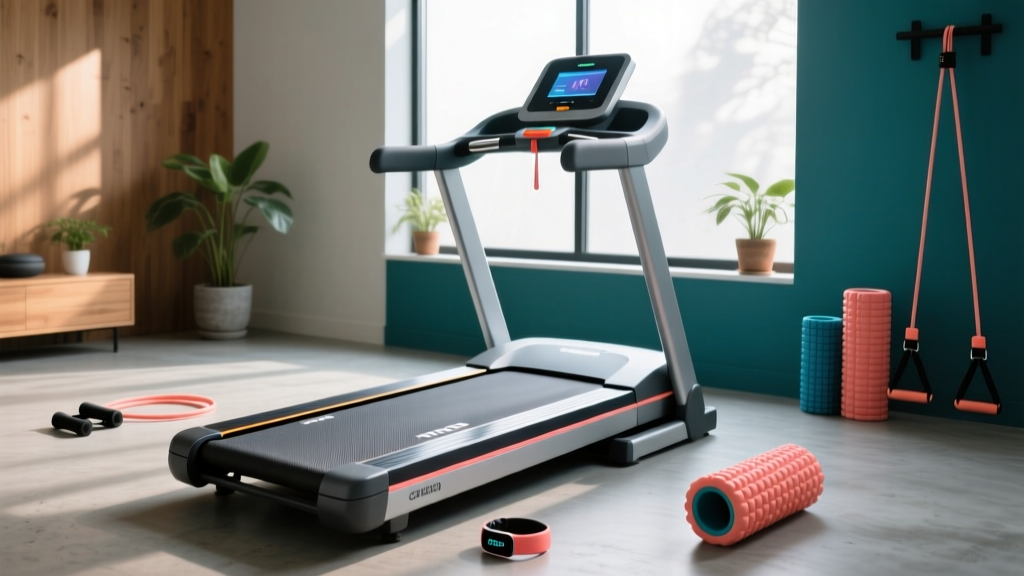
Do Treadmills Build Muscle? Compact Cardio Budget Guide
Wondering if treadmills build muscle? We break down the ROI of traditional treadmills vs. compact portable cardio equipment for muscle engagement.

The Biomechanics: Do Treadmills Actually Build Muscle?
One of the most common questions in home gym design is: do treadmills build muscle? The short answer is no, not in the way most buyers hope. To understand why, we have to look at muscle fiber recruitment. Treadmills primarily engage Type I (slow-twitch) muscle fibers in the calves, quadriceps, and glutes. These fibers are built for endurance, not hypertrophy (muscle growth).
According to the CDC Physical Activity Guidelines, steady-state aerobic exercise improves cardiovascular health and muscular endurance, but it lacks the progressive mechanical overload required to trigger significant Type II (fast-twitch) muscle fiber growth. Even if you crank a motorized treadmill to a 15% incline, the resistance curve caps out quickly. Once your legs adapt to moving your body weight up a slope, muscle growth stalls, and you are strictly burning calories.
Expert Insight: To build actual muscle mass on a treadmill, you would need to perform heavy, low-repetition sled pushes or explosive hill sprints. Standard jogging or walking on a $1,000 home treadmill will not add measurable inches to your quads or glutes.
The Budget Problem with Traditional Treadmills
When analyzing the value proposition of a traditional motorized treadmill (like the Horizon T202 or NordicTrack T Series 8, which range from $600 to $1,000 in the 2026 market), the spatial and financial ROI is remarkably poor for muscle building. A standard treadmill requires a footprint of roughly 20 square feet (approx. 70" L x 30" W) and weighs over 150 lbs. You are paying a premium for a heavy motor, a long running belt, and a steel frame, yet the machine only targets your lower body.
If your goal is comprehensive muscular engagement and cardiovascular health on a strict budget, traditional treadmills represent a misallocation of funds. This is where compact portable cardio equipment options shine, offering a drastically better cost-per-muscle-fiber ratio.
Compact Portable Cardio: The Muscle-Building Alternatives
Compact portable cardio machines have evolved significantly. By combining high-tension resistance with aerobic movement, these smaller footprint machines force your muscles to work against continuous load, bridging the gap between cardio and strength training. Below is a budget breakdown comparing a standard treadmill against the top portable alternatives.
| Equipment Type | Avg. Cost (2026) | Footprint | Muscle Groups Targeted | Hypertrophy Potential |
|---|---|---|---|---|
| Motorized Treadmill | $600 - $1,200 | 20 sq. ft. | Lower Body (Endurance) | Very Low |
| Hydraulic Mini-Stepper w/ Bands | $60 - $90 | 2 sq. ft. | Glutes, Calves, Shoulders, Biceps | Low-Moderate |
| Foldable Magnetic Rower | $200 - $350 | 8 sq. ft. (in use) | Full Body (86% of musculature) | Moderate-High |
| Under-Desk Walking Pad | $250 - $450 | 5 sq. ft. | Lower Body (Endurance/NEAT) | None |
Top Compact Cardio Picks for Muscle & Budget
If you are ready to abandon the bulky treadmill in favor of high-value, space-saving equipment, here are the best compact portable cardio options that actually challenge your musculature.
1. Hydraulic Mini-Steppers with Resistance Bands
Top Model: Sunny Health & Fitness SF-S0978
Price: ~$65
The Value Analysis: For the cost of a single month at a commercial gym, a mini-stepper provides continuous lower-body tension. Unlike a treadmill where momentum carries your foot forward, a stepper requires you to press your entire body weight against hydraulic cylinders with every step. When you add the included resistance bands, you can perform bicep curls, lateral raises, and overhead presses while stepping. This creates a full-body metabolic conditioning circuit that a treadmill simply cannot replicate.
2. Foldable Magnetic Rowing Machines
Top Model: Sunny Health & Fitness SF-RW5201 or XTERRA RSX1500
Price: $200 - $300
The Value Analysis: If you want a machine that genuinely builds muscular endurance and size, the rower is the undisputed king of compact cardio. Rowing engages 86% of the body's muscles, including the lats, rhomboids, core, quads, and hamstrings. The magnetic resistance on these budget models provides up to 12-16 levels of tension. Pulling at a heavy resistance for 20-minute intervals mimics a high-rep weightlifting session, triggering muscle adaptation while keeping your heart rate in the aerobic zone. Furthermore, these units fold in half and roll away on transport wheels, taking up less than 3 square feet in storage.
3. Walking Pads + Kettlebell Supersets
Top Model: UREVO Strol 2E or WalkingPad R2
Price: $350 - $450 (plus $40 for a kettlebell)
The Value Analysis: Walking pads do not build muscle on their own. However, their value lies in their integration into a small-space apartment. A walking pad allows you to accumulate 10,000 steps while working at a standing desk. To satisfy the muscle-building requirement, you pair the walking pad with a single 16kg or 24kg kettlebell. Alternate 15 minutes of brisk walking with 5 minutes of heavy kettlebell goblet squats and swings. This hybrid approach costs less than half the price of a motorized treadmill and yields vastly superior muscular results.
The Decision Framework: Cost-Per-Muscle-Fiber
When evaluating cardio gear on a budget, use this formula to determine true value:
Value Score = (Total Muscle Groups Engaged × Resistance Levels) / (Price × Square Footage)
A $900 treadmill scores poorly because it only engages 1 primary muscle group (legs) and consumes 20 sq. ft. A $250 foldable rower scores exceptionally high because it engages 4 major muscle groups, offers 12+ resistance levels, and stores in under 4 sq. ft. Always prioritize multi-planar resistance over motorized belts.
Hidden Costs and Failure Modes in Portable Gear
As a domain expert, I must warn you that budget compact cardio equipment comes with specific mechanical edge cases and failure modes that you won't see on the product listing. Understanding these will save you money and frustration.
- Hydraulic Cylinder Overheating (Mini-Steppers): The hydraulic pistons on sub-$100 steppers rely on fluid viscosity for resistance. If you use the machine continuously for more than 25-30 minutes, the fluid heats up, thins out, and the resistance drops to zero. Solution: Use steppers for HIIT intervals (10-15 mins max) rather than long, steady-state sessions.
- Belt Drift and Motor Burnout (Walking Pads): Because walking pads lack the heavy, tensioned rollers of full-size treadmills, the belt will inevitably drift to the left or right after 80-100 miles of use. Solution: Keep the included 4mm Allen wrench nearby to adjust the rear roller tension bolts. Additionally, if you weigh over 220 lbs, budget walking pad motors (usually 2.0 HP peak) will overheat and fail within 6 months. Overweight users must upgrade to dual-motor models or stick to rowers.
- Elastic Band Degradation (Steppers): The latex resistance bands included with mini-steppers dry rot and snap after 12-18 months of use. Solution: Factor in a $15 replacement cost every year, or upgrade to a set of fabric-loop resistance bands which offer superior durability and tension.
Cardiovascular Health Without the Bulk
The American Heart Association recommends at least 150 minutes of moderate-intensity aerobic activity per week to maintain cardiovascular health. You absolutely do not need a massive, $1,500 motorized treadmill to achieve this. In fact, relying on a treadmill often leads to a sedentary lifestyle outside of the 30 minutes you spend walking on it.
Compact portable options encourage a more dynamic lifestyle. A foldable rower can be pulled out for a grueling 20-minute full-body interval session that builds back and leg muscle, then folded away to preserve your living space. A walking pad slides under your couch, promoting continuous NEAT (Non-Exercise Activity Thermogenesis) throughout the workday.
Final Verdict: Where Should You Put Your Money?
If your primary question is do treadmills build muscle, the data clearly shows they are the wrong tool for the job. Treadmills are expensive, space-hogging endurance machines. For the budget-conscious home gym builder looking to maximize both cardiovascular output and muscular engagement, compact portable cardio equipment is the superior investment.
The Ultimate Budget Setup: Skip the $800 treadmill. Instead, purchase a magnetic foldable rower ($250) for high-resistance, full-body cardio, and a walking pad ($300) for daily step accumulation. For $550 total—roughly the cost of an entry-level, low-incline treadmill—you will have a complete, space-saving cardio and muscle-endurance system that outperforms traditional treadmills in every measurable metric.
More gear to consider
All reviews
Air Bike vs Assault Bike Comparison & Cursor Fitness Treadmill Data
Bowflex Treadmill 22 Review: Motor Size & Horsepower Guide

Beyond the x22i Treadmill: 2026 Home Stair Climber Guide

Beyond the Treadmill Photo: Upright vs Recumbent vs Spin Bikes

NordicTrack Treadmill Belt Tension vs. Walking Pads: 2026 Review
