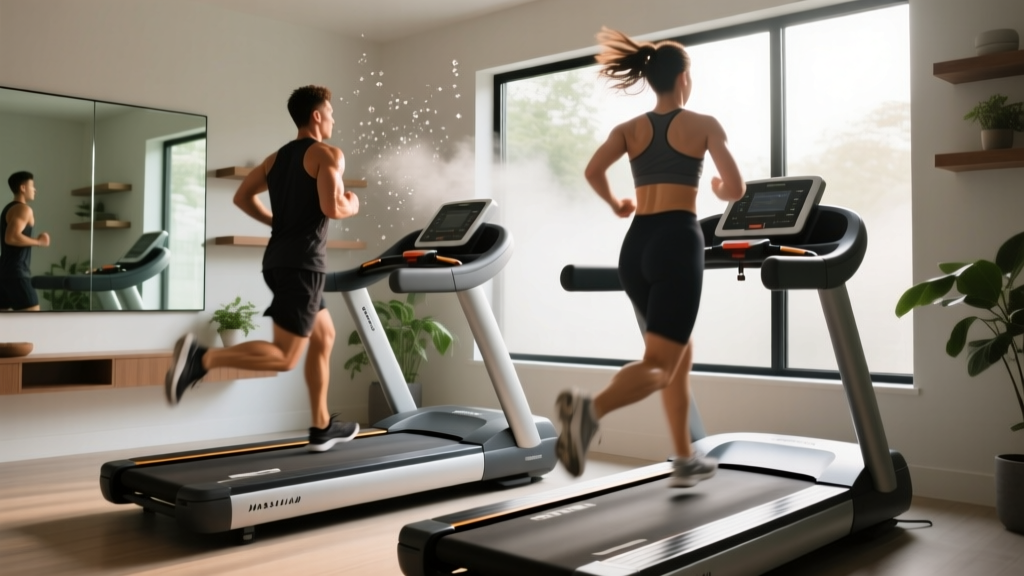
Curved vs Motorized Treadmills: Calorie Burn Incline Treadmill Guide
Compare curved manual and motorized treadmills. This beginner guide reveals how to maximize your calorie burn incline treadmill workouts safely.

The Core Debate: Curved Manual vs. Motorized Treadmills
Stepping into the home fitness market in 2026, beginners are quickly confronted by a major equipment divide: the traditional motorized treadmill versus the modern curved manual treadmill. Both promise exceptional cardiovascular benefits, but they achieve them through entirely different biomechanical mechanisms. If your primary fitness objective is maximizing your calorie burn incline treadmill routines, understanding the mechanical differences between these two machines is the critical first step.
Motorized treadmills rely on an electric motor to pull the belt beneath your feet, requiring you simply to keep up with the set pace. Curved manual treadmills, however, are entirely self-powered. The concave shape of the running surface forces you to drive the belt backward using your own leg power, naturally engaging your posterior chain (glutes, hamstrings, and calves) much like running up a steep hill.
Beginner Insight: You do not need to be an elite athlete to use a curved treadmill. However, because you control the speed entirely through your foot strike and body position, it requires a slightly higher baseline of coordination and cardiovascular effort than a motorized belt.The Physics of the Climb: Why Incline and Curve Matter
To understand why these machines are so effective for fat loss and cardiovascular conditioning, we must look at metabolic equivalents (METs). According to the American Heart Association, increasing the intensity of your aerobic exercise directly correlates to improved heart health and higher caloric expenditure.
Motorized Incline Mechanics
On a standard motorized treadmill, running on a 0% grade primarily engages your quadriceps and hip flexors. When you raise the incline to 10% or 15%, you alter your center of gravity. Your body must now fight gravity to propel your mass upward, drastically increasing the energy demand. A 180-pound individual running at 6 mph on a flat belt burns roughly 700 calories per hour. Raise that incline to 15%, and the burn skyrockets to over 1,200 calories per hour.
The "Built-In Incline" of Curved Treadmills
Curved treadmills do not have an incline button. Instead, the arc of the track creates a perpetual incline effect. Biomechanical studies show that running on a non-motorized curved treadmill increases oxygen uptake and heart rate by approximately 10% to 15% compared to running at the exact same speed on a flat motorized treadmill. The steeper the curve of the slats, the higher the resistance.
Step-by-Step: Setting Up Your Machine for Maximum Burn
Whether you are unboxing a new curved runner or firing up a motorized incline trainer, proper setup prevents injury and optimizes your workout. Follow this beginner-friendly sequence:
- Establish Your Baseline Posture: On a curved treadmill, leaning too far forward engages the hip flexors but limits your stride. Stand tall, keep your chest up, and look 10 feet ahead. On a motorized incline, avoid gripping the handrails; holding on reduces core engagement and artificially lowers your calorie burn by up to 20%.
- Master the Foot Strike: For curved manual treadmills, aim for a mid-foot strike near the apex (the highest point) of the curve to maintain steady speed. To accelerate, push your strike point higher up the front curve. To decelerate, drop your foot strike lower on the back curve.
- Program Your Console (Motorized Only): If using a motorized machine, avoid jumping straight to a 15% grade. Set the machine to a 3% incline for a 5-minute warm-up. This mimics outdoor wind resistance and gently prepares your Achilles tendons for the steeper climbs to come.
Head-to-Head: Equipment & Calorie Data Matrix
Choosing the right machine depends on your budget, space, and specific training goals. Below is a 2026 comparison matrix of top-tier beginner and intermediate models.
| Model | Type | 2026 Retail Price | Incline / Grade | Est. Cal/Hr (180lb user @ 5mph) |
|---|---|---|---|---|
| AssaultRunner Elite | Curved Manual | $3,299 | Fixed Arc (Equiv. ~8-10%) | ~850 kcal |
| TrueForm Runner | Curved Manual | $3,595 | Fixed Arc (Equiv. ~10-12%) | ~880 kcal |
| Sole F80 | Motorized | $999 | 0% to 15% | ~650 kcal (Flat) / ~1,050 kcal (15%) |
| NordicTrack X22i | Motorized Incline Trainer | $2,999 | -6% to 40% | ~1,400+ kcal (at 40%) |
Beginner Workouts: Step-by-Step Routines
Now that you understand the hardware, it is time to apply it. The Centers for Disease Control and Prevention (CDC) recommends at least 150 minutes of moderate-intensity or 75 minutes of vigorous-intensity aerobic activity per week. These two routines will help you hit those marks efficiently.
Routine A: The Curved Manual HIIT (20 Minutes)
Best for: Time-crunched beginners looking for maximum metabolic afterburn (EPOC).
- Warm-up (5 mins): Brisk walk. Focus on pushing the belt from the middle of the curve. Keep your heart rate in Zone 1 (50-60% of max HR).
- Sprint Intervals (12 mins): Perform 8 rounds of 45-second all-out sprints followed by 45 seconds of slow walking recovery. To sprint, push your foot strike high up the front curve and pump your arms. Target Zone 4/5 (80-95% max HR).
- Cool Down (3 mins): Gradually walk slower, dropping your foot strike to the back of the curve to decelerate the belt naturally.
Routine B: The Motorized 15% Incline Climb (30 Minutes)
Best for: Endurance building, glute activation, and low-impact steady-state cardio.
- Warm-up (5 mins): 0% incline at 3.0 mph.
- The Climb (20 mins): Increase incline to 12% and speed to 3.5 mph. Maintain a brisk walk. Crucial Rule: Do not hold the handrails. If you must hold on, lower the speed to 2.5 mph. Pump your arms to increase caloric expenditure.
- Peak Push (2 mins): Raise incline to 15% for a final 2-minute burnout.
- Cool Down (3 mins): Drop incline to 5% and speed to 2.0 mph.
Troubleshooting Common Beginner Failure Modes
Even with the best intentions, beginners frequently encounter physical and mechanical roadblocks. Here is how to troubleshoot the most common issues:
Physical Failure: Anterior Shin Splints
The Cause: Over-striding on a curved treadmill or walking too fast on a steep motorized incline forces the tibialis anterior (front shin muscle) to work overtime to control foot descent.
The Fix: Shorten your stride length. On a curved treadmill, keep your steps quick and compact near the apex. On a motorized incline, ensure your foot lands directly beneath your hips, not out in front of your body.
Mechanical Failure: Curved Belt "Stuttering"
The Cause: Curved treadmills use a slat belt over a series of bearings. If the belt feels jerky or stutters during your foot strike, the bearings may be accumulating dust, or the belt tension is uneven.
The Fix: Unlike motorized treadmills that require silicone lubrication under the belt, curved treadmills generally require dry, clean bearings. Vacuum the sides of the slat belt monthly and consult your manufacturer's manual for specific tensioning adjustments using the rear axle bolts.
Final Verdict: Which Should You Buy?
If your budget is under $1,500 and you prefer guided, structured workouts with interactive screens, a motorized treadmill like the Sole F80 is the undisputed champion. It allows you to precisely dial in your calorie burn incline treadmill metrics and follow along with on-demand classes.
However, if you have a budget exceeding $3,000, suffer from joint pain caused by the repetitive impact of a flat motorized belt, and want a machine that forces perfect running posture while delivering a massive caloric deficit, the AssaultRunner Elite or TrueForm Runner will serve you exceptionally well. The self-powered curve naturally limits over-striding, reducing knee impact while demanding significantly more energy output per mile.
Ultimately, the best machine is the one that aligns with your biomechanics and keeps you consistently moving. Start slow, respect the incline, and let the physics of gravity and friction do the heavy lifting for your fitness journey.
More gear to consider
All reviews
Small Space Folding Treadmill Review: Sprint Exercises on Treadmill
LEGO on a Treadmill: 2026 Walking Pad Comparison Guide

Under Desk Treadmill Review: Does a Treadmill Help With Belly Fat?

Folding Treadmill Small Space Review & Heavy Duty Surge Protector
Elliptical vs Treadmill: Space Design & Backward Walk on Treadmill
