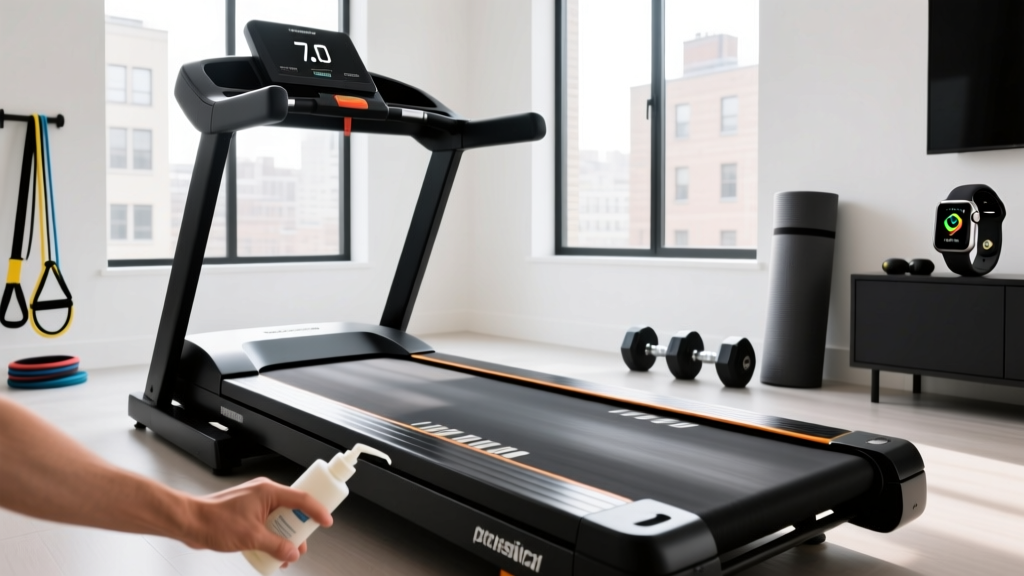
Elliptical vs Treadmill Costs: Why a Budget Treadmill Makes Noise
Compare elliptical vs treadmill costs for 2026. We break down upfront pricing, long-term value, and why a budget treadmill makes noise over time.

When outfitting a home gym, the debate between an elliptical and a treadmill usually centers on joint impact or calorie burn. However, from a purely financial perspective, the decision requires a rigorous budget breakdown and value analysis. In the 2026 home fitness market, the upfront price tag is only a fraction of the total cost of ownership. Hidden expenses—ranging from electrical consumption to acoustic mitigation and mechanical maintenance—can drastically alter the return on investment (ROI) of your cardio equipment.
This guide dissects the true financial footprint of ellipticals versus treadmills, including a deep dive into mechanical degradation and why a budget treadmill makes noise as it ages.
The Upfront Budget Breakdown: Ellipticals vs. Treadmills
To accurately compare value, we must look at equivalent tiers of quality. Comparing a $300 Amazon elliptical to a $2,000 treadmill yields skewed data. Below is a breakdown of the 2026 market averages for reliable, mid-tier to premium home cardio machines that will actually last beyond their warranty periods.
| Quality Tier | Elliptical Benchmark (Model / Price) | Treadmill Benchmark (Model / Price) | Price Delta |
|---|---|---|---|
| Entry-Level (Reliable) | Schwinn 430 / $799 | Horizon T101 / $899 | +$100 (Treadmill) |
| Mid-Range (Enthusiast) | Sole E25 / $999 | Sole F63 / $1,199 | +$200 (Treadmill) |
| Premium (Commercial-Lite) | NordicTrack FS10i / $1,799 | NordicTrack EXP 10i / $1,499 | -$300 (Elliptical) |
As the data illustrates, treadmills generally command a $100 to $200 premium in the entry and mid-level tiers due to the sheer mass of raw materials required (heavy steel frames, large continuous-duty motors, and expansive running decks). However, at the premium tier, high-end ellipticals with complex multi-directional stride mechanics can actually surpass treadmills in upfront cost.
The Acoustic Tax: Why Your Budget Treadmill Makes Noise
One of the most frequently overlooked costs in home gym planning is acoustic mitigation. If you have ever asked yourself why a budget treadmill makes noise after only six months of use, the answer lies in a combination of motor strain, deck friction, and impact physics.
The Mechanics of Treadmill Noise
Treadmills under the $800 mark typically utilize 2.0 to 2.25 Continuous Horsepower (CHP) motors. When a 180-pound user runs at 6.0 mph, the motor must work near its peak capacity. This strain causes the internal components to vibrate, transmitting low-frequency hums through the floorboards. Furthermore, budget treadmills use thinner 1-ply belts and low-density MDF decks. As the factory lubricant dries out, the friction between the belt and deck generates a high-pitched squealing sound, while the repetitive footstrike creates a loud, percussive thud.
Ellipticals, by contrast, utilize magnetic resistance and a continuous flywheel motion. Because your feet never leave the pedals, there is zero impact noise. The only sound is the low hum of the drive system, which is virtually inaudible from the next room.
⚠️ The Noise Mitigation Cost:If you live in an apartment or have roommates, a loud treadmill forces you to spend extra money. A high-density 3/8-inch anti-vibration equipment mat costs between $60 and $120. In severe cases, you may need to invest in acoustic underlayment or decoupling pads ($150+) to stop structural noise transfer. Ellipticals rarely require these expensive acoustic interventions.
5-Year Total Cost of Ownership (TCO) Analysis
According to fitness equipment reliability data tracked by Consumer Reports, treadmills have a statistically higher failure rate than ellipticals due to the high number of moving parts subjected to repetitive impact. Let us break down the mandatory maintenance and repair costs over a 5-year horizon.
Treadmill Maintenance Costs (5 Years)
- Belt Lubrication: 100% silicone lubricant ($15 per bottle, required every 3-6 months) = $75
- Belt Tensioning/Replacement: A budget belt will stretch and fray within 3 years. Replacement belts cost $50 to $150, plus labor if you cannot do it yourself = $100 average
- Deck Replacement: If you fail to lubricate the belt, the deck will warp and burn out the motor control board. Replacing a deck costs $200 to $350 = $200 (assuming one replacement)
- Motor Brush/Board Failure: Out-of-warranty motor control board replacements average $180 = $180 risk cost
Estimated 5-Year Treadmill Maintenance: $375 to $555
Elliptical Maintenance Costs (5 Years)
- Pivot Point Lubrication: White lithium grease for the pedal arm joints ($10 per can, required annually) = $30
- Track and Roller Cleaning: Microfiber cloths and non-abrasive cleaner to prevent track degradation = $20
- Drive Belt Tensioning: Internal drive belts rarely need adjustment in magnetic resistance models, but if they slip, a replacement is $40 = $40 risk cost
Estimated 5-Year Elliptical Maintenance: $50 to $90
Expert Insight: The American Council on Exercise (ACE) notes that while treadmills offer superior bone-density benefits due to impact loading, the mechanical degradation of the machine itself is directly proportional to that same impact. You are essentially paying a "maintenance tax" for the privilege of a high-impact workout.
Energy Consumption and Spatial Economics
The cost of electricity and the opportunity cost of floor space are critical components of the value analysis.
Electrical Draw
Treadmills are the most power-hungry machines in a home gym. A standard 3.0 CHP treadmill motor draws between 600 and 900 watts of continuous power during a moderate run, with peak surges up to 1,800 watts during startup or heavy incline shifts. If you run for 5 hours a week, a treadmill will consume roughly 180 to 220 kWh annually. At the 2026 national average electricity rate of $0.17 per kWh, that is approximately $37 per year in electricity.
Ellipticals with magnetic resistance require electricity only for the console display and the electromagnetic brake. The actual pedaling motion generates the kinetic energy. An elliptical draws less than 50 watts during use, costing roughly $2 per year to operate.
Spatial Footprint
A standard home treadmill requires a footprint of roughly 30 square feet (78" L x 35" W), plus an additional 24 inches of clearance behind the deck for safety egress. Ellipticals generally require 25 square feet (70" L x 25" W) and do not require rear clearance. In urban environments where home office or gym space is valued at $200+ per square foot, the treadmill's spatial demand represents a significant hidden premium. For detailed guidelines on home appliance spatial efficiency, the U.S. Department of Energy provides excellent frameworks for calculating spatial and electrical efficiency in residential setups.
The Verdict: Calculating Your Personal ROI
Choosing between an elliptical and a treadmill is not just about fitness goals; it is a financial decision. Here is the decision framework based on your budget and living situation:
- Choose the Treadmill if: You are training for outdoor running events, require impact-loading for bone density, and have a dedicated, sound-insulated space (like a basement or garage) where noise transfer and spatial footprint are not financial liabilities. Budget at least $1,200 upfront to avoid the mechanical failures associated with ultra-budget models.
- Choose the Elliptical if: You live in an apartment or multi-story home, want to minimize your 5-year maintenance costs, and prioritize a low acoustic profile. An elliptical offers superior long-term ROI for the budget-conscious buyer, providing comparable cardiovascular benefits with a fraction of the mechanical wear-and-tear.
Frequently Asked Questions
Is it cheaper to fix a treadmill or buy a new one?
If the motor or main control board fails on a treadmill that originally cost less than $800, it is almost always more cost-effective to replace the machine. Out-of-warranty parts and labor can easily exceed $400, which is 50% or more of the machine's initial value.
Do ellipticals lose resale value faster than treadmills?
Actually, mid-tier ellipticals from reputable brands (like Sole or Schwinn) hold their resale value remarkably well—often retaining 40% to 50% of their value after three years. Because they suffer less mechanical degradation and do not feature high-wear components like running decks, the secondary market for used ellipticals is highly active.
How can I stop my budget treadmill from squeaking?
The squeak is almost always caused by belt-to-deck friction. Unplug the machine, loosen the rear roller bolts, apply 100% silicone treadmill lubricant directly between the belt and the deck, and re-tension the belt. Do not use WD-40 or petroleum-based oils, as these will destroy the rubber backing of the belt and void your warranty.
More gear to consider
All reviews
Hamster Wheel Treadmill Noise: Curved vs Motorized Guide

Beyond the 12/3/30 Treadmill Workout: Rowing Machine Buying & Technique

ProForm Walking Pad Review: Adjusting Treadmill Belt

Walking Pad Setup Guide & Treadmill Incline Chart Review

Walking Pad Review: Anti-Gravity Treadmill Charleston Alternatives