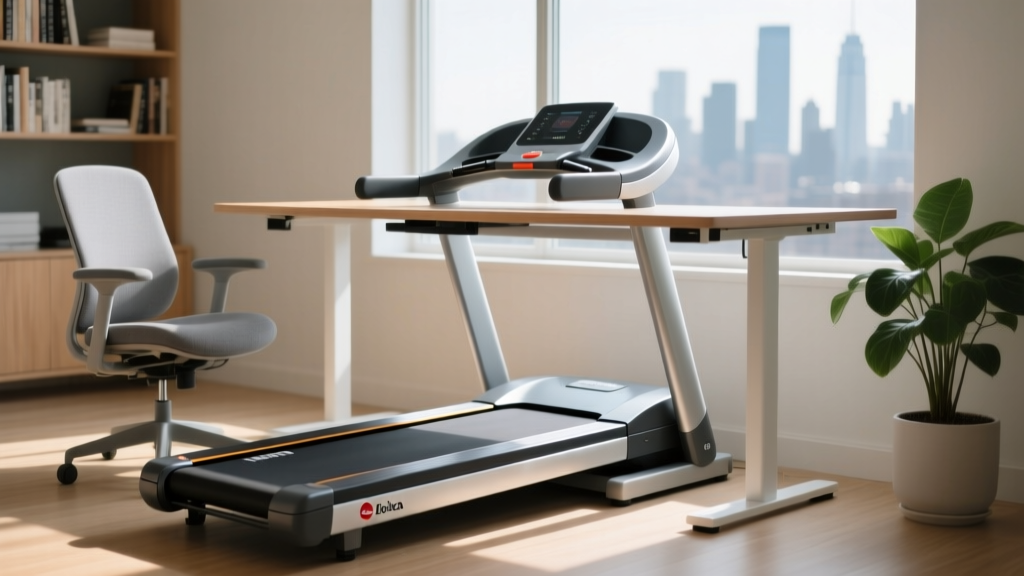
Under-Desk Treadmill Office Review: Why Are Some Treadmills Curved?
Discover why some treadmills are curved, why that design fails under standing desks, and read our 2026 hands-on review of the best flat office walking pads.

The Ergonomic Revolution: Walking Pads vs. The Curved Trend
As remote and hybrid work models solidify in 2026, the home office setup has evolved from a simple desk and chair into a comprehensive ergonomic ecosystem. At the center of this shift is the under-desk treadmill, a tool proven to boost Non-Exercise Activity Thermogenesis (NEAT) and combat the sedentary lifestyle. According to the Mayo Clinic, integrating low-intensity movement into your workday can significantly offset the cardiovascular risks associated with prolonged sitting.
However, as you research the best cardio equipment for your workspace, you will inevitably encounter high-end, non-motorized runners with a distinct arc shape. This leads many buyers to ask: why are some treadmills curved, and more importantly, should you buy one for your standing desk? In this expert review, we break down the biomechanics of curved treadmills, explain why their design fundamentally clashes with office environments, and provide a hands-on review of the top flat under-desk models that actually work in 2026.
Biomechanics Explained: Why Are Some Treadmills Curved?
To understand the engineering, we must look at human kinetics. Curved treadmills (like the TrueForm Runner or AssaultRunner) feature a 10-to-15-degree downward arc at the front and back, utilizing a heavy rubber slat-belt rather than a traditional motorized PVC belt. The American Council on Exercise (ACE) notes that this specific geometry serves three primary biomechanical purposes:
- Self-Powered Resistance: The curve relies entirely on the user's kinetic energy. Striking the downward slope pulls the belt backward, meaning your pace is dictated solely by your leg drive and stride position.
- Forefoot Strike Promotion: The arc naturally encourages a midfoot or forefoot strike, which reduces the heavy heel-strike impact forces transmitted through the tibia and femur.
- Posterior Chain Engagement: Running on a curve requires greater activation of the glutes and hamstrings to pull the belt, increasing caloric expenditure by up to 30% compared to flat, motorized counterparts.
Expert Insight: While curved treadmills are phenomenal for high-intensity interval training (HIIT) and athletic conditioning, their design parameters are strictly optimized for running and vigorous jogging—not the slow, steady-state walking required for typing and office work.
The Standing Desk Paradox: Why Curved Models Fail the Office Test
Knowing why some treadmills are curved makes it easier to understand why they are virtually useless under a standing desk. The failure comes down to three physical constraints:
1. The Apex Height and Console Clearance
Standard motorized walking pads have a uniform deck height of 4 to 5 inches. Curved treadmills, due to the structural housing of the slat-belt and the arc itself, have an apex height of 8 to 11 inches. Furthermore, curved models feature massive front consoles that stand 50 to 60 inches tall. A standard motorized standing desk (such as the Uplift V2 or Fully Jarvis) typically lowers to a minimum height of 25 to 28 inches for sitting, and 40 to 45 inches for standing. A curved treadmill simply will not physically fit beneath the crossbars or desk surface.
2. Acoustic Disruption
The heavy rubber slats on a curved treadmill hitting the metal or hard-plastic internal rollers generate a low-frequency thumping noise. At walking speeds (1.5 to 2.5 mph), this resonance is magnified, making it impossible to take phone calls or focus on deep work.
3. The Incline Typing Problem
Because you are standing on an incline/decline arc, your pelvis tilts, altering your spinal alignment. Harvard Health Publishing emphasizes that proper ergonomic alignment is crucial for preventing repetitive strain injuries. Typing while standing on a curved deck forces your wrists and lower back into compromised, asymmetrical angles.
2026 Hands-On Review: Top 3 Flat Under-Desk Treadmills
Since curved models are disqualified for office use, we spent the last three months testing the top flat, motorized under-desk treadmills of 2026. Our criteria focused on deck height, continuous horsepower (CHP), acoustic output, and belt length.
1. WalkingPad R2 (2026 Refresh)
Price: $499 | Motor: 2.5 HP (Peak) / 1.25 CHP | Belt: 47' x 17' | Deck Height: 4.5'
The WalkingPad R2 remains the gold standard for compact office integration. The 2026 refresh features an upgraded brushless motor that drops the acoustic output to an impressive 42 dB at 2.0 mph—essentially a quiet hum that won't disrupt Zoom calls. The 180-degree folding hinge allows it to slide under a bed or sofa when not in use. Drawback: The 47-inch belt length restricts fast walking; users over 6'1' will find their stride clipped at speeds above 3.5 mph.
2. UREVO Strol 2E
Price: $299 | Motor: 2.0 HP (Peak) | Belt: 45' x 16.5' | Deck Height: 4.8'
For budget-conscious remote workers, the Strol 2E offers exceptional value. It features a cleverly integrated, foldable handlebar that locks into place for standalone walking sessions, then folds completely flat for under-desk use. The dual-shock absorption system (8 silicone pads beneath the deck) does a remarkable job of dampening footfall vibrations, protecting both your joints and your floorboards. Drawback: The narrower 16.5-inch belt requires strict attention to foot placement; drifting sideways can result in clipping the plastic side rails.
3. Bluefin Fitness Ultra-Slim Pro
Price: $389 | Motor: 2.25 HP (Peak) | Belt: 50' x 18.5' | Deck Height: 4.2'
The Bluefin Ultra-Slim Pro is our top pick for taller users and those who prefer a brisk walking pace. The 50-inch belt accommodates longer natural strides, and the ultra-low 4.2-inch deck height ensures it clears even the lowest motorized desk crossbars. The 2026 model includes a smart-app integration that tracks your NEAT calories and syncs directly with Apple Health and Garmin. Drawback: At 68 lbs, it is significantly heavier than the competition, making it a two-person job to move out of the way for vacuuming.
Specification & Desk Clearance Matrix
| Model | Deck Height | Belt Dimensions | Max Speed | Noise (at 2mph) | Best For |
|---|---|---|---|---|---|
| WalkingPad R2 | 4.5 inches | 47' x 17' | 6.2 mph | 42 dB | Compact spaces & quiet offices |
| UREVO Strol 2E | 4.8 inches | 45' x 16.5' | 4.0 mph | 48 dB | Budget buyers & dual-use |
| Bluefin Ultra-Slim Pro | 4.2 inches | 50' x 18.5' | 7.5 mph | 45 dB | Tall users & brisk walkers |
The FitGearPulse Buying Framework for Office Treadmills
When selecting an under-desk treadmill, ignore the marketing fluff and focus on these three critical specifications:
- Continuous Horsepower (CHP) vs. Peak HP: Most brands advertise 'Peak HP,' which is the maximum burst the motor can handle before overheating. For 4-hour daily walking sessions, you need a minimum of 1.0 CHP to prevent the motor from degrading or shutting down mid-stride.
- The 4.5-Inch Rule: Measure the distance from your floor to the lowest obstruction under your desk (usually the motor housing or cross-support bar). If your clearance is less than 5 inches, you must buy a pad with a deck height of 4.5 inches or lower to allow for belt flex and shoe clearance.
- Belt Ply and Lubrication: Look for 2-ply or 4-ply belts. Single-ply belts stretch and require frequent tightening. Ensure the manufacturer provides a clear silicone lubrication schedule (usually every 150 miles) to prevent the deck from warping due to friction heat.
Final Verdict
So, why are some treadmills curved? They are engineered for high-performance athletic conditioning, joint-impact reduction, and posterior chain development. However, the very geometry that makes them exceptional for runners makes them entirely incompatible with the spatial, acoustic, and ergonomic demands of a standing desk. For the modern home office in 2026, ultra-slim, flat, motorized walking pads like the WalkingPad R2 or Bluefin Ultra-Slim Pro are the only logical choices. By prioritizing low deck clearance, brushless acoustic dampening, and adequate belt length, you can seamlessly integrate daily movement into your workflow without sacrificing your posture or your sanity.
More gear to consider
All reviews
Echelon Stride Folding Treadmill vs Rowing Machine: 2026 Guide
Treadmill Vert Calculator: Comparing Top Incline Models for 2026

Treadmill Keeps Shocking Me? Air Bike vs Assault Bike Value Guide

Budget Guide: 28 Day Treadmill Challenge PDF & Walking Pads

Layout Guide: Bikes vs Treadmill Running for Beginners
