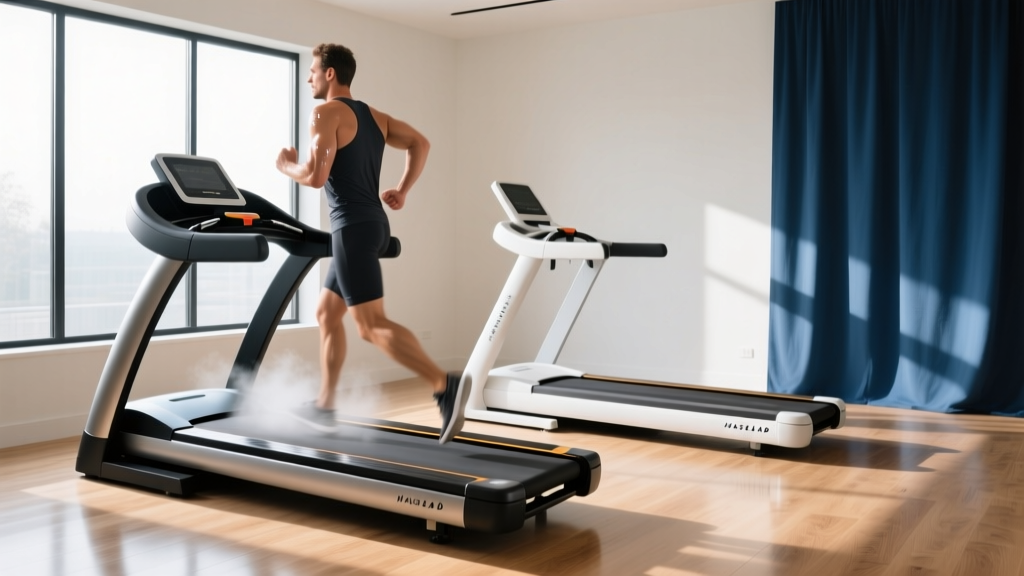
Curved U Treadmill vs Motorized: Mistakes & Fixes
Avoid common pitfalls when switching between a curved U treadmill and motorized models. Expert troubleshooting tips for form, maintenance, and pacing.

The Biomechanical and Mechanical Divide
The home cardio landscape has shifted dramatically, with the curved, self-powered U treadmill (often referred to as a U-shaped manual treadmill) challenging the dominance of traditional motorized decks. Models like the TrueForm Runner and Assault AirRunner have popularized the U treadmill design, characterized by a slatted urethane belt and a curved running surface that relies entirely on the user's biomechanics for propulsion. Conversely, motorized workhorses like the NordicTrack Commercial 1750 or Sole F80 rely on high-torque DC motors and continuous PVC belts.
While both platforms deliver exceptional cardiovascular conditioning, transitioning between them—or attempting to maintain them without understanding their distinct engineering—leads to a host of user errors and hardware failures. This guide dissects the most common mistakes and provides actionable troubleshooting protocols for both the U treadmill and standard motorized models in 2026.
The Biomechanical Learning Curve: Form Mistakes
The most frequent troubleshooting inquiries we receive aren't about broken parts; they are about user discomfort, joint pain, and inefficient workouts stemming from improper form.
Mistake 1: The Toe-Strike Trap on the U Treadmill
Because the U treadmill lacks a motor pulling the belt beneath your feet, you must generate the horizontal force to drive the slats backward. Many runners accustomed to motorized treadmills default to a forefoot or toe-strike when stepping onto a curved manual deck. This causes the slats to catch abruptly, leading to a jarring deceleration and severe Achilles tendon strain.
- The Fix: Adopt a mid-foot strike directly under your center of mass. According to a kinematic analysis published in the National Institutes of Health (NIH), curved treadmills naturally reduce stride length and increase cadence. Lean slightly forward from the ankles—not the waist—to engage the glutes and hamstrings, allowing the U-shape curvature to smoothly transition your foot strike from the top of the curve to the flat bottom.
Mistake 2: Handrail Dependency on Motorized Decks
On motorized treadmills, users frequently grip the handrails during high-incline intervals (12% to 15%). This 'holding on' mistake artificially supports body weight, reducing caloric expenditure by up to 24% and altering natural pelvic rotation, which often results in lower back pain.
- The Fix: If you cannot maintain the speed without holding on, the speed is too high. Drop the speed by 0.5 to 1.0 MPH, pump your arms at a 90-degree angle, and use the rails only for momentary balance checks. Fitness professionals certified by the American Council on Exercise (ACE) emphasize that unassisted walking on an incline recruits significantly more stabilizing core musculature than assisted walking.
Motorized treadmills feature shock-absorption elastomers beneath the deck, reducing peak GRF by 15-20% compared to asphalt. The U treadmill, however, relies on the flexibility of the urethane slats and the curved geometry to absorb impact. If you experience shin splints on a U treadmill, it is rarely a machine defect; it is almost always a symptom of over-striding and heel-striking on the downward slope of the curve.
Pacing and Speed Control Troubleshooting
Speed regulation is where the operational philosophy of these two machines diverges most sharply.
Motorized: The 'Ghost Pacing' Phenomenon
Motorized treadmills enforce a strict pace. A common mistake is 'zoning out' and allowing the belt to pull the user, leading to a dragging foot strike and eventual toe-catches on the motorized hood. To troubleshoot this mental fatigue, utilize 'Ghost Pacing': set the treadmill speed 0.2 MPH faster than your comfortable baseline and use audio cues (like a 170 BPM metronome track) to force a conscious cadence match.
U Treadmill: The Zone 2 Fluctuation Problem
Troubleshooting steady-state cardio on a U treadmill is notoriously difficult. Because speed is dictated by foot placement on the curve, maintaining an exact heart rate for Zone 2 training (typically 60-70% of max HR) often results in micro-fluctuations in speed, causing the user to constantly accelerate and decelerate.
- The Fix: Stop looking at the speedometer. The digital readouts on manual treadmills are calculated via magnetic sensors reading the slat rotations, which can lag or jump during micro-adjustments. Instead, map a specific physical landmark on the U treadmill's curve. For a TrueForm Runner, placing your foot strike precisely on the third slat from the top apex usually correlates to a 10:00 to 11:00 min/mile pace for an average-sized adult. Memorize your physical strike zone rather than chasing the digital MPH readout.
Maintenance & Hardware Failures: A Comparison Matrix
When hardware fails, the troubleshooting steps and replacement costs vary wildly between the two designs. Below is a diagnostic matrix for the most common mechanical issues encountered in home gyms.
| Issue Symptom | Motorized Treadmill Cause & Fix | U Treadmill (Manual) Cause & Fix |
|---|---|---|
| Belt Slipping / Hesitation | Drive belt tension is loose, or the walking belt lacks silicone lubrication. Fix: Tighten rear roller bolts by 1/4 turn; apply 100% silicone lube. | Urethane slats have lost grip, or the guide rail bearings are seized. Fix: Clean slats with isopropyl alcohol; apply lithium grease to side guide rails. |
| High-Pitched Squeaking | Motor hood rubbing against the belt, or worn motor mount bushings. Fix: Realign hood; replace rubber isolation mounts ($15-$30). | Metal-on-metal friction in the slat track or dry wheel bearings. Fix: Inject PTFE dry lubricant into the side track channels. |
| Sudden Stops / Power Loss | Overheating motor control board or tripped safety key magnet. Fix: Replace lower control board ($120-$250) or clear dust from motor vents. | N/A (Self-powered). If console dies, check the magnetic pickup sensor alignment near the front roller. |
| Estimated Major Replacement Cost | Deck & Belt Kit: $150 - $350 | Full Slat Belt Assembly: $450 - $850 |
Troubleshooting Specific Error Codes & Noises
Modern cardio equipment relies heavily on sensor feedback. When the machine detects an anomaly, it halts operation to prevent catastrophic failure or user injury.
Motorized Console Errors: Decoding the Digits
A flashing error code on a motorized console is the machine's way of isolating a subsystem failure. Two of the most common codes across major brands (Life Fitness, Precor, Sole) are speed and incline faults.
Speed Sensor Errors (e.g., Life Fitness Error 1 or Sole E1): This indicates the console is sending power to the motor, but the optical or magnetic reed switch on the flywheel is not registering rotation. Troubleshooting Step: Unplug the unit, remove the motor hood, and locate the small sensor zip-tied near the motor flywheel. Ensure the gap between the magnet and the sensor is exactly 2mm to 4mm. If it has vibrated out of place, reposition it. If the gap is correct, the sensor itself has failed and requires a $25 replacement part.
U Treadmill Squeaks and Friction Degradation
The U treadmill does not have a lower control board or a drive motor, meaning troubleshooting is entirely mechanical. The most common complaint in year three or four of ownership is a rhythmic 'thumping' or squeaking that correlates with stride cadence.
This is rarely a structural failure. The urethane slats on a U treadmill are subjected to immense sheer force. Over time, microscopic debris (dust, pet hair, drywall dust from home gyms) embeds itself into the side guide tracks where the slat bearings roll.
- Step 1: Flip the treadmill on its side (requires two people; models like the AirRunner weigh over 280 lbs).
- Step 2: Use a shop-vac with a brush attachment to aggressively vacuum the exposed guide tracks.
- Step 3: Apply a PTFE (Teflon) based dry lubricant. Warning: Never use WD-40 or wet silicone sprays on a U treadmill track. Wet lubricants will attract dust, creating an abrasive paste that will grind the sealed bearings to dust within weeks.
Expert Verdict: Aligning Your Choice with Your Maintenance Reality
Troubleshooting a motorized treadmill requires basic electrical diagnostics, an understanding of belt tensioning, and occasional component replacements (motors, control boards). It is a high-maintenance machine with many moving, electrified parts.
The U treadmill, by contrast, is a masterclass in mechanical simplicity. You will never troubleshoot a blown capacitor or a fried motherboard. However, the physical maintenance of the slat track and the strict biomechanical discipline required to run on it without injury demand a different kind of upkeep. If you are willing to master the mid-foot strike and perform bi-annual track lubrication, the U treadmill offers a vastly superior, joint-friendly running mechanic with a significantly lower long-term hardware failure rate.
More gear to consider
All reviews
Under Desk Treadmill Review: NordicTrack C1250 Treadmill Care

Stair Climber vs Safe Treadmill for Seniors: 2026 Guide

ProForm Cadence 4.0 Treadmill Motor Troubleshooting & HP Guide

Horizon Fitness 7.0AT Studio Series Treadmill vs Walking Pads
ProForm 14.0 Treadmill vs Ellipticals: Home Space Layout Guide
