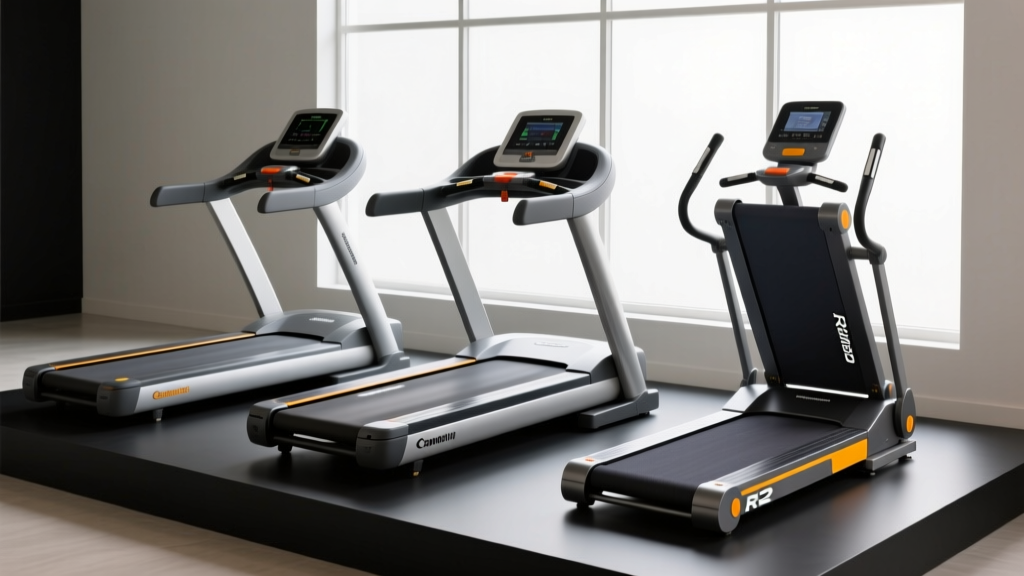
Curved vs Motorized Treadmill vs WalkingPad R2 Folding Treadmill
Compare curved manual treadmills, standard motorized models, and the WalkingPad R2 folding treadmill. Expert buying guide with specs, costs, and biomechanics.

The Home Cardio Paradigm Shift: Choosing Your Drive Type
As we navigate the fitness equipment landscape in 2026, the traditional one-size-fits-all motorized treadmill no longer dominates the home gym. Buyers are now forced to choose between three distinct biomechanical and spatial categories: the heavy-duty curved manual treadmill, the traditional motorized workhorse, and the ultra-compact micro-folder. Understanding the mechanical differences, long-term maintenance costs, and physiological demands of each is critical before dropping thousands of dollars on a machine that might not fit your gait or your floor plan.
This in-depth buying guide dissects the physics of curved manual belts, the engineering of standard motorized decks, and the specific spatial advantages of the WalkingPad R2 folding treadmill to help you make a data-driven purchasing decision.
The Biomechanics of the Drive: Curved Manual vs. Motorized
The fundamental difference between a curved manual treadmill and a motorized unit lies in who is generating the kinetic energy. On a motorized treadmill like the Sole F80 or NordicTrack Commercial 1750, a continuous-duty motor pulls the belt beneath you. This mechanical assistance often encourages a rearfoot (heel) strike, especially at higher speeds, which can increase braking forces and transmit shock directly up the tibia to the knee joint.
Conversely, curved manual treadmills—such as the TrueForm Runner ($4,295) or the AssaultRunner Elite ($3,999)—feature a slatted, vulcanized rubber belt resting on a curved track with zero motor assistance. To move the belt, the user must drive their foot down and back, engaging the glutes and hamstrings.
'The curved geometry forces the user's center of mass forward, naturally promoting a midfoot or forefoot strike. This reduces the impact transient at heel contact and significantly increases posterior chain activation compared to motorized alternatives.'
Because you are the engine, the caloric and cardiovascular demand is substantially higher. Studies indicate that running on a non-motorized curved treadmill can increase oxygen consumption and heart rate by up to 30% at the same perceived pace. This makes curved treadmills exceptional tools for achieving the vigorous-intensity thresholds recommended by the American Heart Association in significantly shorter workout windows.
The Space-Saving Disruptor: Where the WalkingPad R2 Folding Treadmill Fits In
While curved treadmills offer elite biomechanics and motorized units offer programmable inclines, both demand massive footprints (often exceeding 30 square feet). Enter the WalkingPad R2 folding treadmill by KingSmith. Priced around $599 to $699, the R2 is not designed for marathon training; it is engineered for NEAT (Non-Exercise Activity Thermogenesis) and light jogging in ultra-constrained environments.
WalkingPad R2 Technical Specifications
- Motor: 1.2 HP Continuous Duty (Brushless)
- Top Speed: 7.5 MPH (12 km/h) with handrail deployed; 3.7 MPH in flat walking mode
- Weight Capacity: 265 lbs (120 kg)
- Deck Dimensions: 47 x 17 inches (Running area)
- Folded Profile: 180-degree hinge reduces height to just 5 inches
The R2 lacks a traditional suspended deck, meaning impact absorption is minimal. According to guidelines on joint health and aerobic exercise impact, users with pre-existing plantar fasciitis or severe knee osteoarthritis should stick to the R2's walking modes (under 4.0 MPH) rather than utilizing the 7.5 MPH jogging capability, as the thin EVA foam mat provides less shock dispersion than a 1-inch phenolic deck on a full-sized motorized unit.
Head-to-Head Comparison Matrix
To visualize how these three distinct categories stack up for the 2026 home gym buyer, review the comparison matrix below.
| Feature | Curved Manual (TrueForm Runner) | Motorized (Sole F80) | WalkingPad R2 Folding Treadmill |
|---|---|---|---|
| Estimated Price | $4,295 | $1,999 | $599 - $699 |
| Footprint (L x W) | 68 x 31 inches | 80 x 35 inches | 60 x 28 inches (Unfolded) |
| Drive System | 3.5 CHP Motor | 1.2 HP Brushless Motor | |
| Max Speed | Unlimited (User dependent) | 12 MPH | 7.5 MPH |
| Incline Capability | Fixed Curve (Simulates 6-8%) | 0% - 15% Motorized | 0% (Fixed Flat) |
| Acoustic Output | Low (Rubber slat hum) | Medium-High (Motor + footfall) | Low-Medium (High-pitch whine) |
| Primary Use Case | HIIT, Sprint Mechanics, Athletic Conditioning | Steady-State Cardio, Marathon Training, Incline Walking | Under-Desk Walking, NEAT, Light Apartment Jogging |
Real-World Failure Modes and Maintenance Costs
Every cardio machine has specific mechanical failure points. Understanding these will dictate your 5-year cost of ownership.
1. Curved Manual Treadmills
Because there is no motor or electronic control board, curved treadmills are immune to power surges and software bricking. However, the guide rail bearings and slat belt tension require attention. Over 2 to 3 years of heavy sprinting, the vulcanized rubber slats can stretch, causing the belt to slip during aggressive accelerations. Re-tensioning requires a specialized hex tool and 20 minutes of labor. If the belt degrades entirely, a replacement slat belt kit costs between $600 and $850.
2. Standard Motorized Treadmills
The most common failure mode for motorized units like the Sole F80 is deck friction. If the user neglects to apply 100% silicone lubricant to the deck every 3 to 6 months, the friction coefficient spikes. This forces the drive motor to draw excessive amperage to maintain belt speed, eventually tripping the thermal breaker or frying the lower control board. Replacing a control board costs $250-$400, while a warped deck requires a $300+ parts replacement and significant teardown labor.
3. The WalkingPad R2
The R2's 1.2 HP motor is highly efficient for walking but operates near its thermal limit during continuous jogging. Running at 7.0+ MPH for longer than 45 minutes can trigger the unit's internal thermal shutoff to prevent motor melting. Furthermore, the locking hinge mechanism can develop lateral play over time if the unit is dragged across carpets while folded, rather than being rolled on its designated transport wheels.
Decision Framework: Which Footprint Suits Your 2026 Goals?
Do not buy a machine based purely on aesthetics; buy based on your physiological requirements and spatial reality.
- Choose the Curved Manual Treadmill if: You are an athlete focused on sprint mechanics, HIIT protocols, and reducing knee-joint impact transients. You have a dedicated garage gym space and a budget exceeding $3,500. You want a machine that requires zero electrical outlets and has no software subscription paywalls.
- Choose the Motorized Treadmill if: You are training for a 10K or marathon and require precise, programmable pacing and 15% incline simulations. You have a dedicated room with at least 8-foot ceilings (to accommodate the deck height plus your head clearance) and prefer the passive assistance of a motorized belt for long, steady-state zone 2 cardio sessions.
- Choose the WalkingPad R2 Folding Treadmill if: You live in a multi-family apartment or condo where space is at a premium. Your primary goal is increasing daily step counts, combating sedentary desk-work, and achieving light cardiovascular health without dedicating 30 square feet of permanent floor space to a piece of fitness equipment. You value the ability to slide your treadmill under a sofa or bed in under 10 seconds.
Ultimately, the 'best' treadmill is the one that aligns with your biomechanics, respects your spatial constraints, and remains functional enough to endure your daily routine without requiring a technician's visit. Evaluate your gait, measure your room, and select the drive type that supports your longevity.
More gear to consider
All reviews
Air Bike vs Assault Bike: Track Treadmill Workouts & Cardio ROI
2026 Quiet Treadmills for Orange Theory Treadmill Workouts

What's Better for Losing Weight: Elliptical or Treadmill? 2026 Guide

Motor Sizing Guide: Treadmill Workouts for Beginners to Lose Weight
Walking Pad vs Treadmill: Using a Treadmill Distance Calculator
