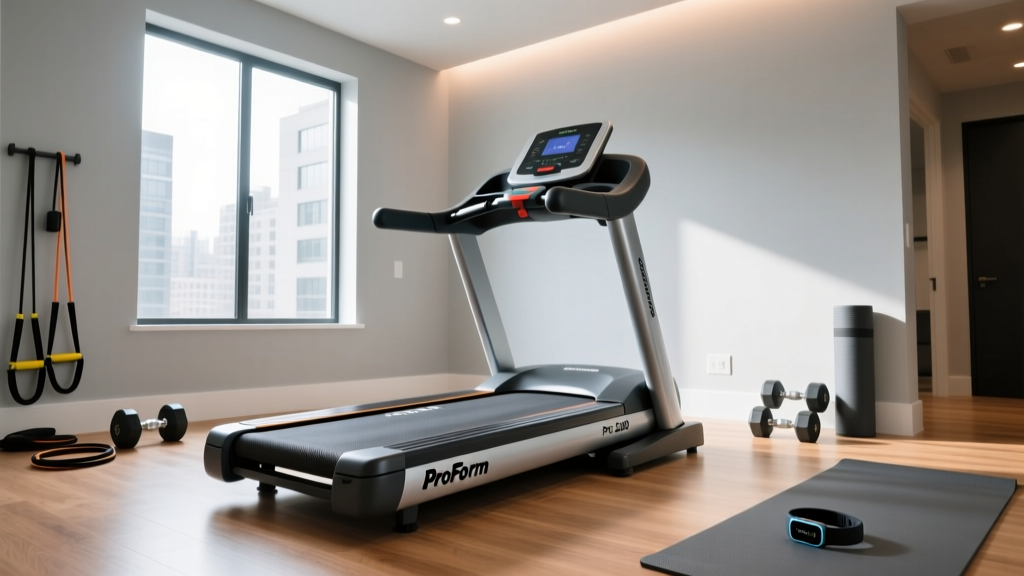
Curved vs Motorized: Reviews on ProForm Pro 2000 Treadmill & Guide
Learn how to choose between curved manual and motorized treadmills. We analyze reviews on ProForm Pro 2000 treadmill models to guide your 2026 home gym buy.

Introduction: The Great Treadmill Divide
Stepping into the home fitness market in 2026, beginners are immediately confronted with a major biomechanical fork in the road: should you buy a curved manual treadmill or a traditional motorized model? Both promise excellent cardiovascular conditioning, but they achieve this through entirely different mechanical philosophies. One relies on a high-torque motor and digital pacing, while the other relies entirely on your own kinetic output. Making the wrong choice can lead to buyer’s remorse, wasted floor space, and abandoned fitness goals.
This step-by-step guide will walk you through the exact differences between curved and motorized treadmills. To ground our comparison in reality, we will use the highly popular motorized ProForm Pro 2000 as our baseline benchmark, while comparing it against the industry-standard curved Assault AirRunner. By the end of this guide, you will know exactly which machine belongs in your home gym.
Step 1: Decode the Biomechanics (Curved vs. Motorized)
Before looking at specific models, you must understand how your body interacts with the deck. A traditional motorized treadmill pulls your feet backward at a predetermined speed. Your primary physical job is to keep up with the belt and maintain balance. According to Harvard Health Publishing, running at a 6 mph pace burns roughly 372 calories in 30 minutes for a 185-pound individual.
Curved treadmills, however, are entirely self-powered. The concave shape of the deck means that when you push forward and strike the front of the curve, your body weight and leg drive pull the slat belt downward and backward. Studies on non-motorized curved treadmills show they can increase caloric expenditure by up to 30% compared to flat motorized decks at the same perceived exertion level, because you are actively driving the resistance rather than just keeping pace with it.
Beginner Insight: Curved treadmills naturally encourage a mid-foot or forefoot strike, which can reduce the harsh heel-strike impact associated with traditional motorized treadmills. However, they demand significantly more posterior chain (glute and hamstring) activation.
Step 2: Assess Your Space and Electrical Constraints
Your physical environment will often make the decision for you. Motorized treadmills are heavy, long, and power-hungry. Curved treadmills are compact but incredibly dense.
- Electrical Requirements: Motorized units like the ProForm require a dedicated 15-amp electrical circuit. Plugging them into a shared living room outlet with a TV and AC unit will frequently trip the breaker during high-incline sprints.
- Footprint: Motorized treadmills typically measure 75 to 80 inches in length. Curved treadmills are much shorter (usually around 65 to 70 inches) because they do not need a long motor housing at the front.
- Weight & Mobility: A motorized treadmill weighs between 200 and 250 lbs. A curved manual treadmill features a dense steel frame and heavy rubber slats, often weighing over 280 lbs. While curved treadmills take up less space, they are much harder to move once assembled.
Step 3: Benchmark the Motorized Option (ProForm Pro 2000 Deep Dive)
If you are sifting through reviews on ProForm Pro 2000 treadmill models to see if a motorized deck is right for you, you will quickly find that it represents the sweet spot for beginners wanting interactive training without a luxury price tag. The Pro 2000 is designed for users who want guided pacing, decline training, and digital integration.
Real-World Specs & 2026 Pricing
Motor: 3.25 CHP Mach Z Commercial Plus (Continuous duty, meaning it sustains this power without overheating during long runs).
Belt Size: 20 x 60 inches (The gold standard for running; anything narrower feels claustrophobic for users over 5’10″).
Incline/Decline: -3% to 12% (The 3% decline is a rare feature in this price bracket, excellent for quad-dominant downhill training).
Pricing: While MSRP hovers around $1,099, real-world street pricing in 2026 frequently drops between $599 and $799 during seasonal sales. Factor in an iFIT subscription ($15 to $39/month) for full interactive functionality.
The primary advantage highlighted in expert reviews is the automated pacing. If you are a beginner struggling to maintain a steady heart rate, the ProForm’s motor and iFIT software will automatically adjust the speed and incline to keep you in your target zone. You do not have to think; you just run.
Step 4: Benchmark the Curved Option (Assault AirRunner)
To provide a fair comparison, we must look at the curved benchmark: the Assault AirRunner. Priced significantly higher (typically around $2,999 to $3,299), it is a staple in CrossFit boxes and elite home gyms.
The AirRunner uses a heavy-duty vulcanized rubber slat belt running on over 100 sealed ball bearings. There is no motor, no screen, and no electrical cord. You simply step on and run. The learning curve is steep; beginners often report feeling off-balance for the first 10 to 15 minutes as they learn to control the belt speed by shifting their center of gravity forward or backward. However, once mastered, the physiological demand is unmatched. As noted by the Mayo Clinic, high-intensity interval training (HIIT) is one of the most efficient ways to improve cardiovascular health, and curved treadmills are inherently designed for rapid, self-paced HIIT sprints without waiting for a motor to spool up or slow down.
Step 5: The Beginner’s Decision Matrix
Use this matrix to determine which machine aligns with your specific lifestyle, budget, and fitness goals.
| Feature / Need | Motorized (ProForm Pro 2000) | Curved Manual (Assault AirRunner) |
|---|---|---|
| Primary Goal | Steady-state cardio, guided pacing, walking | HIIT, athletic conditioning, sprinting |
| Budget (2026) | $599 - $799 (+ monthly software fees) | $2,999 - $3,299 (No software fees) |
| Caloric Burn | Standard baseline | Up to 30% higher at same perceived effort |
| Joint Impact | Moderate (cushioned deck, encourages heel strike) | Lower (slat belt absorbs shock, encourages mid-foot strike) |
| Tech Integration | High (HD Touchscreen, Bluetooth, auto-adjust) | Zero (Optional basic LCD metrics tracker only) |
| Maintenance | Belt alignment, motor dusting, software updates | Silicone slat lubrication every 6 months |
Step 6: Maintenance Realities for Beginners
Many beginners ignore maintenance until the machine breaks. According to the Runner’s World Treadmill Buying Guide, proper upkeep is the difference between a machine that lasts three years and one that lasts fifteen.
- Motorized Belt Lubrication: The ProForm Pro 2000 comes with a pre-lubricated belt, but after 150 to 200 miles of running, you must lift the belt and apply 100% silicone treadmill lubricant. Failure to do so creates friction, which draws excess amperage and will eventually fry the motor control board.
- Curved Slat Maintenance: The Assault AirRunner requires you to vacuum dust out of the slat tracks monthly. Every six months, you must apply a specialized silicone spray to the guide rails to prevent the rubber slats from squeaking and binding.
- Leveling: Both machines require a perfectly level floor. An uneven floor on a motorized treadmill causes the belt to drift to one side, fraying the edges. On a curved treadmill, an unlevel floor will cause the machine to ‘roll’ or feel heavily biased to one leg, leading to hip imbalances.
Frequently Asked Questions
Can I walk on a curved treadmill?
Yes, but it is not ideal. Curved treadmills require a certain amount of kinetic force to keep the heavy slat belt moving. Walking at a slow pace (under 2.5 mph) often results in a jerky, stop-and-start belt motion that feels unnatural. If your primary exercise is walking or light jogging, a motorized treadmill like the ProForm is vastly superior.
Is the ProForm Pro 2000 good for heavy runners?
The ProForm Pro 2000 has a stated weight capacity of 300 lbs. However, for users near this limit, the 3.25 CHP motor will work harder, generating more heat and potentially shortening the motor’s lifespan. Heavy runners (250+ lbs) are generally better served by a curved treadmill, which has no motor to burn out, or a motorized treadmill with a 4.0+ CHP motor and a 350+ lb weight capacity.
Do curved treadmills need a surge protector?
No. Because curved manual treadmills do not plug into the wall, you do not need to worry about power surges, dedicated circuits, or electrical fires. This makes them an excellent choice for garages, sheds, or older homes with outdated electrical wiring.
More gear to consider
All reviews
Can You Lose Weight Walking On A Treadmill? Pad Mistakes

Air Bike vs Assault Bike Guide & How to Lubricate a Treadmill

4.0 HP Treadmill Noise vs. Quiet Cardio: 2026 Buying Guide

What Is a Good Walking Speed on Treadmill to Reduce Noise?

Pro Form Treadmill vs Stair Climber: 2026 Home Guide
