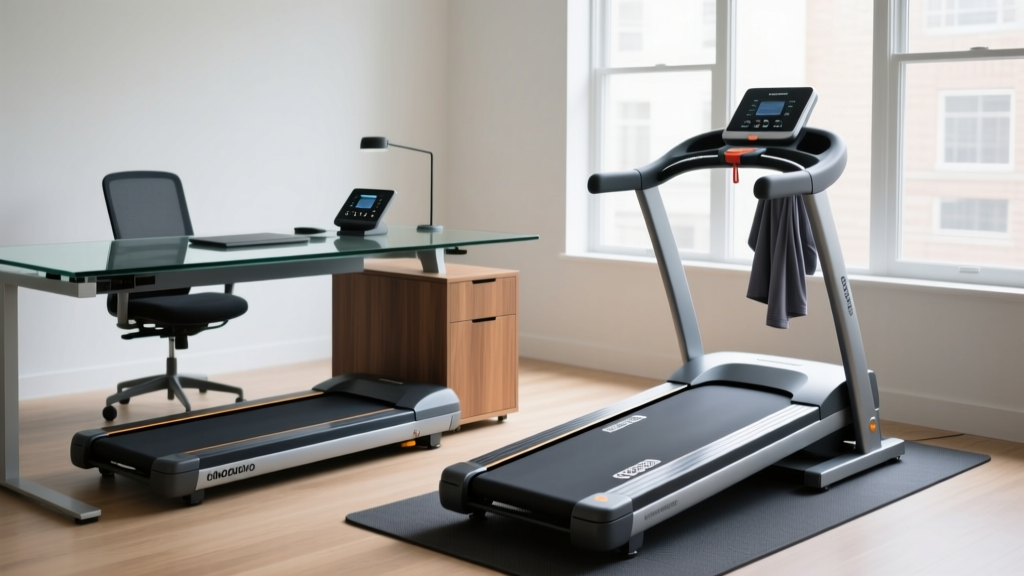
Under Desk Treadmill vs Motorless Curved Treadmill: Office Review
We test top under desk treadmills for office use and compare them to the motorless curved treadmill trend. Find out which fits your 2026 home workspace.

The 2026 Home Office Cardio Dilemma
As remote and hybrid work models solidify in 2026, the home office has evolved from a temporary desk in the corner to a permanent, ergonomically optimized command center. Among the most popular upgrades for combating sedentary fatigue is the under-desk treadmill. However, a growing trend in fitness circles has many remote workers asking a critical question: Should I skip the flat walking pad and invest in a motorless curved treadmill for my office instead?
At FitGearPulse, we have spent the last three months testing the leading under-desk treadmills for daily office use and pitting them against the biomechanical marvel that is the motorless curved treadmill. The results challenge a lot of the marketing hype you will find on social media. Below is our comprehensive, hands-on review, complete with exact dimensions, ergonomic data, and real-world noise metrics to help you make the right choice for your workspace.
Expert Insight: The Footprint Reality CheckBefore diving into the reviews, understand the physical limitations of your space. A standard motorless curved treadmill requires a minimum footprint of 76 x 33 inches and features high handrails. An under-desk treadmill averages 50 x 20 inches and is designed to slide beneath a desk that sits 40-44 inches off the ground. You cannot physically use a curved treadmill under a standard desk. They serve two entirely different office paradigms.
Hands-On Review: Top Under-Desk Treadmills for Office Use
When evaluating under-desk treadmills for 8-hour workdays, we prioritize continuous duty motor heat dissipation, belt length relative to stride, and decibel output during Zoom calls. Here are our top picks for 2026.
1. Lifespan TR1200-Glow (The Heavy-Duty Workhorse)
The Lifespan TR1200-Glow remains the gold standard for dedicated walking-desk setups. Unlike folding walking pads, this is a commercial-grade unit built to run for 6+ hours a day without the motor overheating.
- Price: $1,299
- Belt Dimensions: 56' L x 20' W
- Max Speed: 4.0 mph
- Noise Level: 58 dB at 2.0 mph (quiet enough for unmuted calls)
- Weight Capacity: 350 lbs
The Hands-On Verdict: The 56-inch belt is the standout feature here. It accommodates a full walking stride for users up to 6'2' without the fear of stepping on the rear motor housing. The console features a built-in red LED glow strip that acts as a visual pacer, which is surprisingly useful when you are focused on a spreadsheet and not looking at the display. The 2.25 HP continuous-duty motor barely gets warm after a 4-hour session.
2. WalkingPad C2 (The Compact Budget Pick)
For those who do not have a dedicated office room and need to stow their equipment under a sofa after work, the WalkingPad C2 is the undisputed king of compact design.
- Price: $499
- Belt Dimensions: 47.2' L x 17.3' W
- Max Speed: 3.7 mph
- Noise Level: 65 dB at 3.0 mph (noticeable hum, requires a good headset mic)
- Weight Capacity: 240 lbs
The Hands-On Verdict: The C2 folds in half, reducing its storage footprint to roughly 32 x 20 inches. However, the 47-inch belt restricts you to a brisk walk. If you attempt to jog at 3.7 mph, the short belt forces you to shorten your stride, which can lead to anterior knee pain over time. It is an excellent tool for Non-Exercise Activity Thermogenesis (NEAT), but not for dedicated cardio sessions.
The Motorless Curved Treadmill: Can It Work in a Home Office?
Motorless curved treadmills—like the TrueForm Runner ($4,495) or the Technogym Skillmill ($6,500)—are masterpieces of biomechanics. They use a slatted belt and magnetic resistance, allowing you to dictate the pace entirely through your foot strike. But can you use one while working?
The short answer is no, not while typing.
The primary issue is ergonomic interference. According to CDC NIOSH Ergonomics guidelines, your desk height should allow your elbows to rest at a 90-degree angle. For an average 5'10' user, this means the desk surface should be roughly 41 inches from the floor. The apex of the handrails on a standard motorless curved treadmill sits between 44 and 48 inches high. If you attempt to place a curved treadmill under a standing desk, you will be forced to type underneath the handrails, resulting in severe wrist extension and shoulder elevation.
Furthermore, the rear upward curve of the belt extends the machine's length to over 75 inches. You would need a massive, dedicated open-plan office to accommodate it. Curved treadmills are for performance cardio in a home gym, not for answering emails.
| Feature | Under-Desk Flat Treadmill (Lifespan TR1200) | Motorless Curved Treadmill (TrueForm Runner) |
|---|---|---|
| Primary Use | Low-intensity walking while typing/working | High-intensity interval training (HIIT) & sprinting |
| Total Footprint | 63' L x 20' W | 76' L x 33' W |
| Desk Compatibility | Fits under standard 40'+ standing desks | Handrails block desk access; requires open space |
| Top Speed | 4.0 mph (Motor limited) | Unlimited (User generated, easily hits 15+ mph) |
| Price Range | $499 - $1,299 | $3,995 - $6,500+ |
Biomechanics and NEAT: What the Science Says
Why bother with an under-desk treadmill at all? The science revolves around NEAT (Non-Exercise Activity Thermogenesis). Harvard Health Publishing notes that prolonged sitting suppresses lipoprotein lipase, an enzyme crucial for breaking down fats in the bloodstream. By walking at a leisurely 1.5 to 2.0 mph while working, you keep this enzyme active without triggering the sympathetic nervous system response (sweating, elevated heart rate) that would distract you from cognitive tasks.
Conversely, the Mayo Clinic emphasizes that to counteract the metabolic damage of sitting, you need both low-intensity movement throughout the day and dedicated vigorous exercise. This is where the two machines complement each other perfectly in a holistic home setup: the flat under-desk treadmill handles your 6-hour workday NEAT requirements, while the motorless curved treadmill handles your 30-minute post-work VO2 max intervals.
The Verdict: How to Choose for Your Workspace
Choose an Under-Desk Flat Treadmill if: Your primary goal is to stop sitting while you work, answer emails, and attend virtual meetings. Invest in a heavy-duty model like the Lifespan TR1200 if you plan to walk for more than 3 hours a day to avoid burning out a budget motor.
Choose a Motorless Curved Treadmill if: You have a dedicated home gym space (not an office), you want to perform sprint intervals, and you want a machine that requires zero electricity and has virtually no motor maintenance. Do not buy this expecting to use it while typing on a laptop.
FAQ: Office Treadmill Edge Cases
Q: Will an under-desk treadmill damage my hardwood floors?
A: Yes, over time. The constant micro-vibrations will dent and scratch hardwood. Always use a high-density PVC treadmill mat (at least 3/16-inch thick) that extends 6 inches beyond the machine's footprint to catch dust and distribute the dynamic load.
Q: Can I use a walking pad without a standing desk?
A: We strongly advise against it. Looking down at a laptop resting on a low table while walking alters your cervical spine alignment, leading to 'tech neck' and tension headaches. Your screen must be at eye level, which requires a proper motorized standing desk.
Q: How often do I need to lubricate the belt?
A: For daily office use (4+ hours a day), you should apply 100% silicone treadmill lubricant every 90 days. Budget walking pads often feature 'maintenance-free' belts, but in our testing, these still develop friction hot-spots after 14 months of heavy use, leading to motor strain.
More gear to consider
All reviews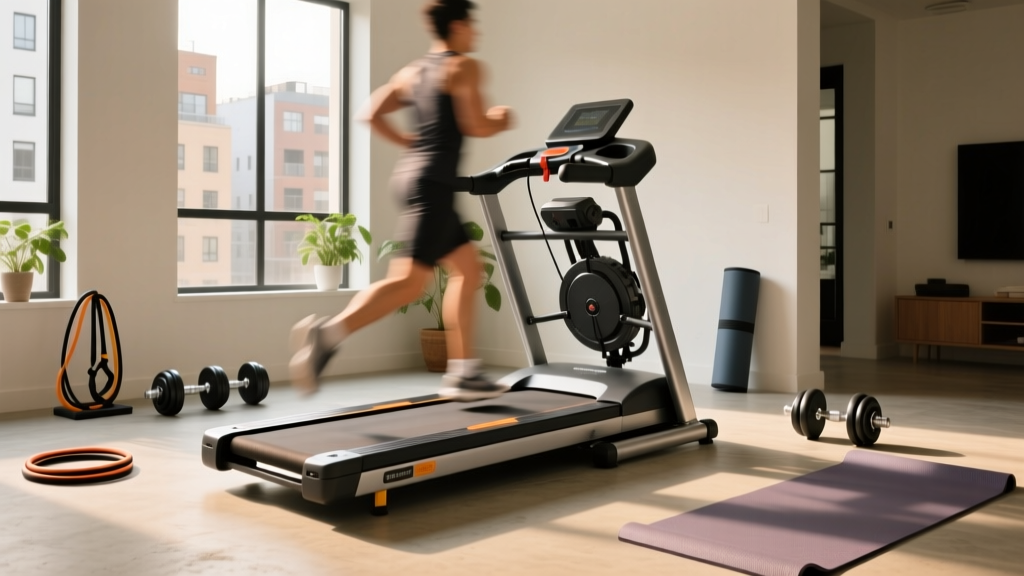
Treadmill Smells Like Burning Rubber? Best Folding Picks Reviewed

Planet Fitness Treadmill vs Elliptical: Space Layout Guide

Elliptical vs Treadmill Care: Exercise Bike vs Treadmill for Weight Loss

Elliptical vs Treadmill Cardio & ProForm Treadmill Track Adjustment

Air Bike vs Assault Bike Guide: Translating Treadmill Speed to Pace KM
