
Curved vs Motorized Treadmills: Anti Static Treadmill Mat Fixes
Compare curved vs motorized treadmills with our expert troubleshooting guide. Learn how an anti static treadmill mat prevents console failure and belt slip.

The Great Debate: Curved Manual vs. Motorized Treadmills
When outfitting a home gym in 2026, the choice between a curved manual treadmill and a traditional motorized treadmill dictates not just your workout biomechanics, but your long-term maintenance workload. Motorized models like the Sole F80 or NordicTrack 1750 offer automated inclines and interactive programming, while curved manual options like the Woodway Curve or TrueForm Runner rely on your own stride to drive the belt, offering unlimited top speeds and a lower impact profile. However, both architectures share a common vulnerability to environmental and mechanical user errors. According to the Consumer Product Safety Commission (CPSC), improper maintenance and environmental factors are leading causes of treadmill degradation and user injury. This troubleshooting guide breaks down the most common mistakes for both treadmill types and reveals the most overlooked preventative tool in your arsenal: the anti static treadmill mat.
The Hidden Enemy: Static Electricity and Console Failure
Before diving into mechanical differences, we must address the silent killer of treadmill electronics: static electricity. As your running shoes repeatedly strike the treadmill belt, friction generates a massive electrostatic charge. In low-humidity environments (common in winter or air-conditioned home gyms), this charge can build up to 10,000 to 15,000 volts.
⚠️ CRITICAL WARNING: Without a proper grounding mechanism, this static charge travels through the belt, into the metal frame, and directly into the Motor Control Board (MCB) or console motherboard. A single electrostatic discharge (ESD) event can fry a $250 MCB or a $600 HD touchscreen, voiding your warranty if the manufacturer detects ESD damage.This is where an anti static treadmill mat becomes non-negotiable. Unlike standard rubber gym mats that merely protect your flooring from sweat and vibrations, a true anti static treadmill mat is manufactured with conductive carbon backing or copper-strip grounding layers. This safely dissipates the electrical charge into the floor, protecting your machine's sensitive lower control boards. While motorized treadmills are highly susceptible due to their complex wiring, curved treadmills with digital displays and electromagnetic resistance modules (like the Technogym Skillmill) are equally at risk.
Troubleshooting Motorized Treadmills: Common Mistakes & Fixes
Motorized treadmills require a delicate balance of belt tension, lubrication, and electrical stability. Here are the most frequent troubleshooting scenarios we see in the field.
Mistake 1: Over-Tightening a Slipping Belt
The Symptom: The belt hesitates or slips underfoot during heavy sprinting, often throwing an E1 or E2 error code (speed sensor mismatch) on models like the Sole F80.
The Mistake: Users immediately grab a hex key and crank the rear roller bolts, over-tightening the belt. This creates excessive friction, overheats the drive motor, and eventually snaps the belt seam.
The Fix: First, check lubrication. A dry belt slips. Apply exactly 1.5 ounces of 100% silicone treadmill lubricant under the belt. If it still slips, adjust the rear roller bolts only a quarter-turn (90 degrees) at a time. The belt should lift about 2 to 3 inches off the deck in the center when the machine is off.
Mistake 2: Ignoring Voltage Drops and ESD
The Symptom: The console randomly reboots mid-run, or the incline motor behaves erratically.
The Mistake: Plugging the treadmill into a shared extension cord or ignoring static shocks when touching the handrails.
The Fix: Plug the treadmill directly into a dedicated 15-amp or 20-amp wall outlet. Furthermore, deploy a high-quality anti static treadmill mat beneath the machine to prevent static buildup from disrupting the optical speed sensor or rebooting the console.
Troubleshooting Curved Manual Treadmills: Slat Belts and Bearings
Curved manual treadmills eliminate the drive motor, but they introduce complex mechanical track systems. The American Council on Exercise (ACE) notes that curved treadmills alter running biomechanics, placing different wear patterns on the equipment compared to motorized decks.
Mistake 1: Lubricating a Slat Belt
The Symptom: The track feels 'sticky' or makes a squeaking noise.
The Mistake: Applying silicone spray to a curved slat belt (like on a Woodway Curve). Slat belts run on sealed ball bearings and UHMW (Ultra-High-Molecular-Weight) polyethylene guide rails. Liquid lubricants attract dust, creating a grinding paste that destroys the guide rails.
The Fix: Never use liquid lubricants on a curved manual treadmill. If the track is sticky, wipe the guide rails with a damp microfiber cloth and a mild degreaser. If squeaking persists, the sealed 608ZZ bearings inside the slats may be failing and require individual slat replacement.
Mistake 2: Misaligning the Running Track
The Symptom: The belt drifts to the left or right, rubbing against the side shrouds.
The Mistake: Attempting to 'center' the belt by adjusting only one side of the rear tensioner.
The Fix: Curved treadmills require symmetrical tension. Use the manufacturer's tension gauge (or a calibrated torque wrench) to ensure both the left and right rear axle bolts are tightened to the exact same specification (usually around 15-20 Nm, depending on the brand).
Comparison Matrix: Maintenance & Troubleshooting Profiles
| Feature | Motorized Treadmill (e.g., Sole F80) | Curved Manual (e.g., Woodway Curve) |
|---|---|---|
| Belt Type | Continuous PVC/Rubber loop over MDF deck | Vulcanized rubber slats on ball bearings |
| Lubrication | Required (100% Silicone every 150 miles) | Never (Sealed bearings & UHMW rails) |
| Static Risk Level | High (Direct threat to MCB & Console) | Moderate (Threat to digital display modules) |
| Anti Static Mat Need | Critical for electronic survival | Highly recommended for display longevity |
| Avg. Belt Replacement Cost | $120 - $180 (DIY feasible) | $400 - $800 (Professional service advised) |
How to Choose and Install the Right Anti Static Treadmill Mat
Not all gym mats are created equal. A standard EVA foam puzzle mat will actually increase static buildup due to its insulating properties. To properly ground your machine, follow this purchasing and installation framework:
- Verify the Material: Look for mats specifically labeled as 'ESD-safe' or 'anti static treadmill mat'. These are typically constructed from dense PVC infused with carbon black, or feature a copper grounding strip.
- Check the Thickness: For heavy motorized treadmills (250+ lbs), choose a mat that is at least 6mm to 8mm thick to prevent bottoming out under the machine's feet, which can cause the frame to torque and misalign the belt.
- Size Appropriately: The mat must extend at least 12 inches beyond the rear of the treadmill to catch sweat and provide a stable step-off zone.
- Ensure Floor Contact: The mat must sit flat against the floor. If you have thick carpet, the anti static properties may be hindered. In carpeted rooms, consider an ESD floor grounding cord that plugs into the grounding prong of a nearby wall outlet.
Expert FAQ: Solving Persistent Treadmill Glitches
Why does my treadmill console flicker when I turn on the AC?
This is a classic voltage drop issue. When your HVAC compressor kicks on, it draws a massive surge of amperage, starving the treadmill's power supply. The console flickers or resets. Solution: Move the treadmill to a dedicated circuit breaker and ensure your anti static treadmill mat is properly dissipating secondary static charges that might be compounding the electrical instability.
My curved treadmill feels like it's 'stuttering' at the top of the curve. Is the belt broken?
Not necessarily. Stuttering on a curved manual treadmill usually indicates that the slat belt tension is too loose, causing the slats to catch on the UHMW guide rails at the apex of the curve. Consult your owner's manual to adjust the rear tensioner bolts symmetrically. Do not over-tension, or you will prematurely wear out the internal slat bearings.
Can I just use a dryer sheet to wipe down the belt and stop static shocks?
No. While dryer sheets contain anti-static compounds, they also leave behind a waxy, slippery residue. On a motorized treadmill, this will cause the belt to slip and throw error codes. On a curved treadmill, it will ruin the grip of the rubber slats. Stick to a dedicated anti static treadmill mat and maintain proper room humidity (40-50%) to eliminate shocks safely.
More gear to consider
All reviews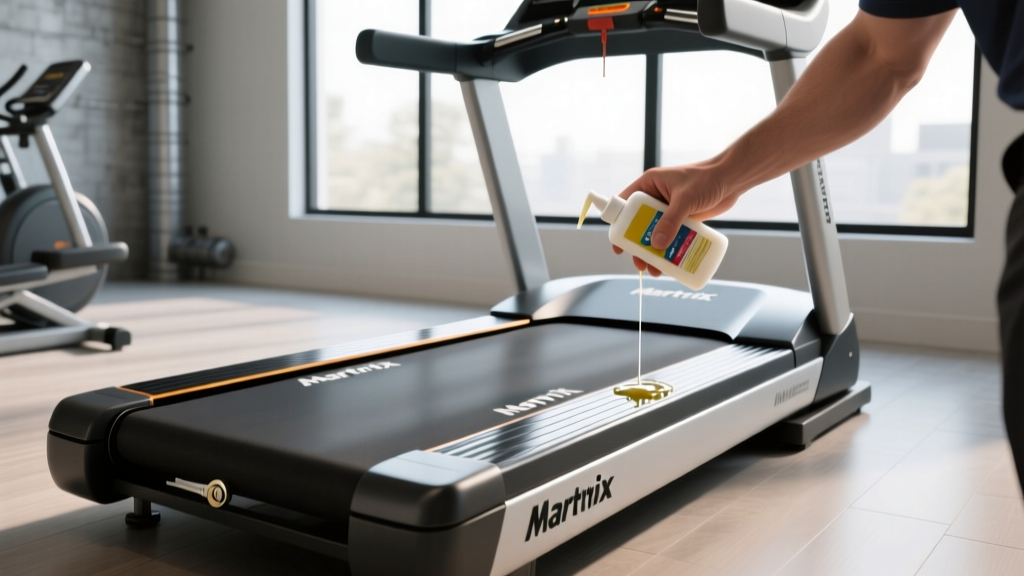
Matrix Treadmill How to Use and Maintain: Belt Lubrication Guide

Compact Layouts: Running Program for Treadmill & Bike Pairings

Intermix Acoustics 2.0 Treadmill Noise Comparison

BXT8J Treadmill Noise Guide: Step-by-Step Cardio Machine Comparison
Walking Pad vs. Treadmill: Fixing 8 Incline on Treadmill Mistakes
