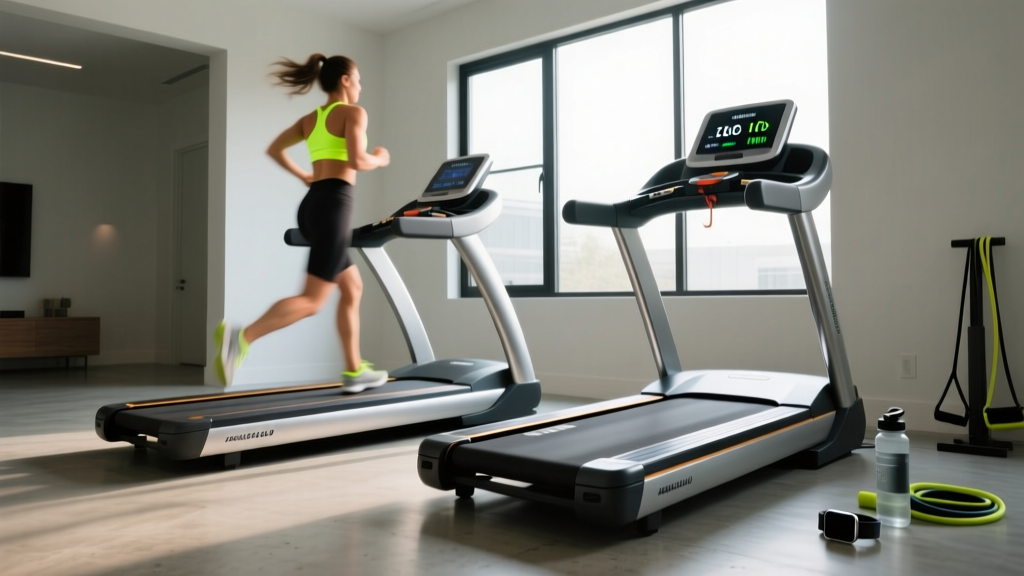
Curved Manual vs Motorized: Is the Starpower Treadmill Right for You?
Compare curved manual treadmills with motorized models like the Starpower treadmill. Discover biomechanics, pricing, and the best fit for your 2026 home gym.

The Biomechanics of Running: Curved Manual vs. Motorized
When designing a home gym in 2026, the debate between curved manual treadmills and traditional motorized models remains one of the most critical decisions for cardio enthusiasts. The fundamental difference lies in the physics of the belt movement. On a motorized machine, the belt pulls your foot backward, which often encourages a rearfoot (heel) strike and relies on the motor to dictate your pace. Conversely, a curved manual treadmill requires the user to push the belt backward with each stride. This self-powered mechanism naturally forces a mid-foot or forefoot strike, engaging the posterior chain (glutes and hamstrings) much more aggressively.
According to research published in PubMed, running on a curved, non-motorized treadmill increases metabolic energy expenditure by approximately 30% compared to running at the exact same speed on a motorized treadmill. This massive difference in caloric burn and muscle recruitment is the primary driver behind the surging popularity of curved decks among elite athletes and HIIT practitioners.
Quick Decision Framework
- Choose a Curved Manual Treadmill if: You prioritize HIIT, want maximum calorie burn, have no access to dedicated electrical circuits, and prefer a natural mid-foot running form.
- Choose a Motorized Treadmill (like the Starpower) if: You want steady-state LISS cardio, require motorized incline adjustments, prefer built-in interactive screens, and are walking or jogging rather than sprinting.
Deep Dive: The Starpower Treadmill and Motorized Mechanics
The Starpower treadmill series has carved out a notable niche in the mid-tier, value-oriented motorized market. Priced typically between $699 and $899, it represents the quintessential motorized home treadmill experience. Most models in the Starpower lineup feature a 2.5 to 2.75 Continuous Horsepower (CHP) motor, a 20-inch by 55-inch running surface, and a motorized incline capability peaking at 12%.
Motorized Advantages and Edge Cases
The primary advantage of the Starpower treadmill is pace control. For beginners, seniors, or those recovering from injuries, having a motor dictate a steady, unyielding pace is crucial for maintaining a target heart rate zone without the physical coordination required to self-pace. Furthermore, the Starpower's motorized incline allows for seamless transition into hill workouts without breaking your stride—a feature entirely absent on non-motorized curved models, which rely solely on the user shifting their center of gravity to change resistance.
However, motorized treadmills come with specific failure modes. The most common point of failure in mid-tier motorized units like the Starpower is the Motor Control Board (MCB). Dust accumulation and inadequate belt lubrication increase friction, forcing the motor to draw excess amperage. Over time, this spikes the voltage through the MCB, leading to catastrophic board failure. To prevent this, owners must strictly adhere to a 100% silicone lubrication schedule every 150 miles of use.
The Curved Manual Advantage: Energy Expenditure and Form
Premium curved manual treadmills (such as the AssaultRunner Elite or Woodway Curve) represent the opposite end of the spectrum, with price tags ranging from $3,500 to over $7,000. These machines utilize a slat-belt design riding on a concave track. Because there is no motor, your top speed is limited only by your physical capacity to run faster.
Biomechanically, the curved deck alters your kinematics. As noted by ACE Fitness biomechanics resources, the curvature prevents over-striding. If you reach too far forward with your heel on a curved treadmill, the physics of the slope will immediately slow you down. This naturally corrects poor running form, reducing the braking forces that commonly lead to patellofemoral pain syndrome (runner's knee) and shin splints.
Head-to-Head Comparison Matrix
Below is a detailed technical comparison between a premium curved manual treadmill and the mid-tier motorized Starpower treadmill to help you visualize the hardware differences.
| Feature | Curved Manual (e.g., AssaultRunner) | Starpower Treadmill (Motorized) |
|---|---|---|
| Drive System | Self-powered Slat Belt | 2.75 CHP Motor & Drive Belt |
| Max Speed | Unlimited (User-dependent) | 10.0 MPH |
| Incline | Fixed Curve (Resistance via posture) | 0% to 12% Motorized |
| Running Surface | 17" x 65" (Curved Slat) | 20" x 55" (Flat PVC Belt) |
| Avg. Price (2026) | $3,999 - $6,500 | $699 - $899 |
| Power Requirement | None (100% Human Powered) | 120V Dedicated 15A Circuit |
Real-World Pricing and Hidden Costs of Ownership
When evaluating the total cost of ownership over a 5-year period, the initial sticker price is only part of the equation. The Starpower treadmill requires an upfront investment of under $900, making it highly accessible. However, motorized treadmills consume electricity. Running a 2.75 CHP motor for an hour a day, five days a week, will add roughly $8 to $15 to your monthly utility bill depending on local rates. Furthermore, if the motor or MCB fails out of warranty (typically after 1-3 years for mid-tier brands), replacement parts and labor can easily cost $350 to $500.
Curved manual treadmills demand a massive upfront capital expenditure (often exceeding $4,000). Yet, their operational costs are virtually zero. With no motor, no electronics, and no MCB to fry, the primary maintenance involves occasionally wiping down the slat belt and checking the rear roller bearings. A well-maintained curved treadmill can easily last 10 to 15 years in a home environment, effectively amortizing the high initial cost over a much longer lifespan.
Space Footprint and Electrical Constraints
Home gym spatial planning is critical. The Starpower treadmill features a traditional folding deck design, allowing you to collapse the running surface vertically to reclaim floor space when not in use. It requires a standard footprint of roughly 70 inches long by 32 inches wide during operation.
Curved manual treadmills do not fold. Their rigid, curved steel frames require a permanent footprint of approximately 75 inches long by 35 inches wide. Additionally, because the rear of the machine slopes upward, you must ensure you have adequate ceiling height (minimum 8 feet recommended) to avoid head strikes during high-incline sprints. On the electrical side, the Starpower requires a dedicated 15-amp or 20-amp circuit; plugging it into a shared circuit with a space heater or window AC unit will inevitably trip the breaker or damage the treadmill's power supply.
Expert Warning on Joint Loading: While curved treadmills promote a mid-foot strike that reduces impact forces on the knees, the increased engagement of the Achilles tendon and calf muscles means users with a history of Achilles tendinopathy or plantar fasciitis should transition to curved decks very gradually to avoid overuse injuries.
Frequently Asked Questions (FAQ)
Can you walk comfortably on a curved manual treadmill?
Yes, but it requires a slight learning curve. Because the belt only moves when you push it, walking at very slow speeds (under 2.5 MPH) can feel slightly jerky compared to the smooth, continuous pull of a motorized belt. Most users adapt within two to three sessions.
Does the Starpower treadmill support interactive app connectivity?
Most recent Starpower models feature Bluetooth FTMS (Fitness Machine Service) protocols, allowing them to connect to third-party apps like Zwift or Kinomap. However, the native screens provided on these mid-tier models are generally basic LCD displays, lacking the immersive HD touchscreens found on premium motorized brands like NordicTrack or Peloton.
How do you maintain a curved slat belt?
Unlike traditional PVC belts that require liquid silicone lubrication, curved slat belts are generally self-lubricating or rely on a dry wax coating applied at the factory. You should never use liquid silicone on a slat belt, as it will attract dust and degrade the rubber. Maintenance primarily involves using a damp microfiber cloth to clean the slats and ensuring the tension bolts on the rear roller are properly calibrated if the belt begins to slip during heavy sprints.
Expert Verdict: Which Should You Buy?
If your budget is strictly under $1,000 and your primary goal is steady-state walking, light jogging, or following guided incline programs, the Starpower treadmill offers exceptional value. It provides the convenience of motorized pacing and automated incline adjustments, making it an ideal workhorse for general cardiovascular health and LISS (Low-Intensity Steady State) training.
However, if you are a serious runner, a CrossFit athlete, or someone who demands high-intensity interval training (HIIT) with zero speed limitations, a curved manual treadmill is a superior biomechanical investment. The 30% increase in caloric expenditure, combined with the natural correction of your running form and the elimination of long-term motor maintenance, justifies the premium price tag for dedicated fitness enthusiasts.
More gear to consider
All reviews
Can an Under Desk Treadmill Be Placed on Carpet? Office Care Guide

Manual vs Motorized Setup: NordicTrack 1250 Treadmill Installation
Xebex Treadmill vs Rowing Machine: Buying Guide & Technique

Air Bike vs Assault Bike: Beyond the Manual or Electric Treadmill

Air Bike vs Assault Bike: Maintenance & Lubricating Oil for Treadmill