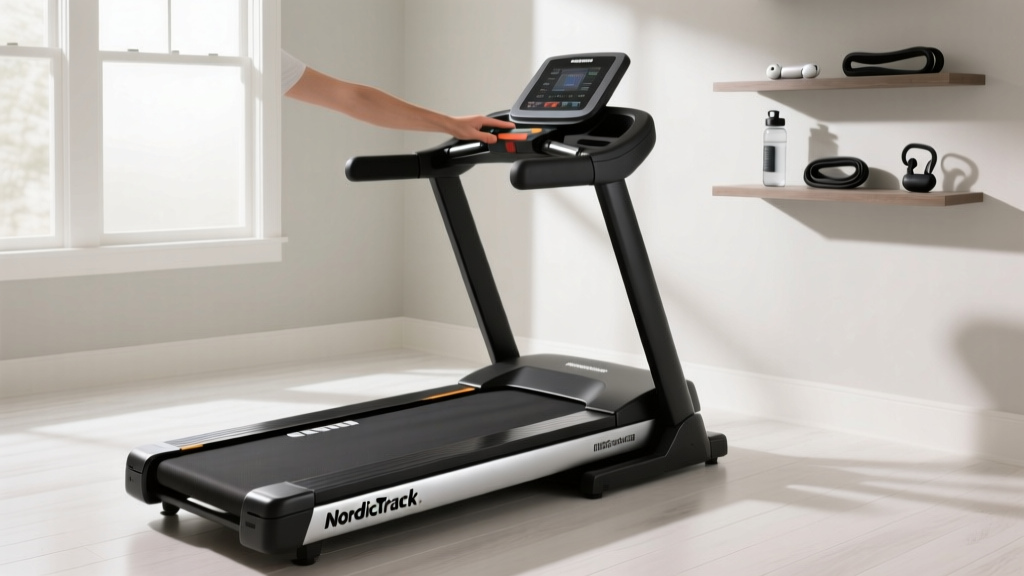
Curved Manual vs Motorized: Sole F63 Treadmill Weight & Performance
We compare curved manual treadmills against motorized models, analyzing the Sole F63 treadmill weight, footprint, calorie burn, and biomechanics.

The Biomechanical Divide: Self-Powered vs. Motor-Driven
As home gym setups evolve in 2026, the debate between curved manual treadmills and traditional motorized models remains a central focal point for cardio enthusiasts and athletes. The choice between these two fundamentally alters your running mechanics, energy expenditure, and spatial requirements. To make an informed purchasing decision, we must look past the marketing brochures and examine the physics of the belt, the structural engineering of the frames, and the long-term maintenance realities of both designs.
Motorized treadmills, like the industry-standard Sole F63, utilize an electric motor to pull the belt beneath your feet. This action assists in the backward extension of the leg, heavily engaging the quadriceps and hip flexors. Conversely, curved manual treadmills (such as the TrueForm Runner or AssaultRunner Elite) feature a slatted belt resting on a curved track. Because there is no motor, the user must physically pull the belt up the incline of the curve with every footstrike. This forces a forefoot or midfoot strike and drastically increases the activation of the posterior chain—specifically the glutes, hamstrings, and calves.
Footprint and Portability: Analyzing the Sole F63 Treadmill Weight
When planning a home gym, spatial efficiency, floor loading, and portability are critical logistical factors. This is where evaluating the Sole F63 treadmill weight becomes highly relevant. The Sole F63 features an assembled net weight of approximately 135 lbs (with a boxed gross weight of 158 lbs). While this is substantial enough to provide a stable base for runners up to 325 lbs, it is remarkably lightweight for a motorized unit in its class.
Because of this manageable 135 lbs footprint and the inclusion of integrated transport wheels, a single user can easily tilt and roll the Sole F63 across a room to vacuum or reconfigure their space. Compare this to premium curved manual treadmills. The TrueForm Runner weighs in at a massive 265 lbs, while the AssaultRunner Elite sits at 255 lbs. These curved units are essentially dead weight; they lack traditional transport wheels due to their curved base geometry, meaning moving one requires two adults or a specialized appliance dolly.
Pro Tip: Electrical and Flooring Requirements
While the Sole F63 requires a dedicated 15-amp electrical circuit to prevent tripping breakers during high-incline startup surges, curved manual treadmills require zero electrical infrastructure. This allows curved models to be placed in off-grid spaces, garages, or basements without worrying about outlet proximity. However, due to the concentrated point-load of the heavier curved frames, a high-density 3/8-inch rubber equipment mat is mandatory to protect hardwood floors and concrete subfloors from permanent indentation.
Spec-to-Spec Comparison Matrix
To visualize the engineering differences, we have mapped the core specifications of the top-selling motorized unit against the two leading curved manual competitors in the 2026 market.
| Specification | Sole F63 (Motorized) | TrueForm Runner (Curved) | AssaultRunner Elite (Curved) |
|---|---|---|---|
| Net Weight | 135 lbs | 265 lbs | 255 lbs |
| Running Surface | 20' x 55' | 17' x 62' | 17' x 63' |
| Max User Capacity | 325 lbs | 400 lbs | 350 lbs |
| Drive System | 3.0 HP DC Motor | Self-Powered Slat Belt | Self-Powered Slat Belt |
| Approximate Price | $999 | $4,295 | $3,299 |
Caloric Burn and Muscle Activation Realities
The most common argument for purchasing a curved manual treadmill is the purported increase in caloric expenditure. Research published in the Journal of Strength and Conditioning Research has consistently demonstrated that running on a non-motorized, curved treadmill requires significantly more energy than running on a motorized treadmill at the exact same speed. The studies indicate an approximate 30% increase in oxygen uptake (VO2) and heart rate response on curved models.
Why does this happen? On a motorized treadmill like the Sole F63, the belt does the work of pulling your trailing leg backward. On a curved treadmill, your trailing leg must actively push off and pull the heavy slatted belt up the curve. According to biomechanical analyses highlighted by the American Council on Exercise (ACE), this continuous resistance mimics the mechanics of running uphill or pushing a sled, leading to greater hypertrophy and endurance adaptations in the gluteus maximus and biceps femoris.
'If your primary goal is high-intensity interval training (HIIT) and maximizing posterior chain engagement in a condensed timeframe, the curved manual treadmill is biomechanically superior. However, for steady-state zone 2 cardio and long-distance pacing, a motorized deck provides the consistent, predictable belt speed required for mental pacing.' — FitGearPulse Biomechanics Review, 2026
Long-Term Ownership: Maintenance and Edge Cases
Every piece of fitness equipment fails eventually; the difference lies in how and when it fails. Understanding the maintenance schedules and common failure modes is vital for calculating the true cost of ownership.
Sole F63 (Motorized) Maintenance Profile
- Belt Lubrication: The Sole F63 requires the application of 100% pure silicone lubricant beneath the belt every 150 miles or every 3 months. Failure to do so causes excess friction, which will eventually burn out the motor control board or the drive motor itself.
- Deck Wear: The phenolic-coated deck will eventually develop grooves. Unlike older treadmills, modern Sole decks are not reversible; they must be replaced entirely once the wear layer is compromised (typically around year 5 to 7 of heavy use).
- Edge Case Failure: Power surges can fry the lower control board. Always use a high-quality surge protector rated for at least 15 amps, rather than plugging directly into a wall outlet.
Curved Manual Treadmill Maintenance Profile
- Slat Belt Tensioning: Over time, the rubber slats stretch. You will need to adjust the tensioning bolts at the rear axle to prevent the belt from slipping during explosive sprints.
- Bearing Replacement: The slats glide on UHMWPE (Ultra-High-Molecular-Weight Polyethylene) bearings or wheels. These will eventually degrade, flatten, or seize, requiring a complete teardown of the belt to replace the bearings (usually required around the 10,000-mile mark).
- Edge Case Failure: Dropping heavy dumbbells or kettlebells onto the curved slats can crack the vulcanized rubber. Unlike a standard PVC treadmill belt that can be replaced for $50, a replacement curved slat belt assembly can cost upwards of $800 to $1,200.
The Decision Framework: Which Belongs in Your Home Gym?
Choosing between a curved manual and a motorized treadmill is not about finding the objectively 'better' machine; it is about aligning the equipment with your specific physiological goals, spatial constraints, and budget. Use the following framework to make your final decision.
Choose the Sole F63 (Motorized) If:
- You prioritize steady-state cardio: If you are training for a marathon and need to lock into a precise 8:00/mile pace for 90 minutes, the motorized consistency of the Sole F63 is essential.
- You have a strict budget: At roughly $999, the Sole F63 offers exceptional value, providing incline capabilities (up to 15%) that curved treadmills physically cannot replicate.
- You need portability: The manageable Sole F63 treadmill weight of 135 lbs and integrated wheels make it the only viable option for multi-purpose rooms where the equipment must be moved frequently.
- You are a heel-striker: The cushioned, flat deck of a motorized treadmill is far more forgiving on the joints for runners who naturally strike with their heels.
Choose a Curved Manual Treadmill If:
- You focus on HIIT and Sprinting: Curved treadmills have no motor lag. When you sprint, the belt accelerates instantly. When you stop, it stops. This makes them vastly safer and more effective for Tabata or sprint-interval protocols.
- You want to fix your running form: The curved geometry physically prevents over-striding and heel-striking, naturally correcting your biomechanics to a safer, more efficient midfoot strike.
- You lack dedicated electrical circuits: If your basement or garage gym lacks a 15-amp dedicated circuit, a self-powered curved treadmill eliminates the risk of tripped breakers entirely.
- Budget is a secondary concern: You are willing to spend $3,000 to $4,500 for a commercial-grade, zero-maintenance motor system that will outlast most motorized treadmills by a decade.
For further reading on optimizing your cardiovascular health and integrating these machines into a holistic fitness routine, consult the aerobic exercise guidelines provided by the Mayo Clinic. Ultimately, whether you opt for the biomechanical intensity of a curved manual runner or the reliable, pace-controlled environment of a motorized deck, consistency in your training remains the true driver of cardiovascular adaptation.
More gear to consider
All reviews
Quiet Cardio: Lopifit Treadmill Walking Bicycle & Noise Comparison

Elliptical Trainer vs Treadmill for Weight Loss in Small Home Gyms

Curved vs Motorized Treadmills: Converting Treadmill MPH to Pace
Air Bike vs Assault Bike: Unboxing & How to Open a Treadmill Safely

Elliptical vs Treadmill: How Fast Do Treadmills Go in 2026?