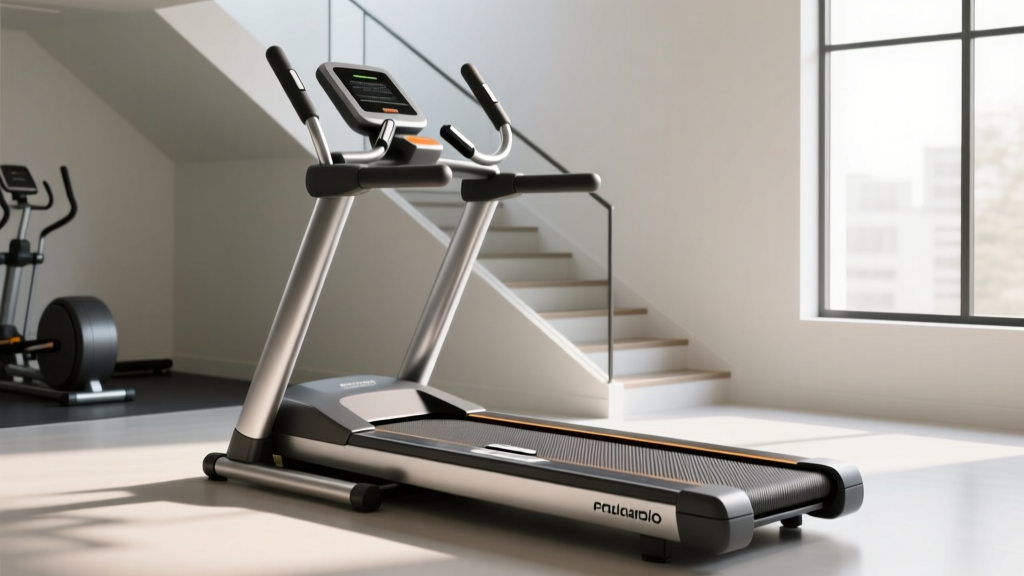
Curved Manual vs Motorized: ProForm Treadmills Beginner Guide
Confused between curved manual and motorized? Our step-by-step guide compares biomechanics, costs, and ProForm treadmills to help beginners choose.

The Great Home Gym Divide: Slats vs. Belts
When outfitting a home gym in 2026, the cardio aisle boils down to a massive fork in the road: curved manual treadmills versus traditional motorized decks. If you are researching ProForm treadmills, you are already looking at the undisputed heavyweight champion of the motorized side. But is a motorized belt actually right for your joints, or should you be investing in a self-powered curved slat runner?
As a beginner, choosing the wrong machine can lead to abandoned workouts, achilles tendonitis, or blown electrical circuits. This step-by-step guide will walk you through the biomechanics, spatial requirements, and financial realities of both categories, using industry-leading motorized models as our benchmark.
⚠️ The Beginner's Trap: Many novices assume curved manual treadmills are "easier" because they lack a motor. The opposite is true. According to the American College of Sports Medicine (ACSM), running on a curved manual treadmill requires up to 30% more energy output than a motorized belt at the same perceived pace. You are the motor.Step 1: Audit Your Biomechanics and Joint Health
The most critical difference between these machines is how they interact with your kinetic chain. Understanding this will dictate which machine keeps you injury-free.
The Curved Manual Treadmill (The Posterior Chain Builder)
Curved treadmills feature a 15-degree concave arc made of vulcanized rubber slats. Because there is no motor pulling your foot backward, you must actively drive your knee upward and push the belt down and back.
- Foot Strike: Forces a mid-foot or forefoot strike. Heel striking on a curve is biomechanically awkward and highly inefficient.
- Muscle Engagement: Heavily targets the glutes, hamstrings, and calves.
- Joint Impact: While the slatted surface absorbs shock, the forced forefoot strike places immense load on the Achilles tendon and plantar fascia. If you have a history of calf strains, proceed with caution.
The Motorized Treadmill (The Guided Stride)
Motorized machines, like the flagship models in the ProForm treadmill lineup, use a continuous PVC belt driven by an electric motor. The belt pulls your foot backward, which slightly alters your natural overground running mechanics by reducing hamstring activation and encouraging a heel-to-toe strike.
- Foot Strike: Accommodates all strike patterns, including heavy heel striking.
- Shock Absorption: Premium motorized decks feature integrated cushioning systems (such as ProForm's ProShox) that reduce impact on the knees and lower back by up to 15% compared to asphalt.
- Joint Impact: Ideal for runners recovering from lower-leg tendon issues, or those who prefer long, steady-state jogging where calf fatigue is a limiting factor. For broader context on joint preservation, Johns Hopkins Medicine notes that proper shock absorption and controlled pacing are vital for long-term cartilage health.
Step 2: Evaluate Your Space and Electrical Constraints
Before falling in love with a machine, you must audit your room. The infrastructure requirements for these two categories are vastly different.
Electrical Requirements
Motorized: Any motorized treadmill with a 3.0 CHP (Continuous Horsepower) motor or higher requires a dedicated 15-amp circuit. Plugging a high-end motorized treadmill into a shared living room outlet alongside a TV and space heater will trip the breaker and potentially fry the machine's control board. Furthermore, motorized units require proximity to an outlet, limiting room layout options.
Curved Manual: Zero electrical requirements. You can place a curved treadmill in the center of a garage, a basement, or a sunroom without worrying about cable management or circuit loads. (Note: Some premium curved models offer optional magnetic resistance consoles that require AA batteries or a simple USB charge, but no wall power).
Footprint and Portability
While motorized treadmills are larger in length (often 80" x 35"), many ProForm models feature a hydraulic folding mechanism, allowing you to reclaim 50% of the floor space when not in use. Curved treadmills do not fold. Furthermore, the dense steel frame and rubber slats make curved machines incredibly heavy (often exceeding 350 lbs), making them a permanent fixture once assembled.
Step 3: The Budget and Maintenance Matrix
Price is often the most shocking differentiator for beginners. Curved manual treadmills are commercial-grade by nature and carry a massive premium, whereas motorized treadmills span from budget-friendly to ultra-premium.
| Machine Type | Benchmark Model | Est. Price (2026) | Running Surface | Primary Maintenance |
|---|---|---|---|---|
| Entry Motorized | ProForm Carbon TLX | $699 - $899 | 18" x 55" Belt | Belt lubrication, tensioning |
| Premium Motorized | ProForm Pro 9000 | $1,299 - $1,599 | 20" x 60" Belt | Belt care, electronic diagnostics |
| Entry Curved | AssaultRunner Elite | $3,299 | 17" x 63" Slats | Slat tightening, bearing checks |
| Premium Curved | TrueForm Runner | $4,995+ | 17" x 62" Slats | Individual slat replacement |
"The maintenance profile is a hidden cost. A motorized treadmill's belt requires silicone lubrication every 150 miles and eventual replacement. A curved treadmill's slats can last a decade, but if the internal guide bearings fail, the repair requires specialized commercial technicians."
Step 4: Aligning the Machine With Your Training Goals
Your workout programming should ultimately dictate your purchase. Here is how the two styles map to common fitness goals.
Goal: High-Intensity Interval Training (HIIT) & Sprints
Winner: Curved Manual. On a motorized treadmill, sprint intervals are dangerous. You must wait for the motor to spool up to 12 MPH, and you must straddle the side rails while it slows down. A curved treadmill accelerates and decelerates instantly with your legs. You can go from a dead stop to a full sprint in two strides, making it the undisputed king of true HIIT and Tabata protocols.
Goal: Long Steady State (LISS) & Incline Hiking
Winner: Motorized (ProForm). If your goal is to zone out for a 10-mile run while watching a show, or to simulate hiking for weight loss, motorized is superior. The ProForm Pro 9000 offers a 15% motorized incline, allowing you to target the glutes without the sheer exhaustion of pushing a curved sled. Furthermore, ProForm's "Incline Trainer" series pushes this to a staggering 40% incline, a feature entirely impossible on a manual curve.
Goal: Interactive Coaching & Gamification
Winner: Motorized. ProForm's integration with the iFIT platform is a game-changer for beginners who lack programming knowledge. The machine's motor automatically adjusts speed and incline in real-time to match global trails or studio classes led by professional coaches. While some curved treadmills offer basic Bluetooth FTMS connectivity to third-party apps like Zwift, they cannot physically adjust your resistance to match a virtual hill automatically.
Why ProForm Treadmills Anchor the Motorized Market
For the vast majority of beginners, a high-quality motorized treadmill is the most pragmatic, versatile, and cost-effective choice. ProForm has cornered this market by balancing commercial-grade durability with consumer-friendly pricing.
When evaluating ProForm models, look for the Mach Z or Continuous Horsepower (CHP) motor ratings. A 3.0 CHP motor (found in their mid-tier Performance series) is the minimum threshold for daily running; anything less is designed only for walking and will overheat during sustained jogging. Additionally, ensure the running belt is at least 20 inches wide and 60 inches long to accommodate a natural stride without the psychological fear of stepping off the back edge.
Frequently Asked Questions (FAQ)
Can I walk on a curved manual treadmill?
Yes, but it requires a learning curve. Because the belt only moves when you push it, walking at a slow pace (under 2.5 MPH) can feel "jerky" or sticky on cheaper curved models. Premium models with advanced bearing systems handle slow walking much smoother.
Do curved treadmills burn more calories?
Yes. Sports science studies indicate that running on a curved manual treadmill increases caloric expenditure by roughly 20% to 30% compared to a motorized treadmill at the exact same speed, due to the lack of motor assistance and the increased demand on the posterior chain.
Is a folding motorized treadmill less stable?
Historically, yes. However, modern 2026 engineering utilizing heavy-gauge steel and hydraulic locking pins has virtually eliminated the "wobble" at high speeds on premium folding models like the ProForm Pro series. Always ensure the locking pin is fully engaged before running.
More gear to consider
All reviews
Air Bike vs Assault Bike: Do Advantages of Treadmill Walking Win?

Stair Climber Machine for Home Use vs Urevo Foldi Mini Treadmill

Treadmill Generator vs Bikes: Upright, Recumbent & Spin Value
Escaping the Hedonistic Treadmill: Motor Size & HP Guide

Is a Bowflex Climber Treadmill Hybrid the Best Compact Cardio?