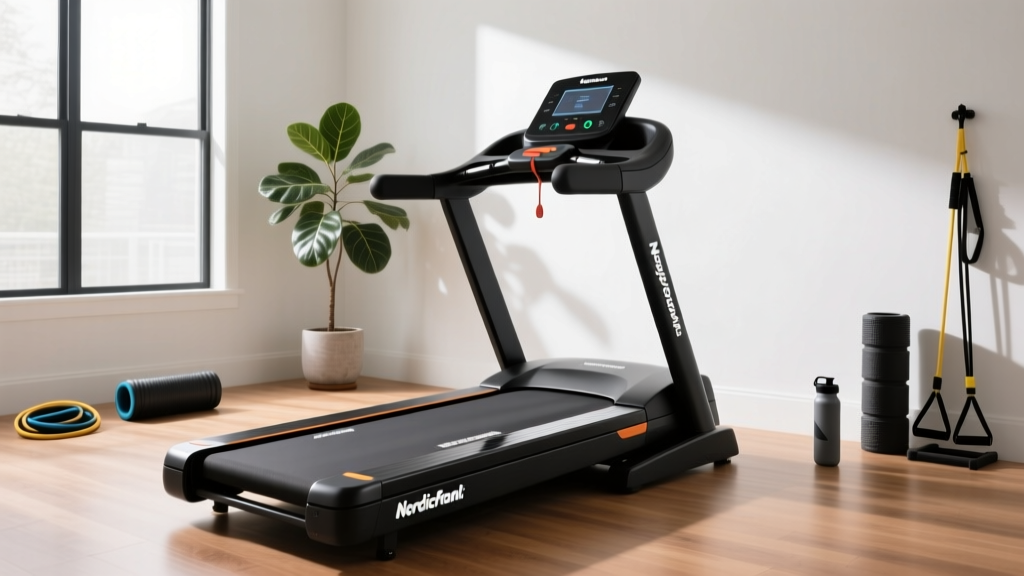
Curved vs Motorized: NordicTrack T Series 8 Review Guide
We compare curved manual and motorized treadmills, featuring a NordicTrack T Series 8 treadmill review to help you choose the right home cardio machine.

The Great Treadmill Divide: Manual Curve vs. Motorized Belt
When outfitting a home gym in 2026, buyers inevitably face a critical crossroads: do you invest in a traditional motorized treadmill, or pivot to the biomechanical advantages of a curved manual treadmill? To answer this, we must establish a baseline. The entry-level motorized market is dominated by budget-friendly workhorses, which is why this guide is anchored by an in-depth NordicTrack T Series 8 treadmill review. By dissecting the T Series 8 as our motorized benchmark, we can accurately contrast its performance, cost, and failure modes against premium curved manual alternatives like the AssaultRunner Elite and TrueForm Runner.
Core Premise
Motorized treadmills pull you through the motion via a continuous horsepower (CHP) motor, while curved manual treadmills require you to generate the belt's momentum through foot strike and gravity. This fundamental difference dictates everything from calorie expenditure to long-term maintenance costs.
The Motorized Baseline: NordicTrack T Series 8 Treadmill Review
The NordicTrack T Series 8 remains one of the most popular entry-level motorized treadmills on the market, typically retailing between $499 and $599. It is designed for walkers, light joggers, and those with strict spatial and financial constraints.
Hardware and Performance Specifications
- Motor: 2.6 CHP (Continuous Horsepower). This is sufficient for sustained walking at 3.5 mph and intermittent jogging up to 10 mph, but it will struggle and overheat if a 220 lb user attempts sustained hill intervals at a 10% incline.
- Running Surface: 18 inches by 55 inches. This is the T Series 8's most significant limitation. Runners over 5'10" will experience stride clipping, forcing an unnatural, shortened gait that can lead to Achilles and calf strain over time.
- Incline: 0% to 10% manual or motorized adjustment (depending on the exact sub-model SKU). The incline motor is relatively slow, taking up to 15 seconds to transition from flat to maximum grade.
- Footprint: 68" L x 28" W x 50" H. It features a hydraulic folding mechanism, reducing its stored depth to roughly 28 inches, making it ideal for multi-use guest rooms.
Software Ecosystem and Hidden Costs
While the hardware is affordable, the T Series 8 is heavily gated behind NordicTrack's iFIT ecosystem. Out of the box, the treadmill operates in manual mode with a basic LCD display. To access automatic trainer-controlled incline and speed adjustments, you must subscribe to iFIT, which costs $15 to $39 per month in 2026. Over a three-year lifespan, this software subscription effectively doubles the total cost of ownership of the machine.
The Biomechanical Shift: Curved Manual Treadmills Explained
Curved manual treadmills feature a concave running surface constructed from vulcanized rubber slats attached to a low-friction polyurethane guide. Because there is no motor, the runner dictates the pace. According to biomechanical analyses cited by the American Heart Association, maintaining proper cardiovascular output requires consistent effort, which the curved design naturally enforces by demanding a mid-foot or forefoot strike.
The Caloric and Postural Advantage
Studies indicate that running on a curved non-motorized treadmill can increase caloric expenditure by up to 30% compared to a motorized treadmill at the same perceived speed. The curve forces the runner to engage the posterior chain (glutes and hamstrings) to pull the belt downward and backward. Furthermore, the curved deck naturally discourages the heavy heel-striking that often leads to patellofemoral pain syndrome (runner's knee). For those prioritizing joint health, the Mayo Clinic's aerobic exercise guidelines emphasize choosing low-impact modalities that preserve cartilage over decades of use.
Head-to-Head Comparison Matrix
Below is a direct comparison between our motorized benchmark (NordicTrack T Series 8) and the industry-standard curved manual treadmill (AssaultRunner Elite).
| Feature | NordicTrack T Series 8 (Motorized) | AssaultRunner Elite (Curved Manual) |
|---|---|---|
| Drive System | 2.6 CHP Electric Motor | Human-Powered Slat Belt |
| Max Speed | 10.0 MPH | Unlimited (User-Dependent, 20+ MPH) |
| Belt Dimensions | 18" x 55" (Continuous PVC Belt) | 17" x 63" (Vulcanized Rubber Slats) |
| Weight Capacity | 300 lbs | 350 lbs |
| Power Requirement | 120V Dedicated Outlet | None (Zero Electricity) |
| Machine Weight | 130 lbs | 280 lbs |
| Average 2026 Price | $499 - $599 + iFIT Subscription | $3,299 (One-time purchase) |
| Maintenance Needs | Silicone belt lubrication every 150 miles | Bearing inspection and slat tensioning annually |
Real-World Edge Cases and Failure Modes
Understanding how these machines fail in a home environment is critical for long-term satisfaction. The FDA Treadmill Safety Guidelines frequently highlight the physical hazards of motorized belts, but mechanical failures are equally disruptive.
Motorized Failure Modes (T Series 8)
- Motor Controller Burnout: The most common catastrophic failure in budget motorized treadmills. If a user consistently walks at high inclines without allowing the motor to cool, the DC motor controller board will overheat and short out. Replacement parts cost around $120, but require technical disassembly.
- Belt Delamination and Slipping: If the user neglects to apply 100% silicone lubricant under the PVC belt every 3 to 6 months, the friction coefficient spikes. This causes the belt to hesitate or 'slip' underfoot during foot strike, which is a major fall hazard.
- Incline Motor Gear Stripping: The plastic gears inside the incline actuator can strip if the user frequently changes incline settings while the full weight of their body is resting on the deck.
Curved Manual Failure Modes (AssaultRunner / TrueForm)
- Slat Belt Tension Loss: Over 1,000+ miles, the rubber slats can stretch, causing the belt to track poorly or rub against the side rails. This requires manual tensioning via the rear axle adjustment bolts—a process that takes about 15 minutes but requires a specific hex wrench set.
- Bearing Degradation: The dozens of individual ball bearings that allow the slat belt to glide over the curved deck are subject to dust and sweat intrusion. If the machine is kept in a humid, unclimate-controlled garage, these bearings can seize, resulting in a 'grinding' sensation that requires a full bearing replacement kit ($150).
- Deceleration Hazard: Unlike a motorized treadmill that smoothly coasts to a halt when you pull the safety key, stopping abruptly on a curved treadmill requires the user to actively fight the momentum of the belt by stepping toward the front curve. Novice users often stumble when attempting to stop too quickly.
Expert Insight: If your primary goal is zone 2 steady-state cardio and walking while working at a standing desk, a motorized treadmill like the T Series 8 is vastly superior due to its ability to hold an exact, slow speed (e.g., 1.5 mph) without requiring active balance. Curved treadmills are notoriously difficult to 'walk' slowly on, as they require a minimum threshold of momentum to keep the belt rotating smoothly.
The 2026 Decision Framework: Which Should You Buy?
Choosing between a curved manual treadmill and a motorized model like the NordicTrack T Series 8 comes down to three distinct variables: budget, biomechanics, and use-case.
Buy the NordicTrack T Series 8 If:
- Your budget is under $800 (including the first year of iFIT).
- You are primarily a walker, hiker, or light jogger under 5'10".
- You want automated, pre-programmed workouts that control your speed and incline without you having to think about it.
- You need a lightweight, foldable machine that can be moved by a single person.
Buy a Curved Manual Treadmill If:
- You have a budget of $3,000+ and view this as a decade-long investment.
- You are a competitive runner or CrossFit athlete who needs to perform high-intensity interval training (HIIT) and sprint work without waiting for a motor to spool up.
- You want to actively correct your running form, eliminate heel-striking, and engage your posterior chain.
- You want zero ongoing software subscription fees and no reliance on electrical outlets.
Frequently Asked Questions
Can I use a standing desk with a curved manual treadmill?
It is highly discouraged. Curved treadmills require active momentum generation and balance. Walking at the 1.0 to 1.5 mph pace required for typing is incredibly difficult on a curved deck, as the belt tends to stutter and stop. Motorized treadmills like the T Series 8 are the only viable option for treadmill desk setups.
Does the NordicTrack T Series 8 require a special electrical circuit?
Yes. While it plugs into a standard 120V outlet, the 2.6 CHP motor can draw up to 15 amps under heavy incline loads. It must be plugged directly into a wall outlet on a dedicated 15-amp or 20-amp circuit. Using an extension cord or sharing the circuit with a space heater or microwave will trip the breaker and potentially damage the motor controller.
Are curved treadmills actually better for your joints?
Yes, but with a caveat. The curved design promotes a mid-foot strike, which reduces the peak vertical impact force on the knees and lower back compared to the heel-strike common on flat, motorized belts. However, this shifts the load to the calves and Achilles tendon. If you have a history of Achilles tendinopathy or plantar fasciitis, a curved treadmill may exacerbate those specific conditions.
More gear to consider
All reviews
HIIT Treadmill vs Walking Pad: Top Mistakes & Fixes

Walking Pad Review: Top Treadmill Interest Free Plans for 2026

Assault Bike vs Air Bike: Budgeting for Hills on Treadmill Cardio
XT185 Treadmill Installation & Motor Horsepower Guide

Rowing Machine Setup & Technique: A VR Treadmill Review Alternative
