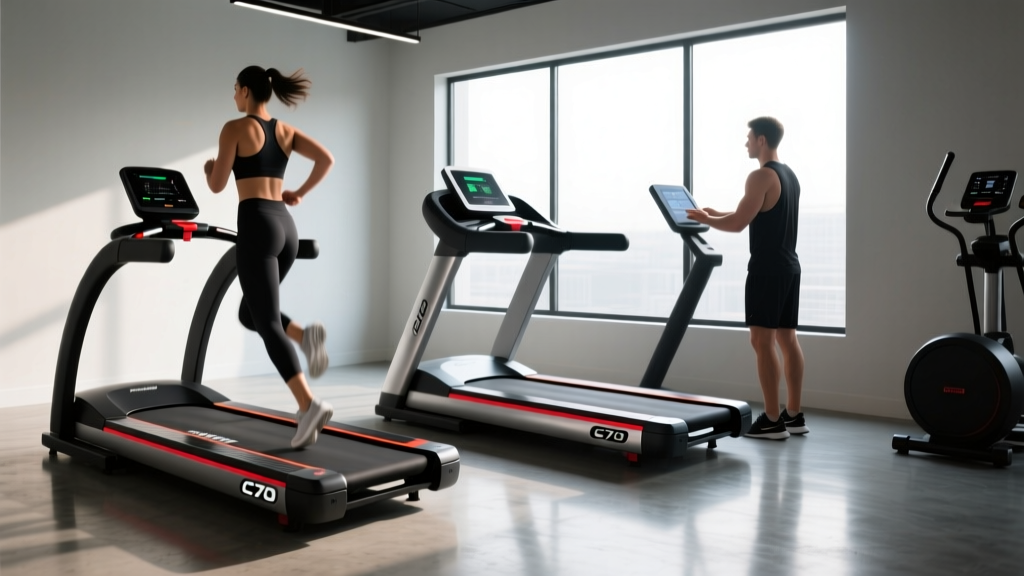
Curved Manual vs C70 Treadmill: Common Mistakes & Fixes
Avoid common mistakes when switching between a curved manual treadmill and a C70 treadmill. Expert troubleshooting for belt friction, pacing, and care.

Transitioning between a self-powered curved manual treadmill and a premium motorized platform like the C70 treadmill requires more than just a change in footwear. As of 2026, hybrid training facilities and high-end home gyms frequently feature both modalities, yet runners consistently make critical biomechanical and maintenance errors when switching between them. Whether you are rehabbing an injury, training for a marathon, or simply optimizing your cardiovascular health, misunderstanding the mechanical differences between these two decks can lead to premature fatigue, equipment damage, or injury.
This comprehensive troubleshooting guide breaks down the most common mistakes users make when navigating curved manual treadmills versus the motorized C70 treadmill, providing actionable, expert-level fixes for pacing, stride mechanics, and hardware maintenance.
The Biomechanical Learning Curve: Pacing and Foot Strike
The most frequent mistake runners make is applying the same pacing strategy and foot strike pattern across both machines. A curved non-motorized treadmill (such as the AssaultRunner Elite or Technogym Skillmill) lacks a drive motor. You are the engine. Conversely, the C70 treadmill utilizes a high-torque 4.0 CHP motor that pulls your feet backward, fundamentally altering your posterior chain engagement.
Warning: The 30% Energy TaxStudies consistently show that running on a curved manual treadmill requires approximately 15% to 30% more energy expenditure than a motorized treadmill at the same perceived speed. Attempting to hold your standard motorized zone-2 pace on a curved deck will rapidly push you into anaerobic thresholds, leading to premature calf and Achilles fatigue.
Troubleshooting the "Runaway" Effect on Curved Decks
On a curved treadmill, your foot strike dictates the speed. If you over-stride and land heavily on your heels near the front apex of the curve, the belt will accelerate uncontrollably.
- The Fix: Shift your center of mass slightly forward and aim for a mid-foot strike directly in the "sweet spot" (the lowest point of the curve). This engages the hamstrings and glutes to pull the belt, rather than relying on gravity and heel-braking.
- Deceleration Technique: Never jump off the side rails to stop. To slow down, consciously shorten your stride and push your hips back, allowing the friction of the curve to naturally brake the slat belt.
Calibrating Your Stride on the C70 Treadmill
When switching back to the C70 treadmill, runners often maintain the shortened, high-cadence stride they adapted to on the curved deck. Because the C70 features an expansive 22" x 60" running surface, this restricted stride limits your power output and reduces the effectiveness of the motorized incline features.
- The Fix: Consciously extend your hip flexion. Allow the motorized belt to pull your trailing leg back, maximizing the stretch-shortening cycle in your hip flexors. Utilize the C70's automated 0-15% incline to simulate outdoor resistance, which is otherwise absent on a flat curved deck.
Maintenance Mismatches: Slat Belts vs. Motorized Decks
Applying motorized treadmill maintenance protocols to a curved manual deck—or vice versa—is a catastrophic mistake that can void warranties and destroy the running surface. The C70 treadmill relies on a continuous PVC belt gliding over a phenolic-coated wooden deck, while curved treadmills use individual rubberized slats riding on polyurethane guide wheels.
| Maintenance Task | Curved Manual Treadmill | C70 Motorized Treadmill |
|---|---|---|
| Lubrication | NEVER lubricate the top slats. Apply 100% silicone spray ONLY to the underside guide wheels/rails every 6 months. | Apply 100% pure silicone liquid between the PVC belt and the wooden deck every 150 miles or 3 months. |
| Belt Tensioning | Adjust via dual rear axle bolts (6mm Allen key). Requires high tension to prevent slat slipping. | Adjust via rear roller bolts. Requires moderate tension; overtightening will burn out the 4.0 CHP drive motor. |
| Cleaning | Vacuum debris from between slats. Wipe slats with a damp microfiber cloth and mild soap. | Wipe belt edges. Vacuum underneath the motor hood to prevent dust buildup on the optical speed sensor. |
Fixing Slat Belt Friction and Slipping (Curved)
If your curved treadmill belt feels "sticky" or hesitates when you accelerate, the issue is rarely the slats themselves. It is almost always debris in the guide tracks or improper axle tension.
- Unplug the console (if applicable) and flip the treadmill on its side (requires two people due to the 300+ lb weight).
- Inspect the polyurethane guide wheels. Use a soft brush to remove embedded dust.
- If the belt slips under heavy foot strikes, locate the dual tensioning bolts on the rear axle. Using a 6mm Allen key, apply exactly one-quarter (1/4) turn clockwise to both sides. Test the belt; repeat only if necessary. Overtightening will crush the bearings.
Resolving C70 Treadmill Belt Tracking and Deck Wear
If the belt on your C70 treadmill drifts to the left or right, friction will generate excess heat, potentially melting the belt edges or triggering a thermal shutdown in the motor controller.
- Run the treadmill at 3.0 MPH.
- If the belt drifts left, use a 6mm Allen wrench to tighten the left rear roller bolt by 1/4 turn clockwise, and loosen the right bolt by 1/4 turn counter-clockwise.
- Allow the belt to run for 2 minutes to center itself. Repeat if necessary.
- Deck Wear Test: Slide your hand under the belt. If you feel deep grooves in the phenolic coating, or if the belt requires constant re-lubrication, the deck is worn and must be replaced to prevent motor burnout.
Electronic and Mechanical Error Codes
Troubleshooting electronics requires a clear understanding of the specific drivetrain. Curved treadmills rely on simple magnetic reed switches to measure slat rotation, whereas the C70 treadmill utilizes complex optical sensors, incline potentiometers, and motor control boards (MCBs).
Curved Treadmill Console Calibrations
If the digital console on a curved treadmill displays erratic speed spikes or drops to zero mid-run, the magnetic speed sensor is likely misaligned. Locate the sensor near the front roller flywheel. Ensure the gap between the magnetic reed switch and the flywheel magnet is exactly 2-3mm. A gap wider than 5mm will cause signal dropout at higher speeds (above 8 MPH).
C70 Treadmill E1 and E2 Error Code Resolutions
- E1 Error (Speed Sensor Fault): This indicates the MCB is not receiving RPM data. Unplug the C70 treadmill, remove the motor hood, and locate the optical sensor near the motor flywheel. Use compressed air to blow out dust. Check the wiring harness for micro-fractures. If the sensor is clean and the error persists, the reed switch must be replaced.
- E2 Error (Incline Potentiometer Fault): If the C70 treadmill fails to calibrate its incline upon startup, the incline motor's internal potentiometer is likely sending erratic voltage. Do not attempt to force the lift motor manually. This requires a multimeter test of the potentiometer pins; if the resistance does not scale smoothly from 0 to 10k ohms as the lift moves, the incline motor assembly must be swapped.
Joint Loading and Cardiovascular Guidelines
Choosing between these machines shouldn't just be about maintenance; it must align with your physiological needs and joint health. According to the American Heart Association, adults should aim for at least 150 minutes of moderate-intensity aerobic activity per week. How you achieve this on a curved deck versus a motorized C70 treadmill impacts your joints differently.
"Curved treadmills naturally encourage a forefoot or midfoot strike, which can reduce the peak impact forces on the patellofemoral joint compared to the heavy heel-striking often induced by the pulling action of a motorized belt."
However, the increased Achilles tendon load on a curved deck means runners with a history of plantar fasciitis or Achilles tendinopathy should transition slowly. The Centers for Disease Control and Prevention (CDC) emphasizes the importance of gradual progression in physical activity to prevent overuse injuries. If you are recovering from a lower-leg injury, utilize the C70 treadmill's shock-absorption system and zero-incline settings until your connective tissue adapts.
Frequently Asked Questions
Can I use a curved manual treadmill for long, steady-state marathon training?
Yes, but expect a higher cardiovascular demand. A 10-mile run on a curved treadmill will feel physiologically similar to a 12-mile run outdoors due to the lack of momentum assistance and the constant need to propel the slat belt. Monitor your heart rate rather than your pace to ensure you stay in the correct training zone.
Why is my C70 treadmill making a high-pitched whining noise at high speeds?
A high-pitched whine on a motorized C70 treadmill at speeds above 8 MPH usually indicates a dry belt-deck interface generating excessive friction, or worn motor bearings. First, perform the "deck drag" test and apply 100% silicone lubricant. If the noise persists after lubrication, the drive motor bearings are failing and require professional servicing.
Which machine is better for HIIT sprint intervals?
The curved manual treadmill is vastly superior for true HIIT. Because there is no motor lag, you can go from a dead stop to a full sprint in under two seconds simply by driving your knees and pushing the belt. On a motorized C70 treadmill, you must wait for the console to ramp up the speed, which disrupts the precise work-to-rest ratios required for effective sprint interval training.
More gear to consider
All reviews
NordicTrack EXP 7i Treadmill vs Walking Pads: Setup & Review

Flexispot WPS03 Walking Pad Treadmill: Office Space & Layout Review

Weslo Cadence G 5.9i Treadmill Review: Small Space Layout Guide
Incline on Treadmill Meaning vs Stationary Bike Types: 2026 Trends

NordicTrack Dual Shox Cushioning Treadmill: Belt Maintenance Guide
