Curved Manual vs Motorized: Is the A2350 Treadmill Worth It?
We compare curved manual treadmills against the motorized A2350 treadmill. Discover which cardio machine fits your biomechanics, space, and budget.

The Biomechanics Showdown: Self-Powered vs. Belt-Driven
The debate between curved manual treadmills and traditional motorized models has dominated the home and commercial gym space for the last decade. As of 2026, the technology gap has narrowed, but the fundamental biomechanics remain vastly different. When evaluating high-end cardio equipment, buyers are frequently caught between the sleek, self-powered appeal of a curved slat treadmill and the feature-rich, consistent pacing of a premium motorized unit like the A2350 treadmill.
On a motorized treadmill, the belt pulls your foot backward. This mechanical assistance slightly reduces the activation of your posterior chain (hamstrings and glutes) during the stance phase of your gait. Conversely, a curved manual treadmill requires you to actively drive the belt backward with every stride. This subtle shift in mechanics forces greater hip extension and significantly increases the metabolic cost of running.
Quick Verdict: Which Type Wins?
- For HIIT & Sprint Mechanics: Curved Manual (Infinite top speed, immediate acceleration/deceleration).
- For Long-Distance Pacing & Incline Walking: Motorized A2350 Treadmill (Consistent belt speed, automated 15% incline).
- For Joint Impact: Tie (Both offer advanced shock absorption, but curved models promote a more natural mid-foot strike).
Motorized Benchmark: Deep Dive into the A2350 Treadmill
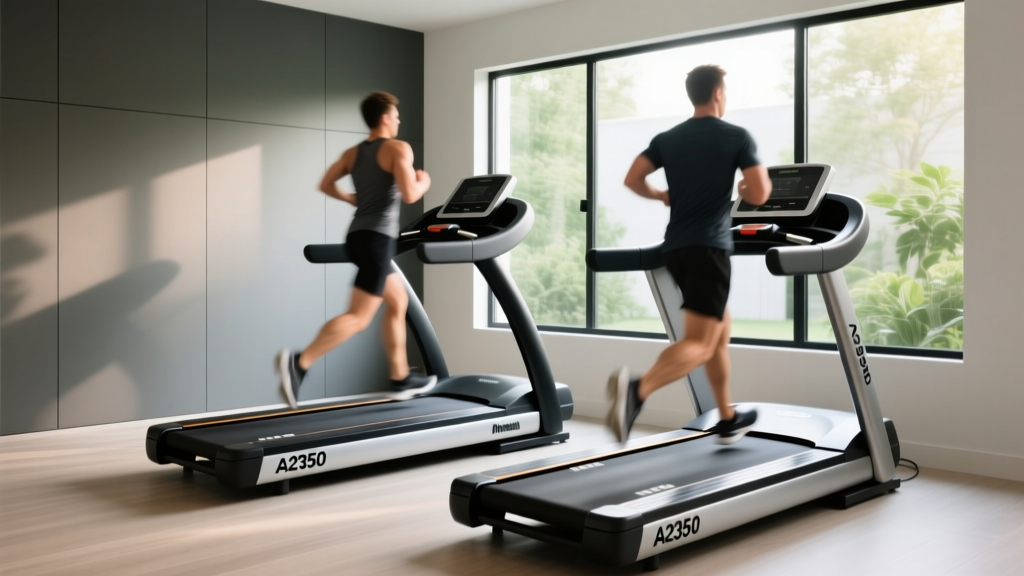
The A2350 treadmill represents the upper echelon of motorized home fitness equipment in 2026. Engineered for high-volume use, it bridges the gap between commercial club models and residential space constraints. Priced between $3,899 and $4,299 depending on the console package, the A2350 is built around a 4.0 Continuous Horsepower (CHP) motor. This is a critical distinction: peak horsepower is a marketing gimmick, but a 4.0 CHP motor ensures the belt will not stutter or jerk when a 250-pound user transitions from a walk to a 10 MPH run.
Key Specifications and Engineering
- Running Surface: 22" x 60" (Accommodates tall runners with long strides without heel-strike clipping).
- Deck Cushioning: Multi-zone elastomer shock absorption. The rear is softer for heel-strike impact dissipation, while the front is firmer for toe-off energy return.
- Incline/Decline: -3% to 15% automated grade. The dual-motor system (one for the belt, one for the lift) adjusts in 0.5% increments.
- Console & Tech: 24-inch HD touchscreen with integrated streaming, Bluetooth FTMS for third-party apps like Zwift, and automated fan speed tied to heart rate zones.
The primary advantage of the A2350 treadmill is pacing enforcement. If you are training for a marathon and need to hold exactly 8.5 MPH at a 2% incline for 45 minutes, the motorized belt forces your body to adapt to that exact cadence. Furthermore, the automated decline feature (-3%) is invaluable for eccentric quad loading and downhill running preparation, a feature entirely absent on manual curved models.
The Challenger: Premium Curved Manual Treadmills
Curved manual treadmills, such as the Woodway Curve or the AssaultRunner Pro, operate on a completely different physical principle. Priced between $3,999 and $6,500, these machines feature a concave running surface made of individual polyurethane or vulcanized rubber slats that glide on a track of ball bearings.
Because there is no motor, your body is the engine. To speed up, you move higher up the curve and push harder; to slow down, you shift your weight backward toward the center or resist the belt with your feet. This design inherently promotes a mid-foot or forefoot strike, as reaching out to heel-strike on the steep front curve is biomechanically awkward and inefficient.
Where Curved Treadmills Excel
- Unrestricted Top Speed: Elite sprinters can exceed 18 MPH on a curved treadmill, unbound by the 12-15 MPH software limits of most motorized units.
- Zero Power Requirements: No 20-amp dedicated circuits needed. You can place a curved treadmill in the middle of a room without worrying about cord tripping hazards or outlet proximity.
- Instantaneous Pacing Changes: Ideal for Tabata or true HIIT protocols where transitioning from 0 to 12 MPH in two seconds is required.
Head-to-Head Comparison Matrix
Below is a direct technical comparison between the motorized A2350 treadmill and a standard premium curved manual treadmill (e.g., AssaultRunner Pro equivalent) based on 2026 market specifications.
| Feature | A2350 Treadmill (Motorized) | Premium Curved Manual |
|---|---|---|
| Drive System | 4.0 CHP Motor, automated belt | User-powered, magnetic/slat resistance |
| Max Speed | 12 MPH (Software limited) | Unlimited (User dependent, 15+ MPH) |
| Incline / Decline | -3% to +15% Automated | Fixed curve (simulates ~8% grade effort) |
| Footprint (L x W) | 82" x 36" (Requires 90" length for incline) | 67" x 33" (Compact, no motor housing) |
| Weight Capacity | 350 lbs | 350 - 400 lbs |
| Average Cost (2026) | $3,899 - $4,299 | $3,999 - $6,500 |
Energy Expenditure and Muscle Activation
One of the most heavily researched areas in sports science is the metabolic difference between curved and flat motorized treadmills. According to data referenced by the American College of Sports Medicine (ACSM), running on a curved manual treadmill elicits a significantly higher heart rate and oxygen consumption (VO2) compared to running at the exact same speed on a motorized treadmill.
"Studies consistently show that self-powered curved treadmills increase caloric expenditure by 20% to 30% compared to traditional motorized treadmills at matched speeds, largely due to the increased demand on the posterior chain and the lack of mechanical belt assistance."
When you run on the A2350 treadmill, the motor does the work of pulling your leg back. On a curved treadmill, your hamstrings and glutes must actively pull the heavy slat belt backward against the friction of the curve. This makes curved treadmills vastly superior for athletes looking to maximize calorie burn in shorter time windows or improve sprint-specific posterior chain strength. However, for users strictly following American Heart Association guidelines for steady-state, moderate-intensity cardiovascular health (Zone 2 training), the A2350's motorized pacing is often more comfortable and sustainable for 45-to-60-minute sessions.
Real-World Maintenance and Failure Points
As a domain expert reviewing hundreds of units, I cannot stress enough that the long-term ownership experience is defined by maintenance and failure modes. The engineering complexities of motorized vs. manual machines present entirely different repair scenarios.
A2350 Treadmill (Motorized) Failure Modes
- Deck & Belt Friction: The most common failure on the A2350 is a blown motor control board caused by excessive belt friction. If you fail to lubricate the deck with 100% pure silicone every 150 miles (or every 3 months), the amp draw on the 4.0 CHP motor spikes, eventually frying the capacitor.
- Incline Motor Potentiometer: After 3-5 years of heavy incline walking, the string potentiometer that tells the console the exact angle of the deck can wear out, resulting in 'Incline Calibration Error' codes.
- Dust Ingestion: Motorized treadmills use cooling fans that suck in room dust. Without annual vacuuming of the motor hood, static buildup can short-circuit the console.
Curved Manual Treadmill Failure Modes
- Slat Bearing Degradation: The 100+ individual ball bearings that allow the slats to glide along the curved track are sealed, but they do degrade. If a bearing seizes, it will chew through the rubber slat above it. Replacing individual bearings is tedious and requires specialized tools.
- Polyurethane Tread Wear: While the slats last a long time, the rubber tread surface will eventually smooth out, especially in the primary strike zone. Resurfacing a curved belt is expensive, often costing upwards of $800 in parts and labor.
- Drive Belt Tension: The internal Kevlar drive belt that connects the front and rear rollers requires tension adjustment every 1,000 miles to prevent slipping during explosive sprint starts.
Space, Noise, and Power Requirements
Environmental factors often dictate the final purchase. The A2350 treadmill requires a dedicated 20-amp electrical circuit. Plugging a 4.0 CHP motor into a shared 15-amp residential circuit with other appliances will trip the breaker during heavy acceleration. Furthermore, the A2350 requires a footprint of at least 85 inches in length to accommodate the deck lifting mechanism at a 15% incline without scraping the wall.
Curved treadmills are entirely self-contained. They draw zero watts, meaning you can place them in a basement, a detached garage, or the center of a living room. They are also significantly shorter (usually under 70 inches long). However, curved treadmills are notoriously loud. The sound of hard plastic or rubber slats rolling over metal bearings at 10 MPH generates a distinct, rhythmic 'rumble' that can transmit through floor joists, whereas the A2350's elastomer deck and insulated motor hood operate at a much lower, consistent hum.
Final Verdict: Which Should You Buy?
Choosing between a curved manual treadmill and the motorized A2350 treadmill comes down to your specific training methodology and household logistics.
Buy the A2350 Treadmill if: You are a distance runner who needs to lock into specific paces for marathon training, you utilize automated incline/decline for hiking simulation and eccentric loading, or you prefer a quieter machine with integrated digital entertainment and guided programming. The A2350 remains the gold standard for structured, long-duration steady-state cardio.
Buy a Curved Manual Treadmill if: You are an athlete focused on HIIT, sprint mechanics, and maximum posterior chain recruitment. If you have limited space, lack dedicated 20-amp circuits, or want a machine that forces you to work 30% harder at lower speeds, the self-powered curve is unmatched. Just be prepared for the acoustic footprint and the strict bearing maintenance schedule.
More gear to consider
All reviews
Folding Treadmill Small Space Review & Treadmill Burn Treatment

Inspire Series Treadmill: Under Desk Office Space & Layout Review
Stair Climber vs Treadmill: How Much Does a Treadmill Cost?
Home Stair Climber Guide: How Much Incline on Treadmill Matches It?
Are Treadmill Heart Rate Monitors Accurate? Portable Cardio Guide
