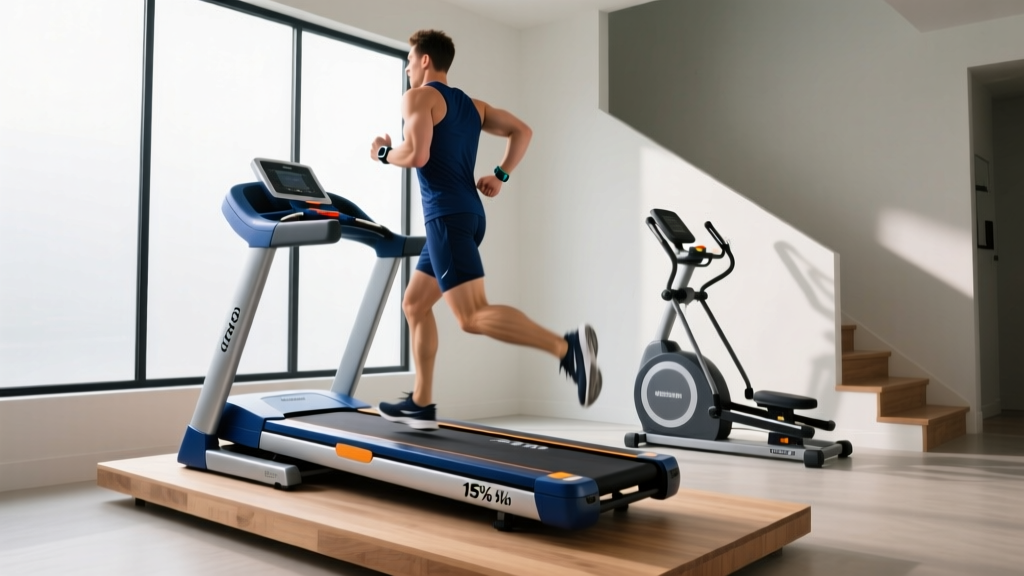
Carbon TLX Treadmill Review: Best Folding Pick for Small Spaces?
Discover if the Carbon TLX treadmill fits your apartment. We review its folded footprint, clearance needs, and layout tips for small-space home gyms.

The Spatial Reality of Home Cardio in 2026
As urban housing footprints continue to shrink and multi-use living spaces become the standard in 2026, integrating heavy fitness equipment into a home requires more than just measuring an empty wall. According to the American Heart Association, maintaining consistent cardiovascular health is non-negotiable, but doing so in a compact apartment or a shared bedroom presents unique architectural and logistical challenges. The market for folding treadmills is heavily saturated with flimsy walking pads and undersized belts that compromise running mechanics. Serious runners need a machine that offers a full-sized deck but vanishes when the workout is over. This is exactly the niche the Carbon TLX treadmill aims to fill. In this comprehensive folding treadmill for small spaces review, we evaluate the Carbon TLX through the critical lens of space optimization, spatial layout design, and structural integration.
Carbon TLX Treadmill: Dimensions and Folded Footprint
When optimizing a room for cardio equipment, the raw specifications dictate your entire floor plan. The Carbon TLX is engineered with a vertical hydraulic folding mechanism that significantly reduces its spatial dominance. Unlike cheaper models that require you to manually lift and lock a heavy deck, the TLX utilizes a soft-drop piston system. Below is the exact spatial data you need to plan your room layout.
| Specification | Measurement | Space Planning Impact |
|---|---|---|
| Unfolded Footprint | 76 in. L x 30 in. W x 55 in. H | Requires a dedicated 16 sq. ft. operational zone |
| Folded Footprint | 42 in. L x 30 in. W x 62 in. H | Reclaims 34 inches of linear floor space |
| Machine Weight | 185 lbs. | Requires permanent placement; not for daily closet storage |
| Running Belt | 20 in. x 55 in. | Standard full-size stride; no spatial compromise on biomechanics |
| Motor Size | 3.25 CHP | Heavier motor housing contributes to the 185 lb. total weight |
Clearance Requirements and Traffic Flow
A common mistake in small-space gym design is pushing the treadmill flush against a wall when unfolded. Ergonomic safety standards dictate strict clearance zones to prevent injury in the event of a stumble or emergency stop. The Mayo Clinic emphasizes that safe home gym environments must prioritize unobstructed movement and emergency egress. For the Carbon TLX treadmill, you must adhere to the following clearance matrix:
- Rear Fall Zone: Minimum 36 inches of clear, unobstructed space behind the rear roller. Do not place beds, dressers, or glass tables in this zone.
- Lateral Clearance: Minimum 24 inches on both the left and right sides of the deck to allow for safe mounting, dismounting, and arm swing.
- Overhead Clearance: Minimum 12 inches above the highest user height to accommodate incline elevation (up to 12 percent) and vertical bounce during sprint intervals.
Layout Design: Integrating the Carbon TLX into Multi-Use Rooms
A treadmill in a living room or bedroom should not look like an industrial machine invading a sanctuary. The Carbon TLX features a matte black frame with brushed aluminum uprights and a low-profile console. This aesthetic is highly advantageous for interior design integration. When folded, the 62-inch height and 30-inch depth allow it to sit neatly behind a low-profile sofa, inside a deep closet alcove, or flanked by tall bookshelves that visually frame the machine.
Visual Weight and Lighting Considerations
In rooms under 150 square feet, bulky fitness equipment creates immense visual weight, making the room feel claustrophobic. To mitigate this, place the Carbon TLX near a natural light source. The brushed aluminum accents reflect ambient light, breaking up the dark mass of the motor housing. Furthermore, avoid placing the folded treadmill directly in the primary sightline from the room entrance. Tuck it into a secondary zone or an architectural nook so the room primary function remains visually dominant.
Floor Loading and Vibration Dampening
Space optimization is not just about horizontal footprint; it is also about vertical force distribution. The Carbon TLX weighs 185 lbs. Add a 200 lb. runner generating dynamic impact forces, and the point-load on your floor joists can exceed 400 lbs. per square foot during heavy heel strikes. If you live in a multi-story condo or an apartment, acoustic transfer and structural vibration are major concerns.
To solve this, you must decouple the machine from the subfloor. Do not rely on thin PVC mats. Invest in a 3/8-inch thick, high-density vulcanized rubber mat cut precisely to the 76 in. by 30 in. unfolded dimensions. This specific thickness disperses the dynamic load across a wider surface area, protecting engineered hardwood from micro-fractures and dampening the 68-decibel acoustic output of the 3.25 CHP motor at 6.0 MPH.
Pros and Cons for Small-Space Dwellers
To summarize the spatial advantages and limitations of this specific model, here is a targeted breakdown for apartment dwellers and compact-home owners.
Spatial Pros
- Hydraulic Soft-Drop: The deck lowers slowly and silently, preventing damage to baseboards or nearby furniture during the folding process.
- Transport Wheels: Dual 2.5-inch polyurethane wheels allow a single user to tilt and roll the 185 lb. machine over thresholds up to 0.75 inches high.
- Console Profile: The ultra-slim console does not protrude excessively when folded, preventing it from catching on curtains or blinds.
Spatial Cons
- Width Limitation: At 30 inches wide, it is significantly wider than ultra-compact walking pads (which often measure 22 inches), making it unsuitable for narrow hallway placements.
- Permanent Footprint: Due to its weight, this is not a machine you will roll into a closet after every use. It requires a dedicated semi-permanent footprint in your room.
- Cable Management: The power cord exits from the rear-center of the motor housing, requiring careful routing to avoid tripping hazards in tight spaces.
Frequently Asked Questions
Can the Carbon TLX be stored horizontally under a bed?
No. The Carbon TLX is designed strictly for vertical folding. The deck does not detach, and the folded height is 62 inches. It cannot be stored under standard furniture. It must be stored upright against a wall or inside a deep, tall wardrobe.
How does the incline motor affect the folded depth?
The incline mechanism is fully housed within the main motor cowling. Engaging the 12 percent incline does not alter the folded dimensions. However, you should always fold the treadmill while the deck is at a 0 percent incline to ensure the hydraulic piston engages the locking pin correctly without lateral stress.
Is the 20-inch belt width sufficient for small-space running?
Yes. While commercial gym treadmills often feature 22-inch belts, a 20-inch belt is the industry standard for premium home models. It provides adequate lateral margin for distance running. In a small space, sacrificing 2 inches of belt width saves 4 inches of total machine width, which is a critical trade-off for room layout optimization.
Final Verdict: Is the Carbon TLX the Right Fit for Your Floorplan?
The Carbon TLX treadmill represents a highly successful compromise between commercial-grade biomechanics and residential spatial constraints. It is not a toy walking pad that can be kicked under a desk; it is a serious 185 lb. running machine that demands respect and proper floor planning. However, its vertical folding efficiency, soft-drop hydraulics, and relatively low visual profile make it one of the most intelligent choices for small-space home gyms in 2026. If you can dedicate a 76 in. by 30 in. operational zone with proper rear and lateral clearances, the TLX will deliver elite cardiovascular training without permanently hijacking your living space.
More gear to consider
All reviews
Rowing Buying Guide & Technique vs. a HIIT Cardio Treadmill for Beginners

Beyond Fixing a Treadmill Belt: 2026 Upright, Recumbent & Spin Bikes
WalkingPad X21 Double Fold Treadmill Review: Under Desk Office Test

Understanding the 8 Speed on Treadmill Pace & Cardio Noise

Stationary Bike Types & Hand Walking on Treadmill: Budget Analysis