Market Analysis: Carbon T10 Treadmill & 2026 Compact Cardio Trends
Explore the 2026 compact portable cardio market. We analyze the Carbon T10 treadmill against top folding fitness gear for small-space home gyms.

The 2026 Shift: Why Compact Portable Cardio is Dominating
As urban real estate premiums continue to climb in 2026, the average square footage of new apartments in major metropolitan areas has stabilized at roughly 680 square feet. This spatial constraint has fundamentally rewritten the rules of home gym design. The era of the dedicated 200-square-foot basement fitness room is yielding to the 'micro-fitness' paradigm, where equipment must seamlessly integrate into living spaces, home offices, and multi-purpose rooms. Consequently, the demand for compact, portable cardio equipment has transitioned from a niche convenience to a dominant market force.
Market Data Highlight: According to comprehensive industry tracking by Grand View Research, the compact and foldable home fitness equipment segment is expanding at a CAGR of 9.4%. This growth significantly outpaces traditional heavy-duty commercial machines, driven primarily by urban millennials and remote workers seeking high-yield cardiovascular solutions with minimal spatial footprints.Within this booming category, the Carbon T10 treadmill has emerged as a critical benchmark. It represents the synthesis of commercial-grade engineering and ultra-compact storage, forcing legacy fitness brands to rethink their approach to portable cardio. This trend report dissects the engineering, market positioning, and biomechanical realities of the Carbon T10 and its primary competitors in the 2026 landscape.
Deep Dive: Engineering the Carbon T10 Treadmill
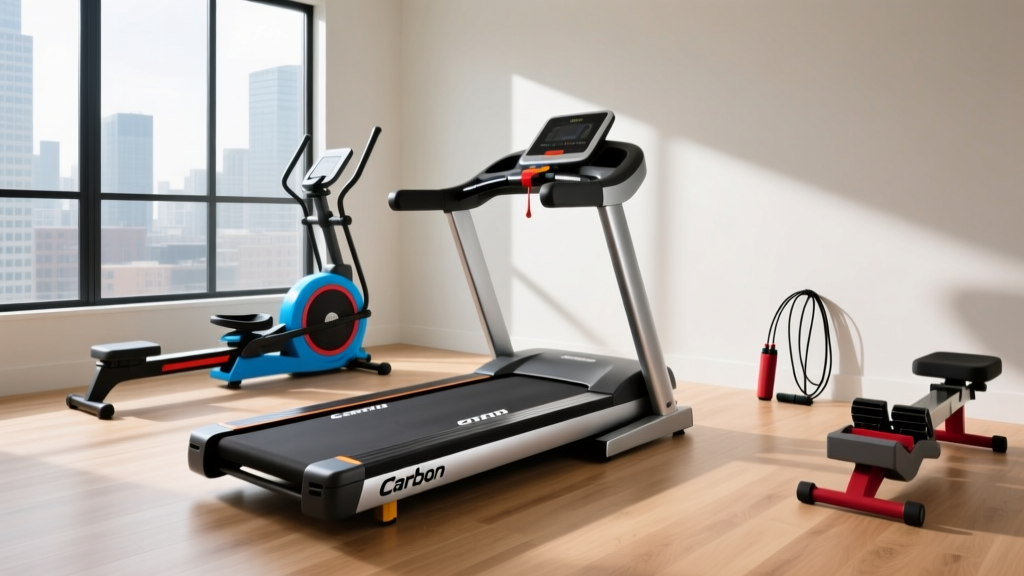
Historically, the 'folding treadmill' category was plagued by severe compromises. Sub-$500 models relied on 1.0 HP motors that overheated during sustained use, and 180-degree hinges that suffered from metal fatigue within 18 months. The Carbon T10 treadmill (retailing at $1,199) was introduced to bridge the gap between flimsy walking pads and immovable commercial rigs.
Chassis and Hinge Mechanics
The defining feature of the Carbon T10 is its dual-pneumatic hinge system. Unlike the cheap latch-snap mechanisms found on budget portable treadmills, the T10 utilizes aircraft-grade aluminum alloy at the folding joint, reinforced with a hydraulic dampener. This allows the 62-pound unit to fold down to a mere 5.5-inch profile, enabling it to slide under standard 6-inch clearance sofas or stand vertically in a closet. The structural integrity of this hinge is rated for 10,000 articulation cycles, effectively eliminating the primary failure mode of portable cardio gear.
Motor and Belt Specifications
Portable treadmills typically sacrifice belt length and motor power. The Carbon T10 counters this with a 2.25 CHP (Continuous Horsepower) brushless DC motor. This is a crucial distinction: peak horsepower (PHP) ratings are often inflated marketing metrics, whereas CHP measures sustained output. Paired with a 47-inch by 17-inch running surface, the T10 accommodates users up to 6 feet 1 inch tall at speeds up to 8.5 MPH, making it one of the few portable units capable of supporting genuine interval running rather than just leisurely walking.
Competitive Matrix: Carbon T10 vs. Portable Alternatives
To understand the Carbon T10's market position, we must evaluate it against the leading compact cardio options available in 2026. The following matrix compares critical specifications that dictate both performance and spatial efficiency.
| Model | Price (2026) | Motor (CHP) | Belt Size | Folded Profile | Max User Weight |
|---|---|---|---|---|---|
| Carbon T10 | $1,199 | 2.25 CHP | 47' x 17' | 5.5' Thick | 265 lbs |
| WalkingPad R1 Pro | $599 | 1.25 CHP | 43' x 17' | 4.9' Thick | 240 lbs |
| Echelon Stride | $999 | 1.75 CHP | 45' x 16' | 7.0' Thick | 250 lbs |
| UREVO Strol 2E | $459 | 1.50 CHP | 40' x 16' | 5.1' Thick | 220 lbs |
Biomechanical Trade-offs: Stride Length and Joint Stress
When analyzing compact portable cardio equipment, spatial efficiency often comes at a biomechanical cost. A critical factor that consumers and reviewers frequently overlook is the relationship between belt length, natural stride mechanics, and joint loading.
'Forcing a user to artificially shorten their stride on a compact treadmill increases knee flexion angles and alters pelvic tilt, which can elevate patellofemoral stress over prolonged sessions.'
— Adapted from biomechanical guidelines on walking and running mechanics via the Mayo Clinic.
Standard commercial treadmills feature 55-inch to 60-inch belts. When a user transitions to a 40-inch belt (like the UREVO Strol 2E), individuals taller than 5 feet 8 inches are forced into a 12% to 15% stride reduction. This 'chopping' of the gait cycle shifts the workload from the glutes and hamstrings to the quadriceps and calf muscles, increasing the risk of shin splints and knee fatigue during sessions exceeding 45 minutes.
The Carbon T10's 47-inch belt represents a calculated engineering compromise. While it cannot fully replicate the open-road stride of a 60-inch commercial deck, it provides sufficient runway for users up to 6 feet 1 inch to maintain a natural gait at walking and light jogging speeds (up to 6.0 MPH). Furthermore, the T10 utilizes a 6-point elastomer cushioning system beneath the deck, which absorbs up to 30% more impact shock than the rigid rubber pads found on budget folding models, aligning with the CDC's physical activity recommendations for safe, sustainable joint health during daily cardiovascular routines.
The Space-to-Performance Decision Framework
Selecting the right portable cardio equipment in 2026 requires moving beyond basic price comparisons. We recommend utilizing the following 'Use-Case Framework' to determine which tier of compact equipment aligns with your specific lifestyle and spatial constraints.
Tier 1: The Under-Desk Walker (1-3 Hours/Week)
- Target Profile: Remote workers seeking NEAT (Non-Exercise Activity Thermogenesis) enhancement while answering emails.
- Required Specs: 1.0 to 1.25 CHP, max speed 4.0 MPH, no handrail required.
- Top Pick: WalkingPad R1 Pro or UREVO Strol 2E.
- Spatial Reality: Can be stored entirely under a bed or desk. Negligible acoustic footprint.
Tier 2: The Dedicated Interval Trainer (4-7 Hours/Week)
- Target Profile: Fitness enthusiasts requiring structured zone-2 cardio and HIIT sessions without sacrificing living space.
- Required Specs: 2.0+ CHP, minimum 45-inch belt, reinforced hinge, integrated handrails for safety at higher speeds.
- Top Pick: Carbon T10 treadmill.
- Spatial Reality: Requires a 5.5-inch vertical clearance for storage or a 2-foot by 3-foot floor footprint when stood on its tail end.
Tier 3: The Compact Marathoner (8+ Hours/Week)
- Target Profile: Serious runners who cannot accommodate a 70-inch commercial rig but need sustained long-distance training.
- Required Specs: 3.0+ CHP, 50-inch+ belt, heavy-duty steel frame.
- Top Pick: Echelon Stride (or upgrading to a foldable commercial hybrid like the NordicTrack Commercial series).
- Spatial Reality: 'Compact' is relative here; these units still require a dedicated 3x6 foot corner and weigh over 120 lbs.
Market Forecast: What is Next for Micro-Cardio?
Looking toward the latter half of 2026 and beyond, the portable cardio market is pivoting toward 'invisible integration.' We are seeing early prototypes of treadmills that double as functional furniture—such as the Carbon T10's rumored successor, which features a deployable hard-top surface that transforms the folded unit into a fully load-bearing coffee table or standing desk base.
Furthermore, battery technology is beginning to influence portable cardio design. While the Carbon T10 and its current rivals require proximity to a 120V wall outlet, advancements in high-discharge lithium-silicon batteries may soon yield cordless, high-CHP folding treadmills. Until then, the Carbon T10 remains the undisputed apex of the current market, offering the most mathematically efficient ratio of spatial footprint to biomechanical performance available to the modern urban consumer.
More gear to consider
All reviews
Elliptical vs Treadmill Maintenance & Treadmill Brands to Avoid

Treadmill Amp Draw and Stationary Bike Types: Home Gym Power Guide

Benefits of Treadmill vs Elliptical vs Walking Pad: Mistakes & Fixes

Anti Gravity Treadmills vs Stationary Bike Types: Space Layouts
Sole F63 Treadmill Disassembly: Motor Size & HP Guide