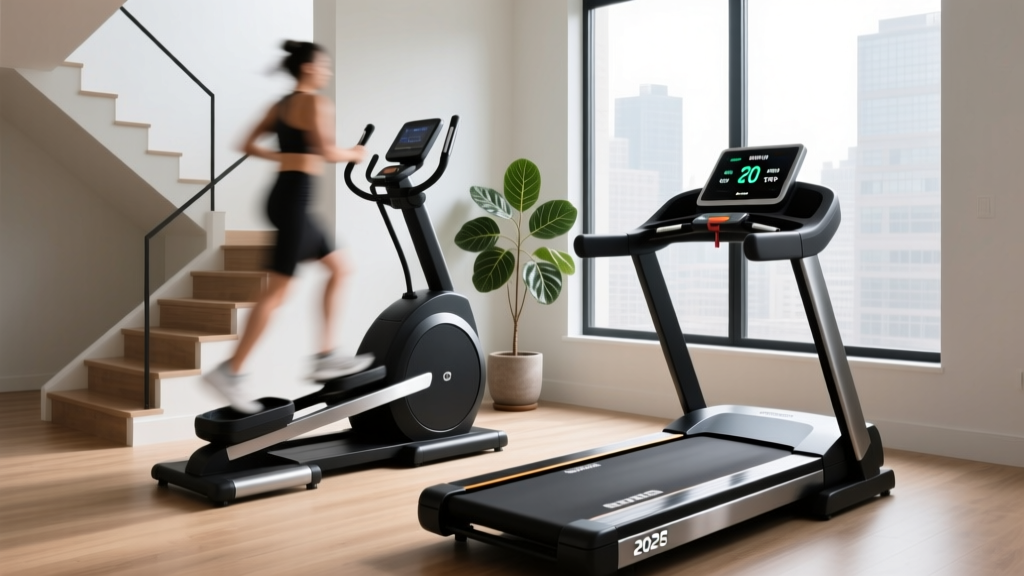
Stair Climber vs Treadmill: How to Calculate 10k Steps on Treadmill
Compare top 2026 stair climbers and treadmills. Learn how to calculate 10k steps on treadmill vs vertical climbers for optimal home cardio.

The 10,000-Step Dilemma: Treadmills vs. Stair Climbers for Home Use
The 10,000-step daily benchmark remains a cornerstone of cardiovascular health, originally popularized by a 1960s Japanese pedometer marketing campaign but now backed by modern cardiology as a reliable metric for reducing all-cause mortality. However, when outfitting a home gym in 2026, fitness enthusiasts face a critical hardware decision: should you invest in a traditional motorized treadmill or a vertical stair climber? Both machines help you hit your daily movement targets, but their biomechanical outputs, spatial footprints, and step-tracking algorithms differ wildly.
In this comprehensive head-to-head guide, we break down the exact math behind step tracking, compare the top-tier stair climbers and treadmills on the market, and help you decide which machine aligns with your joint health, space constraints, and budget.
The Math: How to Calculate 10k Steps on Treadmill vs. Stair Climbers
When figuring out how to calculate 10k steps on treadmill consoles, you are generally relying on a distance-to-stride algorithm. Most treadmill manufacturers use a baseline stride length of 2.5 feet for walking and 4.5 feet for running. Therefore, 10,000 walking steps equates to roughly 25,000 feet, or 4.73 miles. If you walk at a brisk 3.5 MPH on a treadmill like the Sole F80, it will take you approximately 81 minutes to log 10,000 steps.
Stair climbers, however, measure vertical displacement rather than horizontal distance. An average stair step is 8 inches high. Completing 10,000 steps on a machine like the Bowflex Max Trainer M9 means you are climbing 80,000 inches—or 6,666 feet of elevation gain. That is the equivalent of hiking from the base of Mount Washington to the summit and back down. Because of this massive difference in metabolic demand, the American Heart Association (AHA) notes that vigorous-intensity activities (like stair climbing) require half the time of moderate-intensity activities (like flat treadmill walking) to yield similar cardiovascular benefits.
Step Equivalency Formula
1 Stair Climber Step ≈ 2.5 Treadmill Walking Steps in terms of caloric expenditure and cardiovascular load. If your goal is purely caloric burn, 4,000 steps on a stair climber will mirror the metabolic output of 10,000 steps on a flat treadmill.
2026 Head-to-Head Comparison Matrix
Below is a side-by-side comparison of the most popular home cardio machines for step-tracking, featuring current 2026 pricing, physical footprints, and tracking accuracy.
| Model (2026) | Machine Type | Retail Price | Footprint (L x W) | Step Tracking Method | Max User Weight |
|---|---|---|---|---|---|
| Bowflex Max Trainer M9 | Vertical Climber/Elliptical | $1,999 | 49" x 30.5" | Optical Sensor / SPM | 300 lbs |
| NordicTrack CLM 995 | Stair Climber | $1,299 | 54" x 29" | iFIT Integrated Pacing | 350 lbs |
| Sunny Health SF-S902013 | Manual Mini-Climber | $179 | 25" x 16" | Mechanical Pedometer | 220 lbs |
| Sole Fitness F80 | Motorized Treadmill | $1,199 | 82" x 35" | Belt Rotation / Stride | 375 lbs |
| WalkingPad R2 | Foldable Walking Pad | $599 | 57" x 22" (Unfolded) | Accelerometer / Belt | 240 lbs |
Deep Dive: Best Stair Climbers for Home Use
If you are prioritizing vertical movement and high-intensity interval training (HIIT) over long, steady-state walking, a stair climber is the superior choice. Here is how the top three models perform in real-world home environments.
1. Bowflex Max Trainer M9 (Premium Pick)
The Max Trainer M9 remains the gold standard for hybrid vertical climbers. Unlike traditional stair steppers, it combines an elliptical's low-impact footpath with a stair climber's vertical resistance. Priced at $1,999, it features a 10-inch HD touchscreen integrated with the JRNY adaptive AI app, which adjusts resistance in real-time based on your biometric feedback.
- Pros: Unmatched calorie burn per minute; compact footprint for apartments; JRNY app offers highly personalized coaching.
- Cons: High upfront cost; the steep learning curve for the upper-body pull-bar mechanics can cause shoulder fatigue in beginners.
- Failure Mode Watch: The magnetic resistance brake assembly can occasionally throw an 'E3' error code if dust accumulates near the flywheel sensor. Keep the lower chassis vacuumed monthly.
2. NordicTrack CLM 995 (Mid-Tier Smart Climber)
At $1,299, the CLM 995 offers a traditional stair-stepping motion paired with NordicTrack's iFIT ecosystem. The machine automatically adjusts the stepping speed to match the incline of global hiking trails streamed on its 7-inch display.
- Pros: Excellent for users who prefer a natural stair-climbing gait; heavy-duty 350 lb weight capacity; auto-follow resistance.
- Cons: Requires a mandatory $39/month iFIT subscription to unlock manual mode bypasses; larger footprint than the Bowflex.
- Failure Mode Watch: The internal drive belt is prone to squeaking after 400+ hours of use. Apply a silicone-based lubricant to the pedal arm pivots annually to prevent metal-on-metal wear.
3. Sunny Health & Fitness SF-S902013 (Budget Manual Climber)
For under $200, this manual mini-climmer relies on hydraulic cylinders rather than a motorized flywheel. You set the tension via a physical twist knob. It tracks steps via a simple mechanical pedometer built into the console.
- Pros: Extremely affordable; zero electrical draw; easily stored under a bed or in a closet.
- Cons: Hydraulic cylinders overheat and lose tension after 20 minutes of continuous use; step tracking is highly inaccurate (often undercounting by 10-15%).
- Failure Mode Watch: The hydraulic pistons are notorious for developing oil leaks after 12-18 months of heavy use. Keep a mat underneath to protect your flooring.
Joint Health and Biomechanical Realities
When deciding between horizontal and vertical cardio, joint preservation is a primary concern, especially for users over 40. According to the Mayo Clinic, low-impact aerobic exercises are crucial for maintaining cardiovascular health without accelerating cartilage degradation in the knees and hips.
"While stair climbing is an exceptional weight-bearing exercise that improves bone density, the eccentric loading on the patellofemoral joint during the downward phase of a step can exacerbate anterior knee pain. Treadmills with advanced cushioning systems, like the Sole F80's articulated deck, reduce ground reaction forces by up to 30% compared to outdoor concrete."
If you suffer from patellar tendinopathy or lower back issues, a motorized treadmill or a hybrid climber (like the Bowflex, which eliminates the downward 'stomp' phase) is vastly superior to a traditional push-down stair stepper.
Frequently Asked Questions
Do walking pads accurately track 10,000 steps?
Walking pads like the WalkingPad R2 use belt rotation algorithms combined with accelerometer data. While highly accurate for steady-state walking (within a 2% margin of error), they tend to miscount steps if you frequently stop, start, or change speeds while working at a standing desk. For precise 10k tracking, wear a chest strap or smartwatch synced to the machine's Bluetooth.
How does the CDC view stair climbing vs. walking for daily goals?
The Centers for Disease Control and Prevention (CDC) categorizes brisk treadmill walking as 'moderate-intensity' aerobic activity, recommending 150 minutes per week. Stair climbing is categorized as 'vigorous-intensity,' meaning you only need 75 minutes per week to achieve the exact same baseline health benefits. Therefore, 10,000 steps on a stair climber far exceeds the minimum daily requirements for heart health.
Which machine is quieter for an apartment?
Stair climbers with magnetic resistance (like the Bowflex M9) are virtually silent, producing less than 45 decibels of ambient noise. Motorized treadmills generate between 60 and 75 decibels due to the belt friction and motor hum. If you live in a multi-story apartment with downstairs neighbors, a magnetic stair climber or a walking pad placed on a high-density EVA foam mat is your best option to avoid noise complaints.
Final Verdict: Which Machine Wins for Your Home?
If your primary goal is to casually accumulate 10,000 steps while watching TV or working at a standing desk, a folding treadmill or walking pad offers the most frictionless experience. However, if you want to maximize caloric burn, improve VO2 max, and drastically reduce the time required to achieve your daily cardiovascular quotas, a stair climber like the Bowflex Max Trainer M9 is the undisputed champion of the 2026 home gym market. Evaluate your joint health, measure your floor space, and choose the machine that guarantees you will actually use it every single day.
More gear to consider
All reviews
Centr Runr Treadmill vs Walking Pads: 2026 Compact Desk Review

GeeMax Treadmill Noise Test: Head-to-Head 2026 Comparison

Sole F80 Treadmill vs Walking Pads: Beginner Setup Guide
ProForm Treadmill Customer Service: Belt Care in Small Spaces

Curved vs Motorized: WalkingPad R3 Hybrid+ Foldable Treadmill
