
Bowflex Treadmill 10 Reviews vs Stationary Bikes: Budget Guide
We analyze Bowflex Treadmill 10 reviews against upright, recumbent, and spin bikes to help you maximize your home cardio budget and long-term value.

The Premium Treadmill Baseline: What Bowflex Treadmill 10 Reviews Reveal About True Cost
If you have been reading Bowflex Treadmill 10 reviews, you already know that this machine is a powerhouse. With its 22-inch HD touchscreen, -5% to 20% incline/decline capabilities, and a robust 3.5 CHP motor, it represents the upper echelon of home fitness equipment. However, most reviews focus heavily on the immediate user experience and gloss over the long-term financial commitment. In 2026, the retail price of the Bowflex Treadmill 10 hovers around $2,299, but the true cost of ownership extends far beyond the initial checkout.
⚠️ The Hidden Costs of Premium Treadmills:Beyond the $2,299 upfront cost, the Bowflex Treadmill 10 requires a JRNY adaptive coaching subscription to unlock its full smart features. At $49 per month ($588 annually), your 5-year cost of ownership pushes past $5,200. Furthermore, treadmill decks require silicone lubrication every 130 miles, and the high-torque incline motors are prone to gear stripping if subjected to frequent, heavy-impact running without proper maintenance.
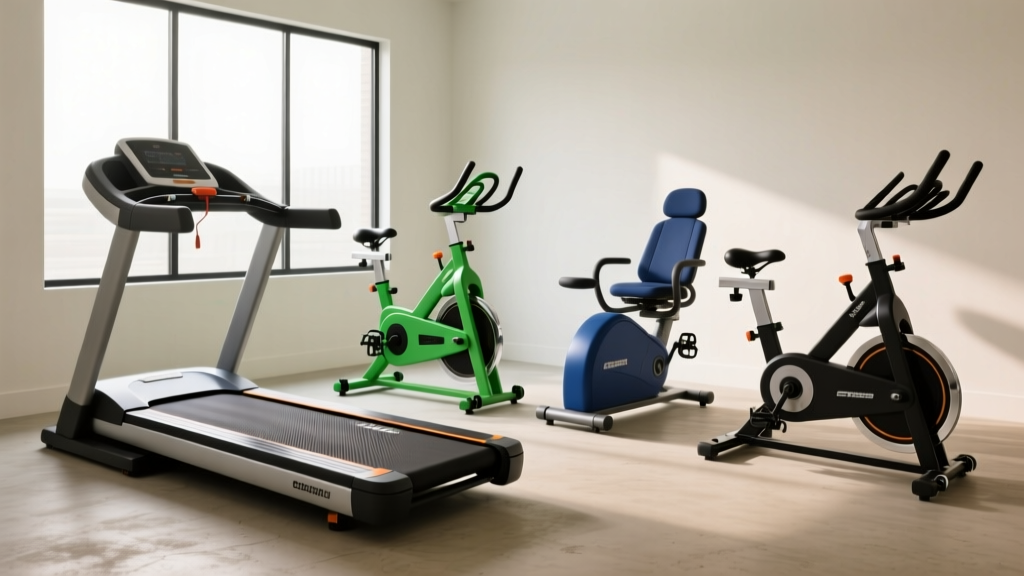
This financial reality leads many home gym builders to a critical crossroads: Is a premium treadmill the best allocation of a $2,500 cardio budget, or can you achieve superior value, lower maintenance, and equal cardiovascular benefits by investing in stationary bikes? To answer this, we must break down the three primary stationary bike types—spin, upright, and recumbent—through a strict value analysis lens.
Stationary Bike Types: A Budget & Value Breakdown
The American Heart Association emphasizes that moderate-to-vigorous aerobic exercise is essential for cardiovascular health, regardless of the modality. Bikes offer a low-impact alternative to treadmills, drastically reducing joint stress while maintaining high caloric expenditure. Here is how the three main categories stack up in terms of budget and long-term value.
1. Spin Bikes (Indoor Cycles): The High-Intensity Value Pick
Spin bikes are designed to mimic the geometry and riding dynamics of outdoor road bikes. They feature a heavy flywheel (typically 30 to 45 lbs) and aggressive, leaned-forward riding positions.
- Price Range: $500 – $1,500
- Top Value Model: Schwinn IC4 ($999) or Peloton Bike ($1,445)
- Maintenance Profile: Extremely low. Magnetic resistance systems have zero physical friction, meaning no brake pads to replace. Drive belts (like the poly-V belt on the IC4) last for years without lubrication.
- Failure Modes: The most common failure point is sweat corrosion. Because riders lean over the handlebars, sweat drips directly onto the bottom bracket and flywheel housing. Failing to wipe down the bike with a 50/50 water-isopropyl alcohol mix after use will destroy the bearings within 18 months.
Value Verdict: Spin bikes offer the highest return on investment for high-intensity interval training (HIIT). A $999 Schwinn IC4 provides a near-identical mechanical feel to a $2,500 commercial cycle, and it requires zero mandatory software subscriptions to function perfectly.
2. Upright Bikes: The Traditional Middle-Ground
Upright bikes feature a smaller footprint, a traditional padded saddle, and a step-through frame design. The pedals are positioned directly under the user's center of gravity.
- Price Range: $300 – $800
- Top Value Model: NordicTrack EXP 7i ($799)
- Maintenance Profile: Low to moderate. Electronics and console mounts are the primary wear points.
- Failure Modes: Seat post wobble and saddle discomfort. Upright bikes place significant pressure on the perineal area and sit bones. Consequently, the most common reason upright bikes are abandoned (and subsequently resold at a massive loss) is user discomfort, not mechanical failure. Additionally, the plastic shrouds covering the resistance mechanism are prone to cracking if bumped during vacuuming.
Value Verdict: Upright bikes are the most budget-friendly option for casual, moderate-intensity cardio. However, their long-term value is often compromised by low user adherence due to ergonomic limitations. They are best suited for users with limited square footage who need a machine that can be rolled into a closet.
3. Recumbent Bikes: The Ergonomic & Rehab Investment
Recumbent bikes feature a bucket seat with a backrest and pedals positioned in front of the body. According to the American Academy of Orthopaedic Surgeons, low-impact conditioning exercises like recumbent cycling are ideal for preserving joint health while building endurance.
- Price Range: $600 – $2,000
- Top Value Model: Sole Fitness R92 ($1,199)
- Maintenance Profile: Very low. The seated weight distribution eliminates the vertical impact forces that destroy treadmill decks and upright bike seat posts.
- Failure Modes: Linear bearing wear. The seat adjustment rail uses linear bearings that can accumulate dust and pet hair, causing the seat to stick. Furthermore, the mesh backing on cheaper recumbent seats can tear after 3-4 years of heavy use, though high-end models like the Sole R92 use reinforced, commercial-grade stitching.
Value Verdict: While the upfront cost is higher than an upright bike, a premium recumbent bike boasts the longest usable lifespan in the home cardio market. Sole Fitness, for example, backs the R92 with a lifetime frame and motor warranty, completely neutralizing long-term repair anxieties.
Cost-Per-Use & Long-Term Value Matrix
To truly understand where your money goes, we must look past the sticker price. The following matrix compares the 5-year projected costs and value retention of the Bowflex Treadmill 10 against top-tier representatives from each bike category.
| Metric | Bowflex Treadmill 10 | Schwinn IC4 (Spin) | NordicTrack EXP 7i (Upright) | Sole R92 (Recumbent) |
|---|---|---|---|---|
| Upfront Cost | $2,299 | $999 | $799 | $1,199 |
| Mandatory Subscriptions | $588/yr (JRNY) | None required | $468/yr (iFIT) | None required |
| 5-Year Maintenance | $150 (Lube/Belts) | $0 | $50 | $0 |
| Est. 5-Year Total Cost | $5,389 | $999 | $3,139 | $1,199 |
| Resale Value (Year 5) | ~$600 | ~$450 | ~$200 | ~$500 |
The 2026 Budget Allocation Framework: Maximizing Your Home Gym
Reading Bowflex Treadmill 10 reviews often triggers the desire for a premium, all-in-one fitness experience. But if your total home cardio budget is capped at $2,500, you have strategic options that can dramatically increase your household's workout adherence and overall value.
Strategy A: The Dual-Modality Setup (Recommended for Couples/Families)
Instead of sinking $2,300 into a single treadmill that only one person may use regularly, split the budget. Purchase a reliable, mid-tier folding treadmill like the Horizon Fitness T101 ($699) for walking and light jogging, and pair it with the Schwinn IC4 ($999) for high-intensity cycling.
Total Cost: $1,698.
Value Gain: You cover both impact and non-impact cardio modalities, eliminate mandatory subscriptions, and leave $800 in your budget for free weights, flooring, or a smart TV to stream your own cycling classes.
Strategy B: The Longevity & Rehab Focus (Recommended for Aging Users)
If joint preservation is your primary goal, the CDC's physical activity guidelines for adults strongly support low-impact aerobic routines. Bypass the treadmill entirely. Invest in the Sole Fitness R92 Recumbent ($1,199) and use the remaining $1,300 to build a comprehensive resistance training setup (adjustable dumbbells, a bench, and resistance bands). This combination builds cardiovascular endurance while actively combating age-related muscle loss (sarcopenia), offering a vastly superior health ROI compared to a treadmill alone.
Real-World Edge Cases: When the Treadmill 10 Actually Wins
To maintain objectivity, we must acknowledge the specific edge cases where the Bowflex Treadmill 10 justifies its premium price tag over any stationary bike:
- Bone Density Training: Stationary bikes are non-weight-bearing. If your physician has prescribed impact exercise to combat osteopenia or osteoporosis, the treadmill's impact forces are medically necessary. Bikes will not stimulate bone remodeling in the hips and spine.
- Specific Race Prep: If you are actively training for a marathon or a hilly trail race, the Treadmill 10's -5% decline and 20% incline capabilities are irreplaceable. No stationary bike can simulate the eccentric muscle contractions required for downhill running.
- The 'Gamification' Factor: For users who absolutely will not exercise unless they are immersed in a high-production-value, interactive digital environment, the JRNY ecosystem on the Bowflex 10 provides a level of engagement that standalone bikes lack without third-party apps like Zwift.
Final Verdict: Where Should Your Money Go?
The insights gleaned from comprehensive Bowflex Treadmill 10 reviews confirm that it is an engineering marvel, but it is also a financial black hole when factoring in subscriptions, maintenance, and depreciation. If you are a dedicated runner with a high disposable income and a need for decline training, the Treadmill 10 is worth the premium. However, from a pure budget breakdown and value analysis perspective, stationary bikes—specifically magnetic spin bikes and heavy-duty recumbents—offer a vastly superior cost-per-use ratio. They require zero mandatory software fees, suffer from fewer mechanical failure points, and provide exceptional cardiovascular benefits with a fraction of the joint wear and tear. Assess your household's biomechanical needs, calculate the 5-year true cost, and allocate your fitness budget toward the equipment that guarantees long-term adherence, not just short-term excitement.
More gear to consider
All reviews
Under Desk Treadmill Review: Do You Need Treadmill Assembly Services?
How Many Calories Burned on Treadmill vs Bikes: Space Layout Guide
2.5 HP Treadmill Belt Maintenance: Lubrication & Longevity Guide

ProForm Carbon TL Treadmill with iFIT: 2026 Portable Cardio Trends

Stair Climber vs Nordic Track Elite 3700 Treadmill Guide
