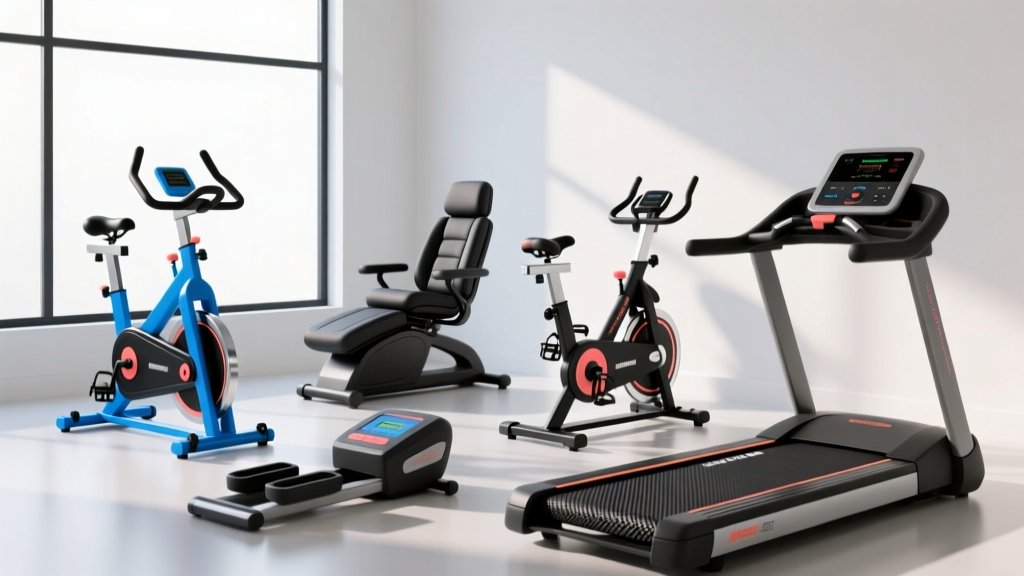
Bike Types vs Stairmaster or Incline Treadmill: 2026 Budget
Compare upright, recumbent, and spin bikes against a stairmaster or incline treadmill. Our 2026 budget breakdown reveals the best value for your home gym.

The 2026 Home Gym Dilemma: Allocating Your Cardio Budget
Building a home gym in 2026 requires a strategic approach to capital allocation. With premium cardio equipment prices stabilizing between $1,500 and $4,500, consumers are forced to make critical decisions about footprint, biomechanics, and long-term return on investment (ROI). The most common crossroads for fitness enthusiasts is choosing between the stationary bike family (upright, recumbent, and spin) and the heavy-duty calorie torchers: a stairmaster or incline treadmill.
This comprehensive budget breakdown and value analysis dissects the hidden costs, spatial requirements, and mechanical longevity of these machines. Whether you are outfitting a 50-square-foot apartment corner or a dedicated 200-square-foot garage gym, understanding the true cost of ownership is vital before swiping your credit card.
Stationary Bike Types: Upright, Recumbent, and Spin Breakdown
Stationary bikes remain the undisputed champions of spatial efficiency and low-impact cardiovascular conditioning. However, the 'bike' category is not a monolith. The value proposition shifts dramatically depending on the specific chassis and resistance mechanism you select.
Spin Bikes (Indoor Cycles)
Spin bikes are designed to replicate the geometry and biomechanics of outdoor road cycling. They feature aggressive forward-leaning postures, heavy flywheels, and minimal console integration.
- Top Value Pick: Schwinn IC4 (Approx. $899). Features a 40-pound flywheel, magnetic resistance, and a 150mm Q-factor (pedal stance width) that mimics real road bikes.
- Premium Pick: Peloton Bike+ (Approx. $2,495). Includes a rotating 23.8-inch HD touchscreen and auto-follow resistance.
- Maintenance Profile: Extremely low. Magnetic resistance systems and poly-V belt drives require virtually zero ongoing maintenance compared to friction-pad or chain-driven legacy models.
Upright Bikes
Upright bikes offer a more relaxed, seated position with a wider saddle and integrated digital consoles. They are ideal for steady-state LISS (Low-Intensity Steady State) cardio and multitasking.
- Top Value Pick: Sole SB700 (Approx. $1,099). Known for its heavy-duty steel frame and 48-pound flywheel.
- Space Footprint: Typically 42 x 24 inches, requiring roughly 7 square feet of floor space.
Recumbent Bikes
Recumbent bikes feature a step-through design with a bucket seat and backrest, shifting the user's center of gravity backward. According to the Mayo Clinic's aerobic exercise guidelines, low-impact modalities like recumbent cycling are highly recommended for individuals managing lumbar spinal stenosis, sciatica, or recovering from lower-extremity joint surgeries.
- Top Value Pick: Schwinn 270 (Approx. $649). Offers 25 levels of magnetic resistance and a ventilated lumbar-support seat.
- Premium Pick: Life Fitness RS1 Go (Approx. $3,200). Commercial-grade alternator and self-generating power supply (no wall outlet required).
When budgeting for a spin bike, do not ignore the Q-factor. Cheaper sub-$500 bikes often have a Q-factor over 170mm, which forces the knees outward and can cause patellofemoral pain syndrome during high-cadence intervals. Invest in models with a Q-factor between 150mm and 160mm for proper biomechanical alignment.
The Heavyweights: Evaluating a Stairmaster or Incline Treadmill
When pivoting your research from stationary bikes to a stairmaster or incline treadmill, the financial and spatial calculus shifts dramatically. These machines are massive, power-hungry, and mechanically complex. They offer unparalleled caloric expenditure and posterior chain development, but they demand a premium in both upfront capital and ongoing upkeep.
StepMills (Stair Climbers)
True revolving staircases (often generically referred to by the trademarked brand name StairMaster) force the user to lift their entire body weight against gravity with every step.
- Market Standard: StairMaster 8G (Approx. $3,899 - $4,299).
- Spatial Reality Check: The footprint is roughly 36 x 28 inches, but the vertical clearance is the hidden killer. You need a minimum ceiling height of 8 feet 2 inches to accommodate a 6-foot-tall user at the top of the step range. Most standard residential rooms with 8-foot ceilings will result in head strikes.
- Maintenance: High. The internal chain drive, sprockets, and step bearings require annual lubrication and eventual replacement. Expect $150-$250 per year in professional servicing or DIY parts.
Incline Treadmills
Incline treadmills have surged in popularity for '12-3-30' style workouts and low-impact hiking simulations. However, pushing a running belt up a 15% to 40% grade requires massive torque.
- Standard Incline Pick: Sole F85 (Approx. $1,999). Features a reliable 4.0 Continuous Horsepower (CHP) motor and a 15% maximum incline.
- Extreme Incline Pick: NordicTrack X22i (Approx. $3,999). Offers a staggering -6% to 40% incline range.
- Electrical Warning: Treadmills with 4.0+ CHP motors pulling heavy inclines will trip standard 15-amp residential circuits. You must budget $150-$300 for an electrician to install a dedicated 20-amp circuit in your gym space.
2026 Cost & Value Comparison Matrix
To visualize the total cost of ownership, we have mapped out the financial and spatial requirements of these cardio categories.
| Machine Category | Entry Price (2026) | Premium Price | Footprint (Sq Ft) | Est. Annual Maintenance |
|---|---|---|---|---|
| Spin Bike (Magnetic) | $699 | $2,495 | 8 sq ft | < $20 |
| Recumbent Bike | $649 | $3,500 | 12 sq ft | < $30 |
| Incline Treadmill | $1,499 | $3,999 | 22 sq ft | $50 - $120 |
| StepMill / Climber | $2,199 | $4,299 | 10 sq ft (High Ceiling) | $150 - $250 |
Budget Analysis: Hidden Costs and Long-Term ROI
When deciding where to allocate your fitness budget, the sticker price is only the beginning. The Centers for Disease Control and Prevention (CDC) recommends at least 150 minutes of moderate-intensity aerobic activity per week for substantial health benefits. To hit this volume consistently at home, your machine must be durable enough to withstand 5 to 7 hours of weekly use.
1. Freight Delivery and Assembly
Bikes typically ship via standard ground carriers (FedEx/UPS) and can be assembled in an hour with basic tools. Conversely, a 350-pound StairMaster or a 400-pound incline treadmill requires LTL (Less Than Truckload) freight shipping. If your gym is in a basement or up a flight of stairs, expect to pay an additional $250 to $450 for 'white glove' inside delivery and assembly. Failing to budget for this often results in a machine sitting on a pallet in your driveway.
2. Belt Lubrication and Motor Degradation
Treadmills require 100% silicone belt lubrication every 150 miles or roughly every three months. Neglecting this increases friction, which forces the motor to draw excess amperage, eventually frying the motor control board (a $400+ replacement part). Magnetic spin and recumbent bikes bypass this issue entirely, as the resistance is generated via eddy currents rather than physical friction.
3. Resale Value Depreciation
Commercial-grade StepMills and premium incline treadmills hold their value reasonably well on the secondary market, often retaining 40-50% of their MSRP after three years if maintained. Budget-tier upright bikes (under $500) depreciate to near-zero within two years due to the proliferation of cheap, identical imports flooding the market.
The 2026 Verdict on Subscriptions: Do not forget to factor in digital ecosystem costs. A $2,495 smart bike or a $3,999 smart treadmill is essentially a brick without its accompanying $44/month streaming subscription. Over five years, that adds $2,640 to your total cost of ownership. Traditional bikes and treadmills with basic LED consoles bypass this recurring financial drain.
Final Decision Framework: Which Machine Wins Your Budget?
To finalize your purchasing decision, apply this practical framework based on your specific living situation and biomechanical needs:
- Choose a Spin or Upright Bike if: You have less than 15 square feet of space, live in an apartment with strict noise/weight limits (treadmills cause severe impact noise transfer to downstairs neighbors), and want a near-zero maintenance profile.
- Choose a Recumbent Bike if: Your budget is under $1,000, and you require lumbar support or are managing joint rehabilitation. It offers the highest safety-to-cost ratio for older adults.
- Choose an Incline Treadmill if: You have a dedicated ground-floor room, a 20-amp electrical circuit, and prioritize walking/hiking mechanics over cycling. The caloric burn per minute is significantly higher than standard cycling.
- Choose a StairMaster if: You have high ceilings (8'2"+), a budget exceeding $3,500, and specifically want to target glute and quad hypertrophy while maximizing cardiovascular output in short 20-minute windows.
Ultimately, the American Heart Association emphasizes that the 'best' cardio machine is simply the one you will use consistently. By mapping out the true spatial, electrical, and maintenance costs outlined above, you can confidently invest in a machine that aligns with both your physiological goals and your financial reality in 2026.
More gear to consider
All reviews
NordicTrack C2270 Treadmill: Small Space Folding Review & Maintenance
Elliptical vs Treadmill Layout: Can a Treadmill Go on Carpet?

BXT6 Treadmill vs Sole F63: Home Gym Noise Level Showdown

Portable Cardio 2026: How to Lose Weight on a Treadmill in a Month
What's the Advantage of a Curved Treadmill? Curved vs Motorized
