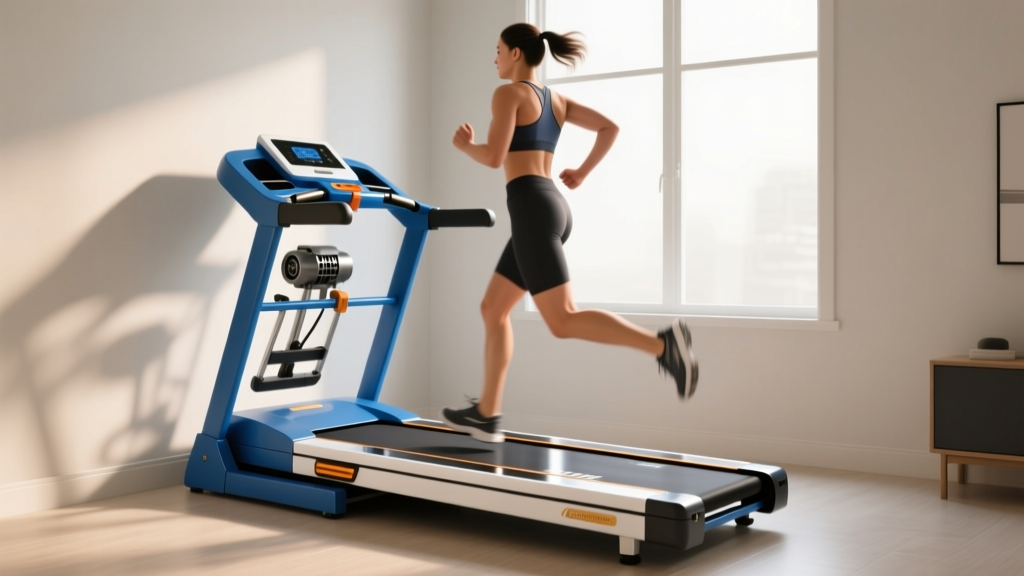
Beyond the iMovr Treadmill: Stair Climber Home Guide 2026
Considering an iMovr treadmill but curious about vertical cardio? Compare top 2026 home stair climber machines, costs, and biomechanics in our expert guide.

Introduction: The Shift from Horizontal to Vertical Cardio
For years, the undisputed king of the home office cardio space has been the premium walking treadmill. Specifically, the iMovr treadmill lineup (such as the Thermotread and Lander series) has dominated the standing-desk market by offering ultra-quiet, low-impact, steady-state (LISS) movement. However, as home gym enthusiasts in 2026 seek higher metabolic returns and greater posterior chain engagement, many are looking beyond the horizontal plane. If you are maxing out the 4.0 MPH walking limit of an iMovr treadmill and craving high-intensity vertical cardio, a stair climber machine is the ultimate upgrade.
This in-depth buying guide bridges the gap between low-impact walking treadmills and high-yield stair climbers. We will break down the biomechanical differences, analyze the top-tier stair climber machines for home use in 2026, and provide exact installation parameters to ensure your investment doesn't end up as a ceiling-scraping clothes rack.
The Biomechanical Divide: iMovr Treadmill vs. Vertical Climbers
To make an informed purchasing decision, you must understand the fundamental mechanical differences between these two cardio modalities. An iMovr treadmill utilizes a continuous-duty DC motor (typically 1.5 HP to 2.5 HP) to pull a belt beneath you, facilitating horizontal locomotion. Stair climbers, conversely, rely on your body weight and gravity, utilizing alternator-generated magnetic resistance or hydraulic cylinders to simulate an endless staircase.
Metabolic & Muscular Output Comparison:- Caloric Expenditure: According to the Centers for Disease Control and Prevention (CDC), vigorous-intensity activities like stair climbing burn significantly more calories per minute than moderate walking. A 180-lb individual burns roughly 250 calories/hour walking at 3.5 MPH on an iMovr, compared to 600-800 calories/hour on a stair climber at a moderate pace.
- Muscle Activation: While treadmill walking primarily engages the calves, hamstrings, and quadriceps in a linear fashion, stair climbing demands explosive hip extension. As detailed by the biomechanics database ExRx.net, the gluteus maximus and adductor magnus are heavily recruited during the vertical drive phase of a stair step, making it superior for posterior chain development.
- Joint Impact: Both are low-impact compared to outdoor running, but stair climbers eliminate the heel-strike deceleration phase entirely, reducing shear forces on the tibial plateau.
2026 Stair Climber Machine for Home Use: Top Tier Models
The home stair climber market has evolved past the clunky, hydraulic mini-steppers of the 2010s. Today's premium models use commercial-grade alternators and optical sensors. Here are the top contenders for home use this year.
1. StairMaster FreeClimber (Home Series)
The FreeClimber remains the gold standard for authentic stair climbing. Unlike the larger StepMill (which uses a rotating escalator), the FreeClimber uses independent pedals that mimic an ascending staircase without the tripping hazard of a moving belt.
- Pricing: $3,899 - $4,299 (Direct and authorized dealers)
- Resistance Mechanism: Poly-V belt driven alternator with 20 levels of eddy-current magnetic resistance.
- Dimensions: 50' L x 28' W x 66' H
- Expert Insight: The 2026 Home Series features upgraded optical sensors for step-rate tracking, eliminating the potentiometer string-snapping issues that plagued older commercial models. However, it requires a dedicated 15-amp circuit; sharing an outlet with a space heater or air conditioner will trip the breaker during high-wattage climbs.
2. Bowflex Max Trainer M9
While technically a hybrid elliptical-stepper, the Max Trainer M9 is engineered for High-Intensity Interval Training (HIIT) and offers a much smaller footprint than a traditional stair climber.
- Pricing: $2,299
- Resistance Mechanism: Air resistance combined with magnetic braking (30 levels).
- Dimensions: 49' L x 30' W x 65' H
- Expert Insight: The M9's integrated upper-body pull handles increase heart rate variability and caloric burn, allowing users to achieve American Heart Association cardiovascular targets in just 14-minute intervals. The primary failure point to watch for is the pivot arm bearings, which require silicone lubrication every 6 months to prevent squeaking.
3. Sunny Health & Fitness SF-S9001 (Budget Alternative)
For those who want the vertical climb without the $4,000 price tag, the SF-S9001 offers a surprisingly robust hydraulic-free, magnetic resistance system.
- Pricing: $450 - $550
- Resistance Mechanism: Belt-driven magnetic flywheel.
- Dimensions: 47' L x 24' W x 62' H
- Expert Insight: At this price point, the console is rudimentary, and the step depth is slightly shallower (8 inches vs. the FreeClimber's 10 inches). It is ideal for users under 220 lbs; heavier users may experience belt slip at higher resistance levels due to the lighter internal flywheel mass.
Comparative Matrix: Footprint, Cost, and Maintenance
| Feature | iMovr Thermotread (Baseline) | StairMaster FreeClimber | Bowflex Max Trainer M9 |
|---|---|---|---|
| Primary Use Case | LISS / Standing Desk Walking | Steady-State Vertical Climbing | HIIT / Short-Burst Cardio |
| 2026 Retail Price | $3,199 | $3,899 | $2,299 |
| Footprint (Sq Ft) | 14.5 sq ft | 9.7 sq ft | 10.2 sq ft |
| Max User Weight | 400 lbs | 350 lbs | 300 lbs |
| Maintenance Need | Belt alignment & deck waxing | Alternator belt tensioning | Pivot joint lubrication |
| Ceiling Clearance | Standard (User Height + 5') | Critical (User Height + 15') | Critical (User Height + 14') |
Critical Installation & Failure Mode Troubleshooting
Transitioning from a low-profile treadmill to a vertical stair climber introduces unique spatial and structural challenges. Ignoring these edge cases is the number one reason for buyer remorse in the vertical cardio category.
The Ceiling Height Math (The 15-Inch Rule)
Unlike an iMovr treadmill where your head remains at a static elevation, a stair climber elevates your entire body mass. The Formula: Take your height in inches, add the maximum step-up height of the machine (typically 14 to 15 inches for commercial-grade models), and add a mandatory 6 inches for overhead clearance and handrail grip extension.
Example: A 6'0' user (72 inches) + 15 inches (step height) + 6 inches (clearance) = 93 inches (7 feet, 9 inches). If your home gym is in a basement with a standard 8-foot (96-inch) ceiling, you will have only 3 inches of margin for error. If your ceiling features exposed HVAC ducts or recessed lighting directly above the machine, you risk head strikes during vigorous climbs.
Sub-Floor Deflection and Sweat Corrosion
Stair climbers generate immense downward vertical force—often exceeding 2.5 times the user's body weight at the bottom of the pedal stroke. If placing the machine on a second-floor wood-framed subfloor, ensure the joists are rated for dynamic loads. Use a high-density rubber equipment mat (minimum 3/8-inch thick) to disperse the point-load of the machine's leveling feet.
Failure Mode Alert: The most common cause of alternator failure in home stair climbers is sweat corrosion. Unlike treadmills where sweat drips onto the belt and evaporates, sweat on a stair climber drips directly down the pedal arms toward the lower magnetic housing. Over time, saline buildup rusts the flywheel and degrades the poly-V drive belt. Solution: Wipe down the lower pedal housings with a diluted vinegar solution weekly, and apply a dry PTFE lubricant to the drive belt every 90 days.
Expert Verdict: When to Choose the Climb Over the Walk
The decision between an iMovr treadmill and a stair climber ultimately hinges on your daily routine, spatial constraints, and cardiovascular goals.
If your primary objective is to integrate continuous movement into an 8-hour workday while answering emails, the iMovr treadmill remains unbeatable. It is designed for sustained, low-heart-rate movement that does not induce sweating or fatigue, making it the perfect office companion.
However, if you are treating your home gym as a dedicated training facility and want to maximize VO2 max, build gluteal strength, and compress your cardio sessions into 20-30 minute high-yield blocks, the stair climber is the superior 2026 investment. The StairMaster FreeClimber offers the most authentic biomechanical experience, while the Bowflex M9 provides an excellent, space-saving alternative for interval training. Measure your ceilings, check your electrical circuits, and prepare to elevate your home cardio regimen.
More gear to consider
All reviews
Bowflex BXT116 Treadmill vs Under Desk Office Use: Value Breakdown
Treadmill Levels vs. Ellipticals: 2026 Noise Comparison

Pad Setup: Calories Burned on Treadmill Calculator With Incline

ProForm Carbon Pro 9000 Treadmill: Beginner's Feature Guide
Curved Manual vs Motorized Treadmill: Setup & Treadmill Upkeep Guide