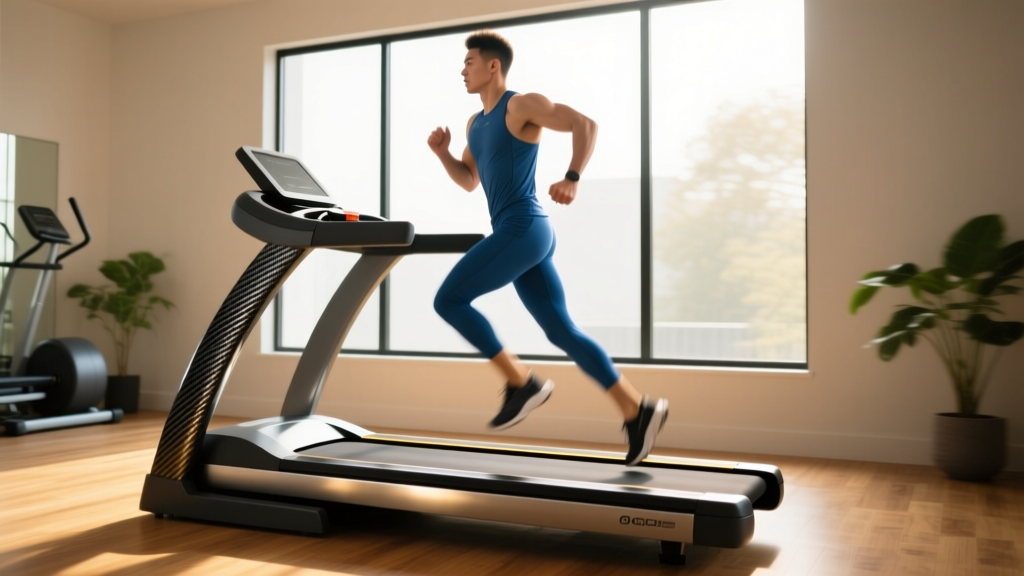
The Core Benefit of Curved Treadmill Training: 2026 Comparison Guide
Discover the primary biomechanical benefit of curved treadmill training. Compare 2026 models, pricing, and features to find the best manual runner.

The Core Benefit of Curved Treadmill Training: Biomechanics Over Motors
For decades, the home fitness market was dominated by heavy, motorized treadmills that dictated your pace and forced your body into a predetermined biomechanical rhythm. Today, the manual curved treadmill has emerged as the gold standard for serious runners, HIIT athletes, and functional fitness enthusiasts. But what exactly is the primary benefit of curved treadmill training, and is it worth the premium price tag in 2026?
The most significant benefit of a curved treadmill is the enhanced activation of the posterior chain combined with a self-regulated metabolic demand. Because there is no motor to pull your legs backward, you must generate 100% of the forward propulsion. This subtle shift in mechanics forces a mid-foot or forefoot strike, drastically reducing the jarring heel-strike impact forces on the tibia and knees while heavily recruiting the glutes, hamstrings, and calves.
Biomechanical Insight: According to the ExRx.net Kinesiology Database, the hip extension required to drive a non-motorized belt recruits the biceps femoris and gluteus maximus far more aggressively than a motorized belt, which essentially 'pushes' the runner forward.
Furthermore, studies published in the American College of Sports Medicine (ACSM) resources indicate that running on a manual curved surface can increase caloric expenditure and VO2 demand by up to 30% compared to running at the exact same speed on a flat, motorized deck. You are not just running; you are pushing the earth away from you with every stride.
2026 Curved Treadmill Feature Comparison Matrix
Not all manual runners are built equally. The market has segmented into two distinct drive systems: continuous vulcanized rubber belts and individual urethane slat tracks. Below is a comprehensive comparison of the top-tier models available in 2026.
| Model (2026) | Belt Type | Running Surface | Max User Weight | Estimated Price | Best For |
|---|---|---|---|---|---|
| Assault AirRunner Elite | Continuous Rubber | 20 x 63 inches | 350 lbs | $5,499 | HIIT & CrossFit |
| TrueForm Runner (Standard) | Urethane Slats | 17 x 62 inches | 300 lbs | $6,495 | Marathon & Form |
| Rogue Echo Runner | Urethane Slats | 17.5 x 63 inches | 350 lbs | $5,890 | Durability & Gyms |
| Technogym Skillmill | Heavy-Duty Slats | 19 x 65 inches | 400+ lbs | $10,500+ | Premium Home & Pro |
Continuous Belt vs. Slat Track: Which Should You Choose?
The Assault AirRunner Elite utilizes a continuous vulcanized rubber belt over a low-friction composite deck. This design offers a slightly softer feel underfoot and is generally quieter, making it ideal for residential spaces where noise transfer is a concern. However, it requires strict maintenance to prevent the friction board from warping.
Conversely, the TrueForm Runner and Rogue Echo Runner use individual urethane slats riding on a track of sealed ball bearings. This slat design provides a firmer, more responsive ground-contact feel that closely mimics outdoor road running. While louder, slat treadmills are virtually indestructible under normal use and are the preferred choice for commercial garages and high-volume training facilities.
The Buying Decision Framework: Space, Power, and Safety
Space & Footprint Advantage
One of the most overlooked benefits of curved treadmill engineering is the spatial efficiency. Because they lack the extended motor hood at the front and the long rear deck required to house a drive motor, curved treadmills are typically 30% shorter in length than their motorized counterparts. The average footprint is roughly 65 x 35 inches, allowing them to fit comfortably in tight home gym corners or low-ceiling basements (the highest point of the curve is usually under 62 inches).
Safety and Injury Prevention
Motorized treadmills pose a unique safety hazard: the belt continues to move at the set speed even if the user stumbles, leading to catastrophic ejection injuries. The U.S. Food and Drug Administration (FDA) tracks thousands of treadmill-related emergency room visits annually, many stemming from motorized belt accidents. A curved treadmill completely eliminates this risk. If you stop pushing, the belt stops moving within a fraction of a second. This inherent safety mechanism makes manual runners vastly superior for elderly users, rehabilitation patients, and athletes recovering from lower-body injuries.
Real-World Failure Modes & Maintenance Costs
Curved treadmills are marketed as 'maintenance-free,' but as a domain expert, I must clarify that this is a marketing myth. While they lack electronic motors and complex incline lifters that fry motherboards, they are subject to intense mechanical friction. Here is what actually breaks and what it costs to fix in 2026:
- Continuous Belt Friction Boards (Assault AirRunner): If you fail to apply 100% silicone lubricant every 90 days, the rubber belt will generate excessive heat, melting the composite deck underneath. Replacement Cost: $150 for the deck, plus 2 hours of labor.
- Slat Bearing Degradation (TrueForm / Rogue): The sealed bearings inside the slat track can seize if exposed to excessive humidity or sweat corrosion. Replacement Cost: Roughly $40 per individual slat. Fortunately, you only need to replace the specific slats that develop a 'clicking' sound, not the whole track.
- Magnetic Resistance Fails (Skillmill / AirRunner): Many modern curved treadmills include a magnetic resistance lever for pushing heavy sleds. The physical cable connecting the lever to the magnetic brake can snap under extreme HIIT torque. Replacement Cost: $45 for the cable assembly.
Frequently Asked Questions
Can I walk on a curved treadmill for LISS cardio?
Yes, but it requires a learning curve. Because the belt is heaviest at the bottom of the curve, initiating a slow walk requires you to lean forward significantly and push through the forefoot. It is excellent for active recovery and posture correction, but users accustomed to flat treadmills may experience calf fatigue during their first few weeks of low-intensity steady-state (LISS) walking.
Do curved treadmills require a dedicated electrical circuit?
No. The defining feature of a manual curved treadmill is that it is 100% human-powered. While some premium models (like the Technogym Skillmill) might plug into a standard 120V outlet to power an integrated LED display or Bluetooth telemetry, the drive mechanism requires zero electricity. This makes them perfect for garage gyms, off-grid cabins, or rooms lacking dedicated 20-amp fitness circuits.
Is the 30% higher caloric burn actually measurable?
The 30% figure is an average derived from high-intensity interval testing. If you are jogging at 5 MPH, the metabolic difference between a flat motorized treadmill and a curved manual treadmill is roughly 10-15%. However, as you increase your speed to sprinting (12+ MPH), the energy required to overcome the belt's inertia and the curve's geometry spikes dramatically, pushing the caloric and VO2 differential closer to that 30% mark.
Final Verdict: Is the Investment Justified?
If your primary goal is casual walking while watching television, a $500 flat motorized treadmill is sufficient. However, if you are an athlete focused on sprint mechanics, posterior chain development, or you want a high-intensity cardio machine that will outlast a decade of brutal HIIT workouts without a motor burning out, the benefit of curved treadmill technology is undeniable. For most home gym owners in 2026, the Rogue Echo Runner offers the best balance of commercial-grade slat durability and residential pricing, while the Assault AirRunner Elite remains the king of quiet, continuous-belt interval training.
More gear to consider
All reviews
Best Walking Pads: Hitting the Treadmill Speed for 8 Minute Mile
Setup Guide: NordicTrack T Series 16 vs Curved Manual Treadmills
Small Space Folding Treadmill Review: Sprint Exercises on Treadmill
WalkingPad X21 Double Fold Treadmill Review: Under Desk Office Test
Cardio Machine Noise: Home Gym vs Treadmill for Horses
