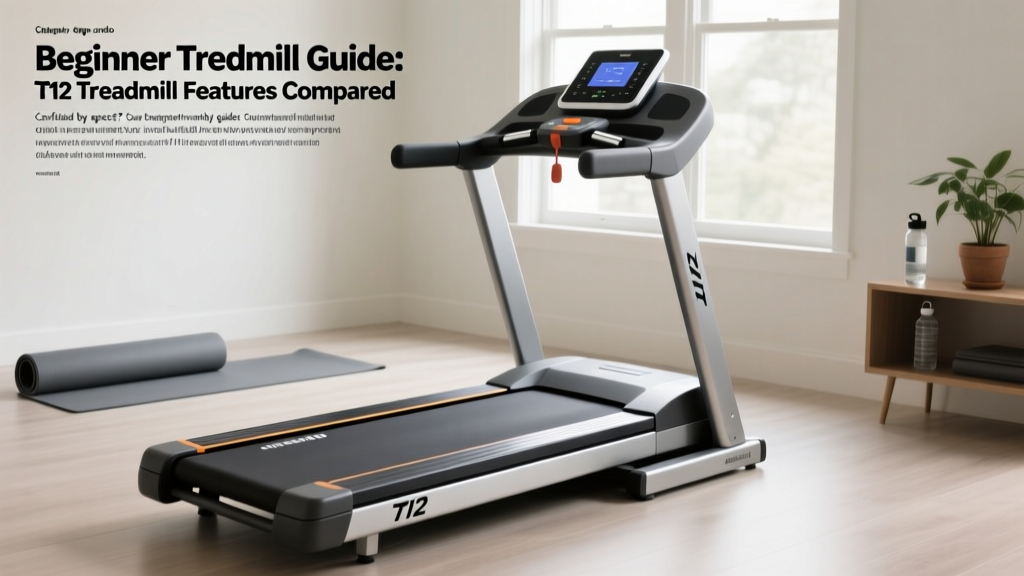
Beginner Treadmill Guide: T12 Treadmill Features Compared
Confused by treadmill specs? Our beginner-friendly guide compares essential features using the popular T12 treadmill as a benchmark for your 2026 home gym.

Stepping Into Home Cardio: The T12 Treadmill Benchmark
Entering the home fitness equipment market in 2026 can feel overwhelming, especially when you are bombarded with technical jargon like 'continuous horsepower,' 'deck cushioning,' and 'ply count.' If you are a beginner looking to start a walking or light jogging routine, you have likely encountered the T12 treadmill during your research. Widely available on major e-commerce platforms, the T12 represents the archetypal budget-friendly, compact folding treadmill—typically priced between $250 and $350.
But how do you know if a budget model like the T12 is actually right for your body and your goals? According to the American Heart Association, adults need at least 150 minutes of moderate-intensity aerobic activity per week to maintain cardiovascular health. To hit those numbers safely at home, you need a machine that matches your biomechanics and usage patterns.
In this step-by-step beginner's guide, we will use the standard specifications of the T12 treadmill class as our baseline. By comparing the T12 against mid-range and premium treadmill features, you will learn exactly what to look for when making your first cardio machine purchase.
Step 1: Decoding Motor Specs (Peak HP vs. CHP)
The motor is the heartbeat of any treadmill, and it is also where budget manufacturers frequently mislead beginners. When you look at the spec sheet for a standard T12 treadmill, you will often see a motor advertised as '2.5 HP' or '3.0 HP.' However, this is almost always Peak Horsepower, not Continuous Horsepower (CHP).
Beginner Trap Alert: Peak HP measures the absolute maximum output the motor can hit for a fraction of a second before burning out. Continuous Horsepower (CHP) measures what the motor can sustain during a 45-minute workout. Always buy based on CHP.How the T12 Compares:
- Budget T12 Class: Usually features a 2.0 to 2.5 Peak HP motor (roughly 1.25 to 1.5 CHP). This is perfectly adequate for walking at 2.0 to 3.5 MPH. If you attempt to run at 6.0 MPH, the motor will overheat, the belt will stutter, and the lifespan of the machine will drop drastically.
- Mid-Range ($800 - $1,200): Offers a true 2.75 to 3.0 CHP motor. This allows for sustained jogging and running without thermal shutdown.
- Premium ($2,000+): Features 3.5 to 4.0 CHP commercial-grade motors designed for daily, multi-user running.
The Takeaway: If your goal is strictly walking while watching TV or working at a standing desk, the T12 treadmill's motor is sufficient. If you plan to run or do high-intensity interval training (HIIT), you must upgrade to a 3.0 CHP model.
Step 2: Belt Dimensions and Ply Count
The running belt dictates your safety and comfort. A belt that is too short or narrow forces you to alter your natural gait, which can lead to hip and knee strain over time. Harvard Health notes that walking is one of the most effective and accessible forms of exercise, but only if done with proper, unrestricted form.
Width and Length Breakdown
The standard T12 treadmill features a belt measuring approximately 15 inches wide by 43 inches long.
- Width (15"): This is quite narrow. You will need to maintain strict lateral awareness. If you naturally sway while walking, you risk stepping on the side plastic rails, which is a major slip hazard.
- Length (43"): This length accommodates walking strides for users up to about 5'8". If you are taller than 5'9" and attempt to jog, your heel will likely strike the rear motor cover.
By contrast, mid-range treadmills offer a 20" x 55" belt, providing a natural runway for users up to 6'2" to run comfortably without looking down at their feet.
Understanding Ply Count
Budget models like the T12 typically use a 1-ply belt. These are thinner, prone to stretching, and require frequent manual re-tensioning via the rear roller bolts. Mid-range and premium machines use 2-ply or 4-ply belts with a textured top layer and a smooth, waxed underbelly that reduces friction against the deck, drastically extending the life of both the belt and the motor.
Step 3: Weight Capacity and the '20% Buffer Rule'
One of the most critical failure modes for beginner treadmill buyers is ignoring the weight capacity rating. The T12 treadmill generally advertises a maximum user weight of 220 lbs. However, taking this number at face value is a recipe for a broken machine.
When you walk or run, the impact force on the deck is significantly higher than your static body weight. A 200 lb runner exerts over 400 lbs of dynamic force on the deck with every footstrike.The 20% Buffer Rule: Never buy a treadmill where your body weight is within 10% of the maximum capacity. Always leave a minimum 20% buffer. If you weigh 180 lbs, you need a treadmill rated for at least 225 lbs. If you weigh 210 lbs, the 220 lb limit of the T12 will cause the deck to flex excessively, creating friction that will eventually burn out the motor controller.
Mid-range treadmills typically offer a 300 to 325 lb weight capacity, utilizing thicker steel tubing and reinforced deck welding to handle dynamic impact forces without flexing.
Step 4: Feature Comparison Matrix
To help you visualize where the T12 treadmill sits in the broader 2026 fitness equipment landscape, review this side-by-side comparison matrix. This framework will help you decide which tier aligns with your budget and biomechanical needs.
| Feature | Budget (T12 Class) | Mid-Range (e.g., Horizon T101) | Premium (e.g., NordicTrack 1750) |
|---|---|---|---|
| Price Range | $250 - $350 | $800 - $1,200 | $1,800 - $2,500+ |
| Motor | 1.25 - 1.5 CHP (Peak 2.5) | 2.75 - 3.0 CHP | 3.5 - 4.0 CHP |
| Belt Size | 15" x 43" (1-Ply) | 20" x 55" (2-Ply) | 22" x 60" (Multi-Ply) |
| Max Speed | 5.0 - 7.0 MPH | 10.0 - 12.0 MPH | 12.0 - 15.0 MPH |
| Incline | 0% (Manual or None) | 0 - 10% (Power Auto) | -3% to 15% (Auto/Decline) |
| Deck Cushioning | Basic MDF Wood (High Impact) | Silicone Elastomers (Medium) | Adjustable Shock Absorption |
Step 5: Incline and Cushioning Systems
Finally, we must look at how the machine handles joint impact and resistance. The CDC recommends incorporating muscle-strengthening and varied-intensity activities into your weekly routine. Incline walking is a phenomenal way to elevate your heart rate without the high-impact joint stress of running.
The Incline Reality
The T12 treadmill typically features manual incline, meaning you must stop your workout, step off the machine, and physically pull a pin or adjust a knob at the rear legs to change the angle (usually offering 0%, 2%, and 4% presets). This breaks your momentum and is rarely used in practice. Mid-range and premium models offer power incline, allowing you to adjust the deck angle from the console mid-stride, which is essential for structured interval training.
Deck Cushioning and Joint Health
Budget treadmills utilize a simple MDF (medium-density fiberboard) deck bolted directly to the steel frame. This offers zero shock absorption; the impact is nearly identical to walking on concrete. If you have a history of shin splints, plantar fasciitis, or knee pain, a rigid MDF deck will exacerbate your condition. Upgrading to a mid-range model introduces elastomer cushions (rubber bumpers) between the deck and the frame, absorbing up to 30% of the impact force and protecting your cartilage over thousands of miles of use.
Final Verdict: Is the T12 Treadmill Right for You?
Use this quick decision framework to finalize your purchase:
Buy the T12 Treadmill (or similar budget class) IF:
- Your primary goal is casual walking (under 4.0 MPH) for 30-45 minutes a day.
- You are under 5'8" tall and weigh less than 170 lbs (respecting the 20% buffer rule).
- You have severe space constraints and need a machine that folds flat or slides under a bed.
- Your budget is strictly capped at $350.
Upgrade to a Mid-Range Treadmill ($800+) IF:
- You plan to jog, run, or perform HIIT workouts.
- You are taller than 5'9" and need a 55-inch belt to prevent heel-strike on the motor cover.
- You weigh over 180 lbs and require a heavy-duty steel frame to prevent deck flex.
- You want to utilize power incline to safely build glute and hamstring strength without joint impact.
Choosing your first treadmill is an investment in your long-term cardiovascular health. By looking past the marketing hype and focusing on continuous horsepower, belt dimensions, and dynamic weight capacity, you can confidently select a machine that will support your fitness journey for years to come.
More gear to consider
All reviews
Vision Fitness Treadmill T9250 vs Stair Climbers: Home Mistakes

Home Gym Layout: Man Running on Treadmill vs Stationary Bike Types

True 540 Treadmill vs Air Bike: Assault Comparison
NordicTrack T 6.5 S Treadmill Details: Belt Maintenance & Budget Value
NordicTrack T 9.5 S Treadmill vs Walking Pads: 2026 Review