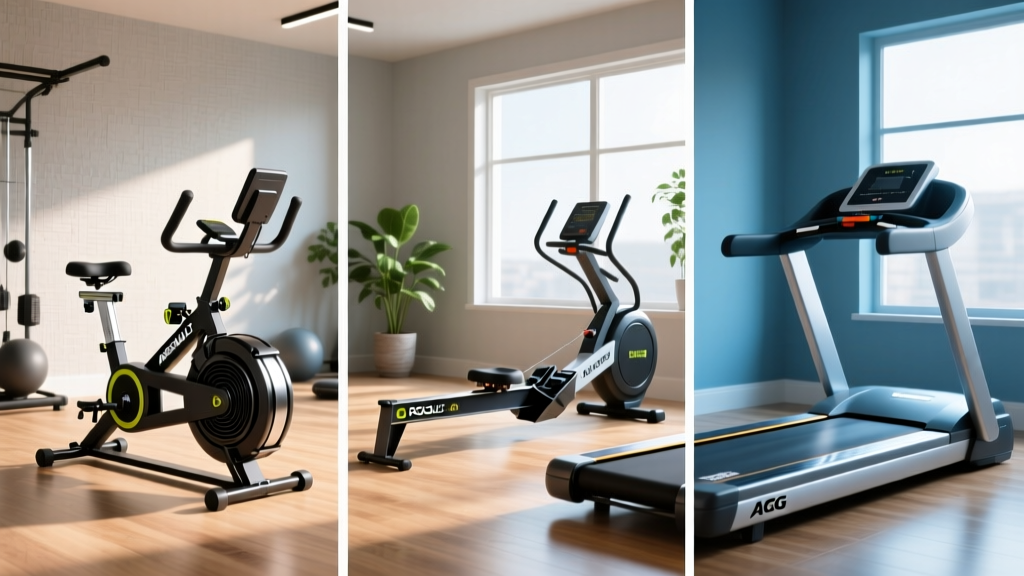
Air Bike vs Assault Bike vs Treadmill AFG: Value Guide
Compare the Assault AirBike, Rogue Echo, and treadmill AFG models. Discover which cardio machine offers the best ROI for your home gym in 2026.

The Cardio Conundrum: Allocating Your 2026 Home Gym Budget
Building a high-performance home gym requires ruthless prioritization. When allocating a $1,000 to $1,500 budget for a primary cardio engine, buyers typically face a crossroads: invest in the high-intensity, full-body torture of an air bike, or opt for the steady-state reliability of a traditional running machine. This guide serves as your definitive air bike assault bike comparison guide, while also introducing a crucial third variable into the value equation: the mid-tier treadmill market, specifically analyzing how a treadmill AFG model stacks up against the fan-bike giants in terms of long-term ROI, biomechanics, and total cost of ownership.
As of early 2026, the fitness equipment market has stabilized, but prices for premium cardio gear remain steep. Making the wrong choice doesn't just waste your initial capital; it costs you in maintenance, floor space, and ultimately, abandoned fitness goals. Let us break down the exact numbers, mechanical failure modes, and physiological returns of these three distinct cardio pathways.
Head-to-Head: Assault AirBike Elite vs. Rogue Echo Bike V2
The term "assault bike" has become genericized, much like "Kleenex," but in the premium air bike space, the rivalry is strictly between the original Assault AirBike Elite and the Rogue Echo Bike V2. Both utilize wind resistance, meaning the harder you pedal and push/pull the handles, the exponentially higher the resistance becomes. However, their engineering philosophies are vastly different, which directly impacts their long-term value.
| Feature | Assault AirBike Elite | Rogue Echo Bike V2 |
|---|---|---|
| 2026 Retail Price | $999.00 | $775.00 |
| Drive System | Poly-V Belt Drive | Steel Chain Drive |
| Fan Diameter | 25 Inches | 27 Inches |
| Weight Capacity | 350 lbs | 350 lbs |
| Footprint | 48" L x 24" W | 52" L x 30" W |
Mechanical Failure Modes & Maintenance Realities
When evaluating value, you must look past the sticker price and examine how these machines fail. The Assault AirBike Elite utilizes a Poly-V belt drive. This makes the machine whisper-quiet, a massive advantage for apartment dwellers or early-morning athletes. However, the failure mode here is belt slip. If ambient dust and pet hair accumulate in the pulley grooves, the belt loses traction, resulting in a "dead spot" during high-RPM sprints. Fixing this requires disassembling the side shroud, cleaning the grooves with a wire brush, and re-tensioning the idler pulley—a 45-minute maintenance task you will likely face every 12 to 18 months.
Conversely, the Rogue Echo Bike V2 uses a traditional steel chain drive. It is virtually bombproof and can withstand the violent torque of elite CrossFit athletes without slipping. The trade-off? Noise and lubrication. The Echo Bike sounds like a fixed-gear bicycle accelerating, and the chain requires periodic application of dry PTFE lubricant. If neglected, the chain stretches and the rear cassette teeth wear down, requiring a $40 drivetrain replacement after roughly three years of heavy use.
Expert Insight: If your primary use case involves interval programming (e.g., Tabata or 30/30 splits) where rapid acceleration and deceleration are required, the Rogue Echo's chain drive provides a more immediate, connected feel to the fan. The Assault's belt can feel slightly "mushy" during explosive direction changes.The Treadmill AFG Variable: Steady-State vs. HIIT
While air bikes dominate the High-Intensity Interval Training (HIIT) space, they are notoriously miserable for Long Slow Distance (LSD) or steady-state Zone 2 cardio. This is where evaluating a treadmill AFG model—such as the highly rated AFG 7.0AT—becomes critical for a well-rounded budget breakdown. Priced around $1,299, the AFG 7.0AT sits in the mid-tier market but offers commercial-grade features that challenge the value proposition of premium air bikes.
Space, Power, and the Hidden Costs of Treadmills
An air bike requires zero electricity; it is entirely human-powered. A treadmill AFG unit, however, requires a dedicated 15-amp circuit to handle the startup surge of its 3.0 CHP motor. Furthermore, the spatial footprint is vastly different. The AFG 7.0AT measures roughly 72" L x 34" W and weighs 280 lbs. You cannot easily roll it into a corner when guests arrive.
- Upfront Cost: AFG 7.0AT ($1,299) vs. Rogue Echo ($775). The air bike wins on initial capital outlay by over $500.
- Energy Consumption: A treadmill running at 7.0 mph for an hour draws approximately 600-800 watts. Over a year of daily use, expect to add $40-$60 to your annual utility bill. The air bike costs $0 in electricity.
- Deck Maintenance: Treadmill decks require silicone lubrication every 150 miles. Failure to lubricate the AFG deck increases friction, which forces the motor to draw excess amperage, eventually frying the motor control board (a $250+ replacement part).
Biomechanics and Joint Impact: What the Science Says
Value isn't just about dollars; it is about physiological ROI and injury prevention. According to the American Council on Exercise (ACE), air bikes elicit a higher peak heart rate and greater Excess Post-exercise Oxygen Consumption (EPOC) compared to steady-state treadmill running, making them vastly superior for time-crunched calorie burning. A 20-minute max-effort air bike session can yield the same metabolic stimulus as a 45-minute jog.
However, joint loading tells a different story. The Mayo Clinic notes that weight-bearing exercises like treadmill running are essential for maintaining bone mineral density, a factor that non-weight-bearing cycling lacks. If you are over 40 and prioritizing bone health alongside cardiovascular endurance, the budget premium of a treadmill AFG model pays dividends in long-term orthopedic health. Conversely, if you are managing patellofemoral pain syndrome or recovering from a lower-body impact injury, the zero-impact, closed-kinetic-chain environment of the Rogue Echo or Assault AirBike is non-negotiable.
5-Year Total Cost of Ownership (TCO) Matrix
To determine the true winner of this budget breakdown, we must project the 5-year TCO, factoring in purchase price, estimated maintenance parts, and average resale value in the robust secondhand fitness market.
Rogue Echo Bike V2
Initial Cost: $775
5-Yr Maintenance: $60 (Chain lube, cassette replacement)
Estimated Resale: $450
Net 5-Year Cost: $385
Assault AirBike Elite
Initial Cost: $999
5-Yr Maintenance: $40 (Replacement belts, pulley cleaning)
Estimated Resale: $550
Net 5-Year Cost: $489
Treadmill AFG (7.0AT)
Initial Cost: $1,299
5-Yr Maintenance: $150 (Deck lube, belt replacement, energy)
Estimated Resale: $400
Net 5-Year Cost: $1,049
Final Verdict: Maximizing Your Home Gym ROI
When executing a strict budget breakdown, the Rogue Echo Bike V2 emerges as the undisputed champion of raw financial value and high-intensity conditioning. At $775, its bombproof chain drive and low maintenance requirements yield the lowest net cost of ownership over a five-year period. It is the ultimate tool for athletes prioritizing VO2 max improvements, metabolic conditioning, and space efficiency.
However, the Assault AirBike Elite justifies its $999 premium for users who require a quieter operational footprint or prefer the slightly smoother, belt-driven pedal stroke for longer, seated endurance intervals.
Finally, do not dismiss the treadmill AFG category if your training goals lean heavily toward marathon prep, Zone 2 base-building, or weight-bearing bone density work. While the AFG 7.0AT carries a significantly higher 5-year net cost ($1,049) and demands more spatial and electrical resources, it provides a biomechanical stimulus that no air bike can replicate. The smartest home gym builders in 2026 aren't just buying equipment; they are investing in specific physiological adaptations. Choose the machine that aligns with your biological goals, and the financial ROI will naturally follow through consistency and longevity.
More gear to consider
All reviews
AssaultRunner Pro Treadmill: Feature Comparison & Setup Walkthrough
Can Walking on a Treadmill Lose Belly Fat? Home Stair Climber Guide
Elliptical vs Treadmill Care: Why Does Running on a Treadmill Feel Harder

Sole Treadmill F80 vs F85 Setup: Curved vs Motorized Installation
0 Gravity Treadmill vs Under Desk Treadmill for Office Use Review
