Air Bike vs Assault Bike: Better Than Treadmill Running Workouts?
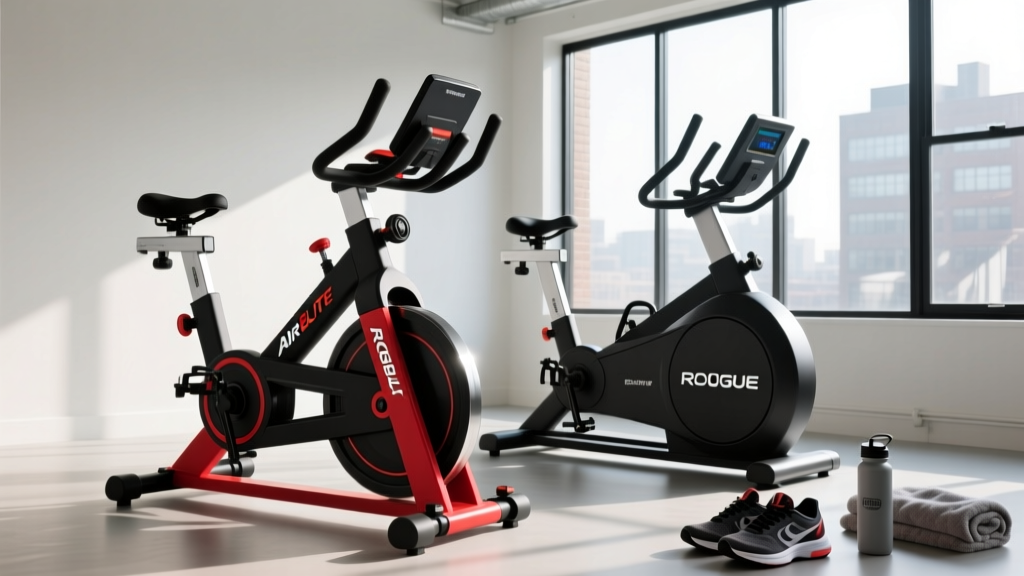
We break down the 5-year cost of the Assault AirBike Elite vs. Rogue Echo V2, and compare their ROI against expensive treadmill running workouts.

The True Cost of Cardio: Treadmill Running Workouts vs. Air Bikes
As we navigate the home fitness landscape in 2026, a massive shift is occurring in garage gyms and spare bedrooms alike. For decades, treadmill running workouts have been the undisputed gold standard for cardiovascular conditioning. However, the hidden costs of motorized treadmills—ranging from mandatory digital subscriptions to inevitable mechanical failures—are forcing budget-conscious athletes to pivot. Enter the air bike: a rugged, analog, high-output alternative that delivers elite cardiovascular stimulus without the $2,500 price tag or the $400 annual maintenance bill.
But if you are abandoning the treadmill belt for the fan blade, which machine actually offers the best long-term value? In this budget breakdown and value analysis, we are putting the two titans of the industry head-to-head: the Assault AirBike Elite and the Rogue Echo Bike V2. We will analyze their 5-year Total Cost of Ownership (TCO), dissect their specific mechanical failure modes, and provide a concrete framework for translating your favorite treadmill running workouts to the air bike.
💡 The 2026 Budget Snapshot
- Average Motorized Treadmill (e.g., NordicTrack 1750): $1,799 upfront + $468/year subscription + $150/year maintenance.
- Assault AirBike Elite: $1,299 upfront + $0 mandatory subscriptions + near-zero maintenance.
- Rogue Echo Bike V2: $1,350 upfront + $0 mandatory subscriptions + near-zero maintenance.
Head-to-Head: Assault AirBike Elite vs. Rogue Echo Bike V2
To understand the value proposition, we must look past the marketing copy and examine the metallurgy, drivetrain mechanics, and warranty structures of both machines. Both bikes utilize air resistance, meaning the work output is theoretically infinite and scales perfectly with the user's effort. However, their engineering philosophies differ drastically.
Assault AirBike Elite ($1,299)
Assault Fitness released the 'Elite' model specifically to address the catastrophic failure modes of their original 'Classic' air bike. The Classic was notorious for bottom bracket shear—where the pedal spindle would literally snap off the crank arm during high-torque standing sprints. The Elite solves this with a heavy-duty, sealed cartridge bottom bracket and a reinforced steel crank. It features a 25-inch fan, a belt-drive system (eliminating the chain maintenance of older models), and a 10-year frame warranty. At 115 lbs, it is relatively easy to move, though it can exhibit slight lateral wobble during aggressive out-of-the-saddle sprinting.
Rogue Echo Bike V2 ($1,350)
Rogue Fitness took a different approach with the Echo V2. Recognizing that chain-stretch and derailment were the primary complaints of the V1, Rogue completely overhauled the drivetrain, switching to a high-tension belt drive. The Echo V2 boasts a massive 27-inch fan, which moves more air per revolution, resulting in a smoother, less 'choppy' resistance curve at lower RPMs. The frame is an absolute tank, weighing in at 135 lbs assembled. It includes a lifetime frame warranty, reflecting Rogue's confidence in its structural integrity. The trade-off? The sheer footprint and weight make it a permanent fixture in your gym.
5-Year Total Cost of Ownership (TCO) Matrix
When evaluating cardio equipment, the sticker price is merely the entry fee. Below is a realistic 5-year TCO comparison, factoring in electricity, required digital subscriptions, and preventative maintenance.
| Cost Factor (5 Years) | Premium Treadmill | Assault Elite | Rogue Echo V2 |
|---|---|---|---|
| Initial Hardware Cost | $1,799.00 | $1,299.00 | $1,350.00 |
| Mandatory App Subscriptions | $2,340.00 ($39/mo) | $0.00 | $0.00 |
| Electricity (Est. 1hr/day) | $180.00 | $0.00 | $0.00 |
| Maintenance (Belts/Lube/Parts) | $350.00 | $45.00 (Pedal lube) | $45.00 (Pedal lube) |
| Total 5-Year Cost | $4,669.00 | $1,344.00 | $1,395.00 |
Note: According to the CDC's Physical Activity Guidelines, adults need at least 150 minutes of moderate-intensity aerobic activity per week. Achieving this on a subscription-locked treadmill costs nearly $3,400 more over half a decade compared to an analog air bike.
Value Analysis: Where Do These Bikes Actually Fail?
No machine is perfect. To provide a genuine value analysis, we must examine the real-world edge cases and failure modes that manufacturers rarely discuss in their brochures.
- The Sweat Corrosion Factor: On both the Assault Elite and Rogue Echo, the console sits directly above the fan. The fan's primary job is to pull air from the front and exhaust it upward to cool you. Unfortunately, this also pulls microscopic sweat droplets directly into the console's circuit board vents. Fix: Buy a $15 silicone console cover or drape a microfiber towel over the monitor during high-sweat HIIT sessions. Console replacement on out-of-warranty units costs upwards of $250.
- The 'Glute Assault' (Seat Discomfort): Air bikes are notorious for uncomfortable seats. The stock seats on both the Rogue and Assault are narrow and hard, designed for standing sprints, not 45-minute steady-state rides. Fix: Budget an extra $40 for a universal gel seat cover or swap the saddle entirely using a standard bicycle seat post adapter.
- Pedal Bearing Wear: Because air bikes generate immense downward force (often exceeding 1,500 watts of peak output during max sprints), the pedal bearings take a beating. If you hear a rhythmic clicking or grinding from the crank area, the pedal bearings are failing. Fortunately, both bikes use standard 9/16-inch pedal threads, meaning you can replace the pedals with high-end mountain bike platform pedals for about $60.
Programming: Translating Treadmill Running Workouts to the Air Bike
The primary hesitation athletes have when switching from treadmill running workouts to an air bike is the programming mismatch. Running is a weight-bearing, lower-body-dominant movement. The air bike is non-weight-bearing and recruits the upper body (push/pull mechanics). This upper-body engagement causes a faster cardiovascular spike and higher localized muscular fatigue in the shoulders and triceps.
According to research highlighted by the Mayo Clinic's guidelines on aerobic exercise, incorporating low-impact, full-body cardio is crucial for joint longevity and preventing overuse injuries associated with daily running. Here is our proprietary 1:1.5 Translation Framework for adapting your treadmill routines to the air bike:
- The Time Reduction Rule: Because the air bike engages roughly 30% more muscle mass than running, your heart rate will reach target zones much faster. Rule: Reduce the total duration of your steady-state treadmill run by 25%. A 40-minute Zone 2 treadmill jog translates to a 30-minute Zone 2 air bike session.
- The Interval Conversion (Speed vs. RPM): On a treadmill, a sprint interval is dictated by belt speed (e.g., 10 MPH). On an air bike, speed is irrelevant; RPM and Wattage are king. Rule: Map your treadmill sprint intervals to an RPM target. A moderate 6 MPH run equates to roughly 55-60 RPM. An all-out 10 MPH treadmill sprint equates to 85-95+ RPM.
- The Recovery Multiplier: Lactic acid clears slower from the upper body than the lower body. If your treadmill interval protocol calls for a 1:1 work-to-rest ratio (e.g., 1 minute hard, 1 minute easy), you must adjust this on the bike. Rule: Shift to a 1:2 work-to-rest ratio on the air bike (e.g., 30 seconds max effort, 60 seconds active recovery at 40 RPM) to prevent premature upper-body failure.
⚠️ Biomechanical Warning: Posture on the Bike
When fatigue sets in during a translated treadmill interval, users tend to round their thoracic spine and dump their chest over the handlebars to cheat the push/pull motion. This not only reduces caloric output but places severe strain on the lumbar spine. Maintain a neutral spine, keep your chest proud, and initiate the push from the core, not just the triceps.
Resale Value and Depreciation: The Hidden ROI
Value analysis is incomplete without examining the exit strategy. Motorized treadmills suffer catastrophic depreciation. A $2,000 treadmill is virtually worthless on the secondary market after three years; buyers simply do not want to inherit an out-of-warranty motor or an expired software subscription.
Air bikes, conversely, hold their value remarkably well. Because they lack complex electronics and motors, a used Rogue Echo V2 or Assault AirBike Elite in good condition will routinely sell for 65% to 75% of its original retail price on platforms like Facebook Marketplace or Craigslist. If you buy a Rogue Echo V2 for $1,350 and sell it three years later for $900, your actual 3-year hardware cost was only $450. This makes the air bike not just a fitness purchase, but a highly liquid physical asset.
The Final Verdict: Which Budget Wins?
If your primary goal is to execute traditional treadmill running workouts to train for a marathon, you must eventually buy a treadmill; the biomechanical specificity of running cannot be entirely replicated on a bike. However, for 90% of home gym users seeking elite cardiovascular health, fat loss, and high-intensity interval training (HIIT), the air bike is the undisputed champion of value.
"The Rogue Echo Bike V2 edges out the Assault AirBike Elite purely on long-term structural value. The lifetime frame warranty, the heavier 135 lb footprint for stability, and the smoother 27-inch fan curve justify the $51 premium. It is a buy-it-for-life piece of equipment that will outlast three motorized treadmills."
By ditching the treadmill's hidden subscription fees, electrical costs, and inevitable motor replacements, you reclaim thousands of dollars over a five-year period. Invest that savings into high-quality bumper plates, kettlebells, or simply keep it in your pocket—your cardiovascular system won't know the difference.
More gear to consider
All reviews
Home Stair Climber Guide: Mistakes & ProForm 520X Treadmill Fixes

The Long Walk Treadmill Setup: Motor Size & Horsepower Guide

Stair Climber Home Guide: Troubleshooting Mike Tyson Treadmill Myths

NordicTrack 1750 Treadmill Setup & Walking Pad Comparison

Life Cycle Treadmill Maintenance: 2026 Belt Lubrication Trends
