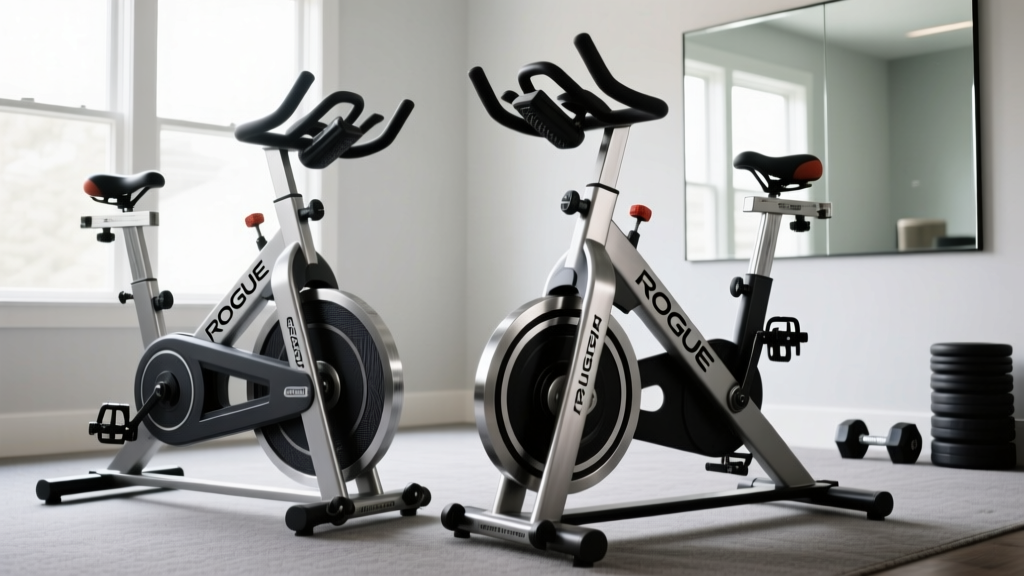
Air Bike vs Assault Bike: Value Beyond iFIT Treadmill Workouts
Compare the Rogue Echo and Assault AirBike Elite. We break down costs, maintenance, and value versus iFIT treadmill workouts for your home gym.

The Home Cardio Dilemma: Air Bikes vs. Smart Treadmills
When outfitting a home gym in 2026, buyers typically face a major crossroads: invest in a smart, connected treadmill or opt for the brutal, analog efficiency of an air bike. For years, the default choice has been a motorized treadmill, heavily driven by the immersive appeal of iFIT treadmill workouts that offer global scenic runs and trainer-led pacing. However, as subscription fatigue sets in and home gym enthusiasts demand higher caloric ROI per square foot, air bikes—specifically the Assault AirBike and the Rogue Echo Bike—have surged in popularity.
This guide provides a comprehensive budget breakdown and value analysis of the two premier air bikes on the market. We will dissect upfront costs, long-term maintenance, and the biomechanical value they offer compared to the subscription-heavy ecosystem of smart treadmills. If you are trying to decide where to allocate your cardio budget, this deep dive will give you the exact numbers and mechanical realities you need.
Head-to-Head: Assault AirBike Elite vs. Rogue Echo Bike Gen 2
The air bike market is essentially a duopoly at the premium end. While the original Assault AirBike Classic (chain-drive) is still available, serious buyers in 2026 are looking at the belt-driven models for reduced maintenance. Below is a direct specification and pricing comparison between the industry standard Rogue Echo Bike Gen 2 and the Assault AirBike Elite.
| Feature | Rogue Echo Bike Gen 2 | Assault AirBike Elite | Assault AirBike Classic |
|---|---|---|---|
| Retail Price | $775 | $999 | $749 |
| Drive System | Belt Drive | Belt Drive | Chain Drive |
| Fan Material | Steel / Composite | Steel / Composite | Steel / Composite |
| Bike Weight | 127 lbs | 140 lbs | 123 lbs |
| User Capacity | 350 lbs | 350 lbs | 350 lbs |
| Console | LCD (Basic Interval Timers) | LCD (Advanced Metrics, Bluetooth) | LCD (Basic Metrics) |
| Frame Warranty | 2 Years | Lifetime (Frame) | Lifetime (Frame) |
Drive System & Durability: Belt vs. Chain
The most critical mechanical difference lies in the drive system. The Assault AirBike Classic uses a motorcycle-style chain. While incredibly durable and capable of transferring massive wattage, chains stretch over time. In a high-humidity garage gym, they are also prone to rust if not lubricated monthly with a dry PTFE bike lube. You will need a 10mm socket wrench to adjust the rear axle tension every 3 to 6 months to prevent chain slip during max-effort sprints.
Both the Rogue Echo Bike Gen 2 and the Assault AirBike Elite utilize industrial-grade poly-V belt drives. This eliminates the need for lubrication and drastically reduces operational noise—a massive value-add if your gym is in a shared living space. The trade-off? If a belt snaps after 4 to 5 years of heavy use, replacement belts cost between $50 and $80 and require partial disassembly of the fan cage to install.
Budget Tip: If you are on a strict sub-$800 budget and do not mind basic mechanical maintenance, the Assault Classic at $749 offers the exact same air resistance curve as the $999 Elite. The extra $250 for the Elite primarily buys you a belt drive, a slightly heavier/stabler frame, and Bluetooth connectivity for third-party apps.Budget Breakdown: Upfront Costs vs. Long-Term Value
To truly understand the value proposition of an air bike, we must compare the 3-year total cost of ownership (TCO) against a smart treadmill ecosystem. Let us look at the math for a mid-tier home gym setup.
Scenario A: The Smart Treadmill Route
- Hardware: NordicTrack T-Series 800 or similar entry-level smart treadmill ($599)
- Software: iFIT Individual Membership ($15/month x 36 months = $540)
- Maintenance: Belt lubrication (silicone spray, $30 over 3 years) and eventual motor wear.
- 3-Year TCO: $1,169
Scenario B: The Air Bike Route
- Hardware: Rogue Echo Bike Gen 2 ($775)
- Software: Free programming via CrossFit WODs, Tabata timers, or self-guided intervals ($0)
- Maintenance: Periodatic dusting of the fan cage and tightening of seat post bolts ($0)
- 3-Year TCO: $775
While iFIT treadmill workouts provide exceptional value for users who require external motivation, scenic distraction, and guided coaching, you are effectively renting the software. If your credit card expires or you cancel the subscription, the treadmill's interactive features lock down, reducing a $1,000+ machine to a basic, manual-speed belt. The air bike, conversely, is a 100% owned asset from day one. Its resistance is generated purely by your physical output, meaning it never suffers from software paywalls or server outages.
How Air Bikes Stack Up Against iFIT Treadmill Workouts
Beyond the financial math, the physiological stimulus of an air bike differs vastly from a motorized treadmill. According to the Centers for Disease Control and Prevention (CDC), adults need at least 150 minutes of moderate-intensity or 75 minutes of vigorous-intensity aerobic activity per week. Air bikes are uniquely engineered to push you into the vigorous-intensity zone in a fraction of the time.
The Biomechanics: Concentric vs. Eccentric Loading
This is where the air bike holds a massive, often overlooked advantage over treadmill running. When you run on a treadmill, your body absorbs the impact of the moving belt. This involves significant eccentric muscle contractions (where the muscle lengthens under tension), which are the primary cause of Delayed Onset Muscle Soreness (DOMS) and joint degradation over time.
Air bikes are purely concentric (muscle shortening under tension). You are pushing and pulling against air resistance without any ground reaction forces or eccentric braking. This means you can perform a brutal 20-minute high-intensity interval training (HIIT) session on an Echo Bike, spike your heart rate to 90% of your max, and walk away with virtually zero joint impact and minimal next-day soreness. This allows for higher frequency training, making it a superior tool for athletes who are also lifting weights and need to preserve their central nervous system and joints.
'For pure cardiovascular conditioning and metabolic output per minute, the air bike is unmatched. It removes the biomechanical limitations of running form and allows the user to safely redline their cardiovascular system without the impact forces associated with treadmills.' — Sports Science Biomechanics Consensus
Real-World Failure Modes & Edge Cases
As fitness equipment reviewers, we test machines until they break. Here are the specific failure modes you need to budget and plan for when buying an air bike:
- Squeaking Bottom Brackets: Both Rogue and Assault use standard bicycle bottom brackets. After 1,000+ hours of use, the bearings can dry out or degrade, resulting in a rhythmic clicking sound. Replacing a bottom bracket requires a specialized bicycle tool and costs about $25 for the part.
- Console Battery Drain: Air bike consoles are notoriously power-hungry. If you rely on AA batteries, you will burn through them monthly. Fix: Budget $20 for a third-party USB power adapter kit to run the console off a wall outlet or power bank.
- Seat Comfort: The stock seats on both the Echo and Assault are universally despised. They are hard, narrow bicycle saddles designed for 5-minute CrossFit WODs, not 45-minute steady-state cardio sessions. Budget an additional $40-$60 for an ergonomic gel seat cover or swap the seat entirely for a standard oversized cruiser bike saddle (both bikes use standard bicycle seat post rails).
- Fan Cage Dust Buildup: The massive front fan acts as a magnet for pet hair and dust. If not vacuumed out every 3 months, the debris creates drag on the fan blades, artificially inflating your wattage readings and causing the internal belt to slip.
The Final Verdict: Where Should Your Budget Go?
The decision ultimately hinges on your psychological relationship with exercise and your long-term budget constraints.
Choose the Smart Treadmill (and iFIT treadmill workouts) if: You struggle with self-motivation, you prefer steady-state Zone 2 cardio while watching TV or following a scenic trail, and you do not mind paying a $15 to $39 monthly subscription fee for premium guided content. The treadmill is also better if you are specifically training for a road race or marathon and need to acclimate your joints to running impact.
Choose the Rogue Echo or Assault AirBike if: You want a one-and-done purchase with zero monthly fees, you have limited floor space (the Echo Bike has a footprint of just 30 x 53 inches), and your goal is maximum caloric burn and cardiovascular conditioning in under 30 minutes. For pure financial ROI and mechanical simplicity, the Rogue Echo Bike Gen 2 at $775 remains the undisputed king of the home gym cardio market in 2026. It offers commercial-grade durability, a maintenance-free belt drive, and a workout intensity that no motorized treadmill can safely replicate.
For more guidance on building a resilient, budget-friendly home gym, always consult the cardiovascular health guidelines provided by the American Heart Association to ensure your chosen equipment aligns with your long-term health goals.
More gear to consider
All reviews
What Speed is Considered Jogging on a Treadmill? Air vs Assault Bike Care

Sunny Manual Treadmill vs. Walking Pads: 2026 Review
Under Desk Treadmill Review: Ditching the Nordic Track Treadmill 1250

Curved vs Motorized Treadmills: Buying Guide & Treadmill Donation
Crosswalk 415 Treadmill Review: Top Compact Portable Cardio Pick
