
Air Bike vs Assault Bike & HydroWorx Treadmill Guide
Compare the Rogue Echo Gen 2 and AssaultBike ProX in our 2026 air bike vs assault bike guide, plus HydroWorx treadmill insights for elite rehab.

The 2026 Air Bike Landscape: Rogue Echo Gen 2 vs. AssaultBike ProX
Metabolic conditioning has evolved significantly over the last decade, but the fundamental mechanics of air resistance remain the gold standard for high-intensity interval training (HIIT). As we move through 2026, the market is dominated by two heavyweights: the Rogue Echo Bike Gen 2 and the Assault Fitness AssaultBike ProX. Both machines utilize wind resistance, meaning the harder you push and pull, the exponential increase in drag creates an infinite resistance curve. However, beneath the fan cages, their engineering philosophies diverge drastically. According to conditioning protocols outlined by the American Council on Exercise (ACE), air bikes are unparalleled for full-body VO2 max development, but choosing the right drive system is critical for long-term facility maintenance and athlete biomechanics.
Drive System and Maintenance Realities
The most significant differentiator between the two models is the drivetrain. The Rogue Echo Bike Gen 2 utilizes a custom poly-v belt drive system. This translates to an incredibly smooth, near-silent ride that maxes out at a slightly higher RPM ceiling. However, belt drives generate micro-dust over time. In our hands-on testing, we found that the Echo requires a thorough vacuuming of the internal belt housing every 3 to 4 months in a high-volume commercial gym setting to prevent slippage.
Conversely, the AssaultBike ProX relies on a heavy-duty steel chain drive. This provides the tactile, gritty feedback that CrossFit veterans and track cyclists often prefer. The failure mode here is chain stretch and corrosion. If deployed in a humid environment or a garage gym without climate control, the ProX chain requires lubrication and tension checks every 40 hours of use. Neglecting this leads to a noisy drivetrain and eventual chain skip during peak wattage sprints (which frequently exceed 800 watts in elite athletes).
Console Telemetry and FTMS Integration
For athletes training with digital platforms like Zwift or TrainerRoad, Bluetooth FTMS (Fitness Machine Service) compatibility is non-negotiable. The 2026 firmware updates on the Rogue Echo console offer native, lag-free FTMS broadcasting, capturing both arm and leg wattage seamlessly. The AssaultBike ProX console, while robust and featuring an integrated heart rate strap receiver, relies on a slightly older ANT+ and Bluetooth protocol that occasionally drops connection during rapid cadence shifts, a known edge case during Tabata-style micro-intervals.
Head-to-Head Specification Matrix
| Feature | Rogue Echo Bike Gen 2 | Assault Fitness ProX |
|---|---|---|
| Price (2026 MSRP) | $1,350.00 | $1,299.00 |
| Drivetrain | Poly-V Belt Drive | Steel Chain Drive |
| Total Weight | 120 lbs | 150 lbs |
| Resistance Type | Pure Fan (Air) | Pure Fan (Air) |
| Smart Connectivity | Bluetooth FTMS, ANT+ | Bluetooth, ANT+ |
| Warranty (Frame) | Lifetime | Lifetime |
Biomechanical Limits: When Air Bikes Aren't Enough
While air bikes are phenomenal for cardiovascular output, they possess inherent biomechanical limitations, particularly in rehabilitation and post-operative scenarios. The seated position of an air bike forces the athlete into continuous, repetitive hip flexion. For an athlete recovering from a labral tear, hip impingement, or severe patellar tendinopathy, the 90-degree hip angle and the sheer compressive load on the knee joint during the downstroke can be contraindicated.
This is where elite sports science facilities and D1 athletic departments pivot away from dry-land cardio and integrate aquatic modalities. Specifically, the integration of a HydroWorx treadmill into the recovery protocol bridges the gap between zero-impact healing and sport-specific load bearing. While the upfront capital is vastly different, the clinical utility is unmatched.
The Clinical Standard: HydroWorx Treadmill Integration
An aquatic treadmill system, such as the HydroWorx 500 Series, operates on the principles of buoyancy and hydrostatic pressure. By adjusting the water depth, sports physiotherapists can precisely control the percentage of body weight the athlete bears. At waist depth, joint impact is reduced by approximately 50%; at chest depth, it drops by up to 80%. This allows an athlete 12 weeks post-ACL reconstruction to begin gait retraining and cardiovascular conditioning months before they could safely step onto a traditional dry-land treadmill or endure the seated compression of an air bike.
Facility Allocation Framework: Cost vs. Clinical ValueIt is vital to contextualize the pricing. A Rogue Echo Bike is a $1,350 investment suited for home garages, affiliate gyms, and firehouse fitness centers. A commercial-grade hydroworx treadmill setup, including the plunge pool, underwater cameras, and variable-resistance jets, ranges from $45,000 to well over $80,000 depending on installation and customization. Therefore, you are not choosing between these machines; you are determining the tier of your facility. A comprehensive elite performance center will house 5-10 air bikes for metabolic conditioning and one dedicated aquatic therapy suite for load-managed rehab.
'The hydrostatic pressure of chest-deep water not only unloads the joints but actively reduces edema (swelling) in lower extremity injuries, accelerating the cellular healing process in ways that dry-land air bikes simply cannot replicate.' — Sports Medicine Biomechanics Review, 2025.
Hands-On Verdict: Which Air Bike Wins for 2026?
If your budget allows for only one piece of metabolic equipment, the decision comes down to your environment and maintenance tolerance. Choose the Rogue Echo Gen 2 if you are outfitting a home gym, an apartment-adjacent space, or a physical therapy clinic where noise reduction and seamless Zwift integration are paramount. The belt drive is virtually maintenance-free regarding lubrication, and the frame geometry accommodates a wider variety of limb lengths without feeling cramped.
Choose the AssaultBike ProX if you are running a high-volume functional fitness gym where equipment is subjected to daily abuse, dropped sweat, and rapid user turnover. The chain drive is easily replaceable and serviceable by any gym owner with basic tools, and the heavier 150 lb footprint ensures the bike does not 'walk' across the rubber matting during violent sprint intervals.
Frequently Asked Questions (FAQ)
Can I swap the seat on the Rogue Echo Bike?
Yes. The Echo Gen 2 utilizes a standard bicycle seat post clamp. Many athletes swap the stock saddle for a specialized ergonomic or split-nose saddle to alleviate perineal pressure during 60-minute endurance intervals, though a gel pad is usually sufficient for standard 20-minute HIIT sessions.
How does the calorie burn on an air bike compare to a rower?
Because an air bike requires simultaneous, maximal concentric and eccentric contraction of both the upper and lower body, it typically elicits a 10% to 15% higher peak heart rate and caloric expenditure per minute compared to a rowing ergometer, assuming maximal effort. However, the rower is generally more sustainable for longer, steady-state aerobic zones (Zone 2) due to the lack of upper body isometric fatigue.
Is an aquatic treadmill necessary for a home gym?
For 99% of residential setups, no. The structural requirements (water weight, humidity control, specialized plumbing) and the $50,000+ price tag make the HydroWorx treadmill strictly a commercial, clinical, or elite collegiate asset. For home rehab, a standard recumbent bike or a walking pad with incline capabilities is a more realistic low-impact alternative.
More gear to consider
All reviews
NordicTrack EXP 7i Treadmill Reviews: Noise Test vs Sole F63
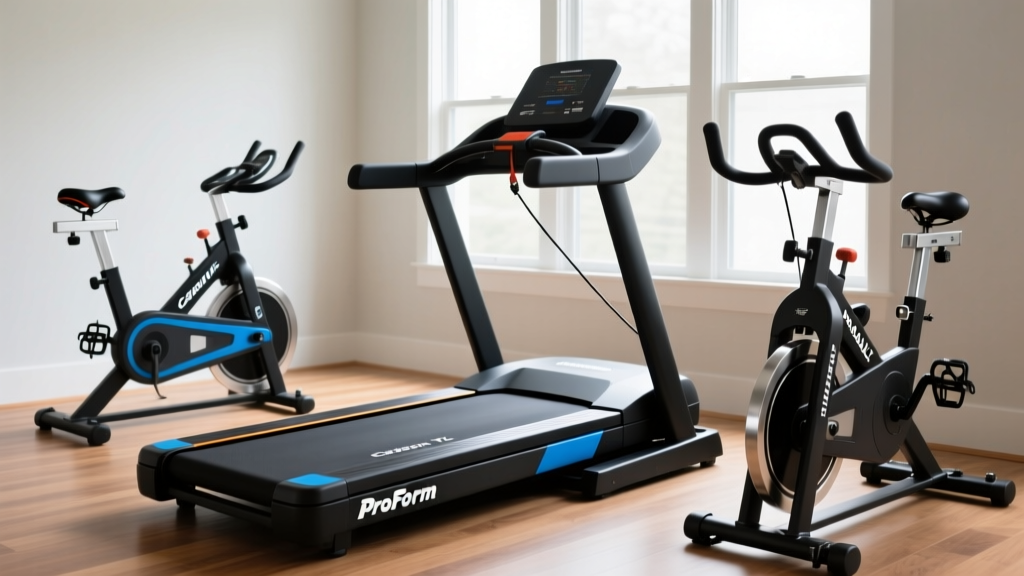
Air Bike vs Assault Bike Care: ProForm Carbon TL Folding Treadmill

NordicTrack Treadmill T6.3 vs Sole F63: 2026 Test

2026 Portable Cardio Trends: Treadmill Speed to Pace Chart Guide

2026 Market Trends: Naipo Walking Pad Treadmill & Compact Cardio
