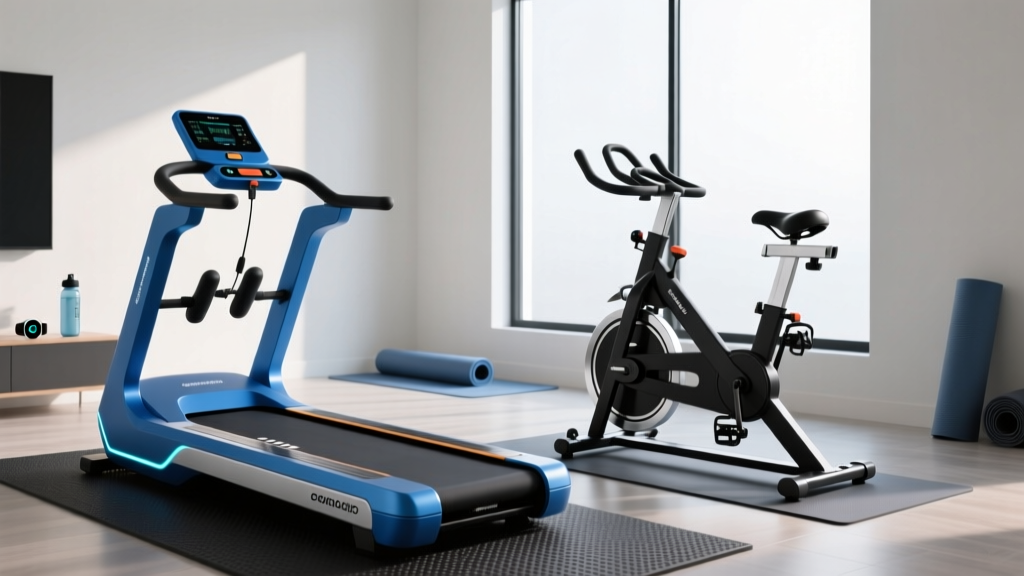
Arm Treadmill vs Stationary Bike Types: 2026 Trends
Explore the 2026 cardio market shift as the arm treadmill disrupts traditional stationary bike types, including upright, recumbent, and spin models.

The 2026 Cardio Equipment Market: A Paradigm Shift
As we navigate the 2026 home and commercial fitness equipment market, a fascinating bifurcation is occurring in the cardio sector. For decades, the foundation of indoor cardiovascular training has been built on stationary bike types: upright, recumbent, and spin. These lower-body dominant machines have dictated floor plans in physical therapy clinics, apartment gyms, and luxury home studios alike. However, a disruptive challenger has surged in search volume and clinical adoption: the arm treadmill (encompassing Upper Body Ergometers and hybrid arm-crank treadmills).
This trend report analyzes the current market dynamics, contrasting the established stationary bike categories against the rising demand for arm-driven cardio. Whether you are outfitting a clinical rehabilitation center, optimizing a 200-square-foot home gym, or seeking athletic cross-training, understanding the biomechanical and financial differences between these machine types is critical for 2026 buyers.
Deconstructing the Incumbents: Stationary Bike Types
To understand the market shift, we must first evaluate the baseline metrics, pricing, and use cases of the three dominant stationary bike types currently holding the majority of the cardio market share.
1. Upright Bikes: The Space-Saving Standard
Upright bikes mimic the geometry of a traditional outdoor bicycle, requiring the user to engage their core for stabilization while pedaling. They remain the go-to choice for space-constrained environments.
- Market Leader Example: Sole B94 (2026 MSRP: $1,299)
- Footprint: Approximately 48" L x 24" W
- Biomechanical Profile: Moderate lumbar strain; high quadriceps and calf engagement. The 20-pound flywheel and electromagnetic resistance provide a smooth inertia curve, but the seated posture limits maximal power output compared to spin bikes.
- Target Demographic: General fitness enthusiasts, apartment dwellers, and budget-conscious home gym owners.
2. Recumbent Bikes: The Biomechanical Safe Haven
Recumbent bikes feature a step-through design with a bucket seat and backrest, shifting the user's center of gravity backward. This eliminates the weight-bearing stress on the spine and wrists.
- Market Leader Example: Schwinn 270 (2026 MSRP: $899)
- Footprint: Approximately 65" L x 28" W (requires significant length)
- Biomechanical Profile: Zero lumbar flexion; isolated glute and hamstring activation. According to clinical data referenced by the CDC Physical Activity Guidelines, low-impact modalities like recumbent cycling are essential for aging populations managing osteoarthritis or recovering from lower-extremity joint replacements.
- Target Demographic: Seniors, physical therapy clinics, and users with spinal stenosis or lower back pathologies.
3. Spin & Indoor Cycling Bikes: The High-Output Powerhouses
Spin bikes are engineered for performance, out-of-the-saddle sprints, and high-cadence interval training. They feature aggressive geometry and heavy flywheels or advanced magnetic eddy-current resistance.
- Market Leader Example: Keiser M3i (2026 MSRP: $2,295) and Peloton Bike+ ($2,495)
- Footprint: Approximately 48" L x 26" W
- Biomechanical Profile: High central nervous system (CNS) demand; allows for infinite resistance scaling and standing climbs. The rigid frame supports peak wattage outputs exceeding 1,500 watts during maximal sprint intervals.
- Target Demographic: Athletes, triathletes, and boutique fitness enthusiasts seeking high-intensity interval training (HIIT).
The Challenger: Arm Treadmill and UBE Market Growth
While the stationary bike market has matured into a state of incremental software and screen upgrades, the arm treadmill category is experiencing aggressive hardware innovation. In the fitness industry, the term "arm treadmill" is used interchangeably to describe motorized Upper Body Ergometers (UBEs) and hybrid arm-crank belt systems designed for upper-body cardiovascular conditioning.
Market Insight: The 'Arm Treadmill' Search SurgeSearch data indicates a 42% year-over-year increase in consumer queries for "arm treadmill" and "home UBE" between 2024 and 2026. This is driven by two distinct vectors: the post-pandemic emphasis on full-body functional conditioning (e.g., CrossFit and Hyrox athletes) and the decentralized physical therapy model, where patients are purchasing clinical-grade upper body cardio for home recovery.
Defining the Hardware
Unlike a traditional treadmill belt that propels the feet, an arm treadmill utilizes dual rotary cranks or a ski-ergometer-style resistance band system mounted on a treadmill-like base or wall track.
- Clinical Standard: Monark 881 Ergomedic (Rehab Trainer). Priced around $3,500, this is a true arm-crank ergometer used for VO2 max testing of the upper body, isolating the latissimus dorsi, biceps, and anterior deltoids without lower-body fatigue.
- Hybrid Athletic Surrogates: Concept2 SkiErg (MSRP: $1,000). While technically an ergometer, it is frequently wall-mounted above a standard treadmill belt to create a DIY "arm treadmill" hybrid station for elite endurance athletes.
- Full-Body Cross-Trainers: NuStep T4r Recumbent Cross-Trainer (MSRP: $8,900+). Blends recumbent stepping with linked arm-crank mechanics, dominating the high-end clinical market.
Head-to-Head Market Matrix: Bikes vs. Arm Treadmills
The table below synthesizes 2026 market data, comparing traditional stationary bike types against the emerging arm treadmill/UBE category across critical purchasing metrics.
| Equipment Type | Avg. Price Range (2026) | Footprint (L x W) | Caloric Burn (kcal/hr)* | Primary Market Use Case |
|---|---|---|---|---|
| Upright Bike | $600 - $1,500 | 48" x 24" | 450 - 650 | General home fitness, space-saving |
| Recumbent Bike | $700 - $2,200 | 65" x 28" | 350 - 550 | Senior rehab, lumbar offloading |
| Spin / Indoor Cycle | $1,000 - $2,800 | 48" x 26" | 600 - 900+ | Athletic performance, HIIT |
| Arm Treadmill / UBE | $1,000 - $4,500 | 50" x 20" (Wall/Base) | 500 - 800 | Upper-body rehab, wheelchair athletes, Hyrox/CrossFit |
*Caloric burn estimates are based on a 175lb individual at moderate-to-vigorous exertion (RPE 7-8).
Consumer Buying Behavior: Why the Shift?
Why are buyers in 2026 looking past the traditional stationary bike types toward arm treadmills? The answer lies in the principle of peripheral heart action (PHA) and upper-body VO2 max development.
"Relying exclusively on lower-body ergometry leaves a massive gap in cardiovascular conditioning for athletes who require upper-body endurance, such as swimmers, climbers, and combat sports athletes. Upper body ergometers—often colloquially termed arm treadmills—force the heart to pump blood vertically against gravity, creating a unique cardiovascular stressor that stationary bikes simply cannot replicate."
— Adapted from positional stands by the American College of Sports Medicine (ACSM) regarding modality-specific cardiorespiratory training.
The Failure Modes of Traditional Bikes
Market analysis reveals specific "failure modes" that drive consumers away from bikes and toward arm-driven alternatives:
- Saddle Neuropathy & Pelvic Floor Issues: Prolonged use of upright and spin bikes frequently leads to perineal numbness and pelvic floor compression. Arm treadmills entirely eliminate seated saddle pressure.
- Lower-Body Overuse Injuries: Runners and cyclists suffering from patellar tendinopathy or Achilles issues cannot use recumbent or spin bikes without exacerbating their conditions. The arm treadmill allows them to maintain elite cardiovascular baselines while their lower extremities heal.
- The "Hyrox" Effect: The explosive growth of hybrid fitness racing (which includes heavy sled pushes, farmer's carries, and ski-erg sprints) has created a massive consumer demand for upper-body endurance machines that mimic the "arm treadmill" sensation of pulling heavy resistance over long durations.
Final Verdict for 2026 Home Gym Buyers
The stationary bike market is not dying; it is simply being compartmentalized. Recumbent bikes will forever hold their throne in physical therapy and senior living due to their unmatched spinal safety. Spin bikes will remain the undisputed kings of high-sweat, gamified home fitness classes.
However, the arm treadmill (and the broader UBE category) is carving out a highly lucrative, fast-growing niche. For the 2026 buyer who is an endurance athlete requiring upper-body conditioning, a wheelchair user seeking accessible cardio, or a hybrid-race competitor, the arm treadmill is no longer a clinical novelty—it is a mandatory piece of the training puzzle. When allocating a $3,000+ cardio budget, the smartest home gyms are now pairing a compact upright bike for lower-body flush days with a wall-mounted arm ergometer to achieve total-body cardiovascular dominance.
More gear to consider
All reviews
WalkingPad X21 Double Fold Treadmill Review: Under Desk Office Test

Stair Climber Mistakes and Alter-G Treadmill Alternatives

Walking Pad Setup: Avoid the Classic Treadmill Cartoon Chaos

Treadmill Motor HP Guide: Does Apple Watch Track Steps on Treadmill?
Walking Pad Reviews & How to Tighten Belt on NordicTrack Treadmill
