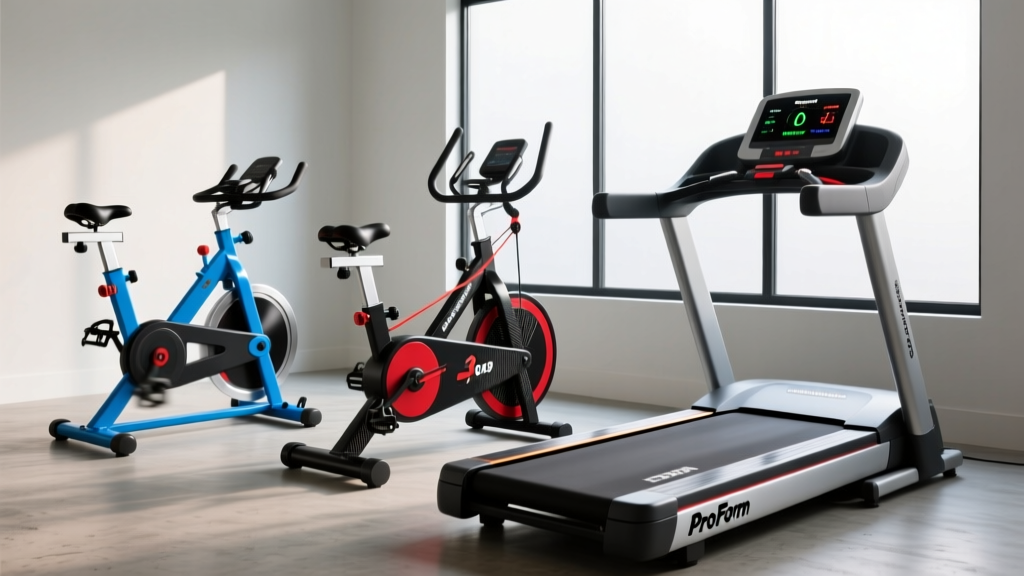
2026 Cardio Market: Air vs Assault Bike & ProForm Sport 6.0 Review
Explore 2026 cardio market trends comparing Air vs Assault bikes for HIIT, plus a detailed ProForm Sport 6.0 treadmill review for steady-state.

The 2026 Bifurcation of the Home Cardio Market
As we navigate the 2026 fitness equipment landscape, market data reveals a stark bifurcation in consumer purchasing behavior. The post-pandemic stabilization period has given way to a highly segmented market: premium, commercial-grade High-Intensity Interval Training (HIIT) ergometers dominate the upper-tier spending bracket, while budget-friendly Low-Intensity Steady State (LISS) machines capture the high-volume, entry-level demographic. To understand this ecosystem, we must analyze the leading edge of both extremes.
This brings us to a dual-pronged analysis. First, we will decode the high-intensity segment with a comprehensive air bike vs. Assault Bike comparison guide, clarifying nomenclature and mechanical failure modes. Second, to provide a complete market synthesis, we will anchor the LISS segment with an in-depth ProForm Sport 6.0 treadmill review, evaluating how budget steady-state machines perform under modern usage demands.
Air Bike vs. Assault Bike: Nomenclature and Physics
A common point of confusion in the 2026 market is the terminology. 'Air bike' is the generic category for fan-resistance stationary ergometers. 'Assault Bike', conversely, is a specific trademarked brand manufactured by Assault Fitness. When consumers search for an air bike assault bike comparison guide, they are typically looking to compare the generic category (represented by competitors like the Rogue Echo and Schwinn Airdyne) against the flagship Assault Classic V2.
The Physics of Fan Resistance
Unlike magnetic resistance bikes that offer linear or stepped tension, air bikes utilize fluid dynamics. The drag force generated by the fan increases with the square of the velocity. This means that doubling your pedaling speed quadruples the resistance. This exponential curve is what makes air bikes the gold standard for VO2 max testing and anaerobic threshold training, as the machine inherently adapts to the user's maximum power output without requiring manual tension adjustments.
2026 Flagship Air Bike Comparison Matrix
| Feature | Assault Classic V2 | Rogue Echo V2 | Schwin Airdyne Pro |
|---|---|---|---|
| Drive System | Chain | Belt | Belt |
| Fan Blade Count | 26 | 27 | 26 |
| Weight Capacity | 300 lbs | 350 lbs | 300 lbs |
| Bottom Bracket | Sealed Cartridge | Sealed Cartridge | Sealed Cartridge |
| 2026 MSRP | $1,099 | $1,250 | $1,199 |
Drive System Failure Modes: Chain vs. Belt
From a maintenance and longevity perspective, the drive system is the most critical differentiator in the air bike market. Understanding these failure modes is essential for buyers investing over $1,000 in home gym equipment.
Chain Drive (Assault Classic V2)
The Assault Bike utilizes a traditional steel chain drive. While this provides a highly durable, positive-engagement transfer of power, it requires strict maintenance. In high-humidity environments or garages without climate control, the chain is susceptible to surface oxidation. Furthermore, chain stretch is an inevitable mechanical reality. Users must manually adjust the rear axle tensioners every 40 to 60 hours of use to prevent chain slap and sprocket wear. Failure to do so results in accelerated degradation of the front chainring.
Belt Drive (Rogue Echo V2 & Schwinn Airdyne)
Belt-driven models use reinforced polyurethane or Kevlar-core belts. These are virtually maintenance-free and operate with near-silent acoustics, making them ideal for apartment dwellers. However, belt drives have a specific edge-case failure mode: tension slip. If the ambient humidity drops significantly (common in winter months with central heating), the belt can contract, altering the tension profile. Conversely, excessive moisture can cause micro-slippage under peak wattage outputs (1,000+ watts). The Rogue Echo V2 mitigates this with an advanced idler pulley system that maintains dynamic tension, a key reason it commands a $150 premium over the Assault.
Industry Insight: The shift toward belt drives in 2026 reflects a broader consumer demand for 'zero-maintenance' home fitness equipment, even if it slightly caps the absolute maximum power transfer efficiency compared to a freshly lubricated steel chain.
The LISS Counterweight: ProForm Sport 6.0 Treadmill Review
While air bikes dominate the HIIT conversation, cardiovascular health guidelines emphasize the necessity of sustainable, moderate-intensity volume. This is where the budget LISS market thrives. In this ProForm Sport 6.0 treadmill review, we analyze how this entry-level machine serves as the steady-state anchor in a hybrid home gym setup.
ProForm Sport 6.0 (Model PFTL71224) Specifications
- Motor: 2.5 CHP Mach Z Commercial Plus
- Tread Belt: 18' x 55'
- Speed Range: 0 - 10 MPH
- Incline: 0% - 10% Motorized
- Footprint: 72' L x 29' W x 54' H
- 2026 Street Price: $499 - $599
Motor Thermals and Continuous Horsepower Realities
The ProForm Sport 6.0 is equipped with a 2.5 Continuous Horsepower (CHP) Mach Z motor. In the budget treadmill segment, manufacturers often inflate 'Peak HP' numbers, but ProForm's use of CHP is an honest metric. CHP represents the power the motor can sustain indefinitely without overheating. For users under 180 lbs walking or jogging up to 6.0 MPH, the 2.5 CHP motor operates well within its thermal envelope, utilizing Pulse Width Modulation (PWM) to deliver smooth, consistent torque.
However, edge cases emerge with heavier users or sustained running. If a 220 lb user attempts to run at 8.0 MPH on a 5% incline for 45+ minutes, the motor controller will approach its thermal limit. The internal thermistor will detect the heat spike and initiate thermal throttling, subtly reducing belt speed to protect the copper windings from melting. Therefore, the Sport 6.0 is highly recommended for walking, power-incline routines, and light jogging, but it is not engineered for marathon-training pace runs.
Belt Dimensions and Biomechanical Limitations
The 18-inch by 55-inch tread belt is standard for the sub-$600 price point. While 18 inches provides adequate lateral margin for walking and jogging, runners taller than 6'0' may find the 55-inch length restrictive. A natural running stride at 7.0 MPH requires approximately 58 to 62 inches of belt length to accommodate heel-strike to toe-off phases without the user subconsciously shortening their gait (which can lead to anterior knee pain). Users must consciously maintain a mid-foot strike and stay centered on the deck.
Market Synthesis: Building a Hybrid Cardio Portfolio
The most effective 2026 home gym setups do not rely on a single modality. Exercise science strongly supports polarized training—combining high-intensity anaerobic work with low-intensity aerobic base building.
According to comprehensive cardiovascular analyses published by the National Institutes of Health (NIH), combining HIIT (like air bike sprints) with Moderate-Intensity Continuous Training (MICT, like steady-state treadmill walking) yields superior endothelial function and mitochondrial density compared to relying on a single modality. Furthermore, the American Heart Association (AHA) recommends at least 150 minutes of moderate-intensity aerobic activity or 75 minutes of vigorous activity per week for optimal cardiovascular health.
The Actionable Hybrid Protocol
To maximize the ROI on your equipment purchases, implement this weekly framework utilizing both the high-intensity air bike and the steady-state ProForm treadmill:
- Monday (HIIT - Air Bike): 5-minute warm-up. 8 rounds of 20 seconds maximum wattage output followed by 10 seconds of active recovery (Tabata protocol). 5-minute cool-down.
- Tuesday (LISS - ProForm Sport 6.0): 45 minutes of incline walking (8% incline, 3.2 MPH). Keep heart rate in Zone 2 (60-70% of max HR).
- Wednesday: Active recovery or mobility work.
- Thursday (HIIT - Air Bike): 5-minute warm-up. 4-minute AMRAP (As Many Calories As Possible) at 85% effort, rest 3 minutes, repeat twice.
- Friday (LISS - ProForm Sport 6.0): 30 minutes of light jogging (5.5 MPH, 0% incline) focusing on cadence and form.
- Weekend: Outdoor activity or extended Zone 2 treadmill walking while consuming media.
Final Verdict
The 2026 cardio equipment market rewards informed consumers who understand the mechanical realities of their purchases. If your primary goal is anaerobic conditioning, metabolic conditioning (metcon), and VO2 max expansion, the Rogue Echo V2 offers the best maintenance-free belt drive, while the Assault Classic V2 remains the rugged, chain-driven workhorse. Conversely, if you require a reliable, space-efficient LISS machine for Zone 2 heart rate training and daily step accumulation, the ProForm Sport 6.0 delivers exceptional value, provided you respect its 2.5 CHP thermal limits and belt dimensions. By strategically deploying both modalities, you can build a commercial-grade cardiovascular engine within the footprint of a standard home gym.
More gear to consider
All reviews
Treadmill Mat for Concrete Floor: Upright, Recumbent, Spin
Walking Pad Setup & Review: What Does METs Mean on a Treadmill?

The Squeaky Treadmill Dilemma: 2026 Belt Maintenance Trends
2026 Review: Folding Treadmills From Commercial Treadmill Brands

Under Desk Treadmill Review: Office Picks & ProForm Treadmill Fix
